

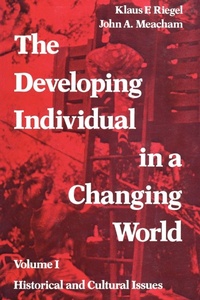
The Developing Individual in a Changing World
Volume 1, Historical and Cultural Issues
1st Edition
Published on 15. December 2007
Book
Paperback/Softback
470 pages
978-0-202-36129-1 (ISBN)
Description
This two-volume work levels both criticism and challenge to traditional developmental psychology. For too long, developmental psychologists have been studying individuals as if they developed in a sociocultural vacuum. As psychologists began to study the individual's development more broadly, they considered the impact of a number of other factors in the physical and social environment: early education, sociocultural differences, mass communication, alternative living arrangements, and medical care--to name but a few.
Volume I, Historical and Cultural Issues, examines the problems of behavioral development from historical, political, theoretical, and cultural points of view. A number of content areas already familiar to developmental psychologists are discussed: Piaget's theory, perceptual development, socialization, and language acquisition. In addition, topics relatively unfamiliar to American psychologists are included: the contribution of early European developmentalists such as William and Clara Stern, Alfred Binet, and Eduard Spranger; and an introduction to recent Soviet developmental theory.
Volume II, Social and Environmental Issues, considers the effects of changes in social and environmental conditions upon individual development. The expanding impact of technology such as the communications media, the importance of nutrition, and the design of playgrounds and other spaces for growing children are among the changes examined, as are the impact of social organizations and interactions within small groups, focusing upon preschool education, interaction within the family, and personality development throughout the individual's life.
Volume I, Historical and Cultural Issues, examines the problems of behavioral development from historical, political, theoretical, and cultural points of view. A number of content areas already familiar to developmental psychologists are discussed: Piaget's theory, perceptual development, socialization, and language acquisition. In addition, topics relatively unfamiliar to American psychologists are included: the contribution of early European developmentalists such as William and Clara Stern, Alfred Binet, and Eduard Spranger; and an introduction to recent Soviet developmental theory.
Volume II, Social and Environmental Issues, considers the effects of changes in social and environmental conditions upon individual development. The expanding impact of technology such as the communications media, the importance of nutrition, and the design of playgrounds and other spaces for growing children are among the changes examined, as are the impact of social organizations and interactions within small groups, focusing upon preschool education, interaction within the family, and personality development throughout the individual's life.
More details
Language
English
Place of publication
Somerset
United States
Publishing group
Taylor & Francis Inc
Target group
College/higher education
Dimensions
Height: 229 mm
Width: 152 mm
Thickness: 28 mm
Weight
760 gr
ISBN-13
978-0-202-36129-1 (9780202361291)
Copyright in bibliographic data and cover images is held by Nielsen Book Services Limited or by the publishers or by their respective licensors: all rights reserved.
Schweitzer Classification
Other editions
Additional editions
Klaus Riegel | John Meacham
The Developing Individual in a Changing World
Volume 1, Historical and Cultural Issues
Book
08/2018
1st Edition
Routledge
€134.10
Shipment within 10-20 days
Klaus Riegel | John Meacham
The Developing Individual in a Changing World
Volume 1, Historical and Cultural Issues
E-Book
07/2017
Routledge
€44.99
Available for download
Klaus Riegel | John Meacham
The Developing Individual in a Changing World
Volume 1, Historical and Cultural Issues
E-Book
07/2017
Routledge
€44.99
Available for download
Persons
Klaus F. Riegel (1925-1977) was a professor of psychology at the University of Michigan, Ann Arbor. His books include Psychology, mon amour: A countertext, Foundations of Dialectical Psychology, and Psychological Studies in Bilingual Performances and Cross-linguistic Differences. John A. Meacham is distinguished professor of psychology at the University of Buffalo. His current research interests include the influence of student diversity on teaching and learning and the science of teaching for and assessment of undergraduate teaching and learning. He has served as a consultant for the Association of American Colleges and Universities' Asheville Institute on General Education and initiated the concept of prospective memory.
Content
I: Historical and theoretical issues in the development of the individual and society; 1: Early European contributions to developmental psychology; A: Overview, Contexts, and Selections; B: The Contribution of William and Clara Stern to the Onset of Developmental Psychology 1; C: The Real World of Alfred Binet; D: Development and Value Orientation: The Contribution of Eduard Spranger to a Differential Developmental Psychology; 2: The development of women through history; A: Astarte Moses and Mary: Perspectives on the Sexual Dialectic in Canaanite, Judaic, and Christian Traditions; B: B. Two Types of Women Writers and Three Periods in Time: A Psychohistorical Analysis; C: Planned Obsolescence: Historical Perspectives on Aging Women; 3: Formal models of development; A: Organization and Transformation; B: Conceptualizing Behavioral Development; C: C. A View of Cognition from A Formalist's Perspective; D: D. Some Ingredients for Constructing Developmental Models; II: Cognitivists' and socialists' inquiries into human development; 1: The concept of development and the genetic approach in psychological theory of the Soviet Union and other socialist countries; A: Philosophy and Psychology in the Soviet Union; B: B. The Soviet Concept of Development and the Problem of Activity; C: Conditions and Determinants of Child Development in Contemporary Polish Psychology; 2: Soviet developmental study of verbal self-regulation; A: Recent Developments in Soviet Research on the Verbal Control of Voluntary Motor Behaviour; B: Speech-For-Self as a Multiply Reafferent Human Action System; C: C. Developmental Aspects of Rhythm in Selfregulation; D: The Function of Speech Rhythms in the Regulation of Non-Speech Activity; E: Soviet Research in the Psychophysiology of Individual Differences; F: Life-Span Cognitive Development and the Soviet Theory of Self-Regulation; 3: Cognitive development through life: Research based on Piaget's system; A: Sensorimotor Period: The Source of Intellectual Development; B: The Role of Structures in Explaining Behavioral Development.; C: Life-Span Analyses of Piagetian Concept Tasks: The Search for Nontrivial Qualitative Change; 4: Theoretical viewpoints in perceptual development: The illusion as paradigm; A: Illusions and Perceptual Development: A Tachis-Toscopic Psychophysical Approach; B: Perceptual Development: A Distorted View; C: Cross-Cultural and Personality Factors Influencing the Ponzo Perspective Illusion; III: Cross-cultural differences in human development; 1: The individual in developmental theory: Cross-cultural perspectives; A: A Conceptual Model for Study of Individual Development in Different Cultures; B: Erikson's Theory in Cross-Cultural Perspective: Social Class and Ethnicity in Third World' Communities; C: Thematic Structuration in Adolescence: Findings from Different European Countries; D: Thematic Structuration in Adolescence: Findings From Pedi Adolescents; 2: Problems of cross-cultural research; A: The Problem of the Packaged Variable; B: Situating the Experiment in Cross-Cultural Research; C: Cross-Cultural Research and Piagetian Theory: Paradox and Progress; D: Cross-Cultural Piagetian Studies: What Can they Tell Us?; 3: Cultural differences in socialization techniques; A: Maternal Socialization Practices and Spatial-Perceptual Abilities in Newfoundland and Labrador; B: A Test of the Universality of an 'Acculturation Gradient' in Three Culture-Triads; C: A Cross-Cultural View of Adult Life in the Extended Family; 4: Subcultural differences in language aquisition; A: Some Theoretical Considerations of Subcultural Differences in Language Development; B: An Information Processing Approach to Some Problems in Developmental Sociolinguistics; C: Some Psycholinguistic and Social Predictors of Dialect Usage Among Subjects and Their Most Preferred Peers