

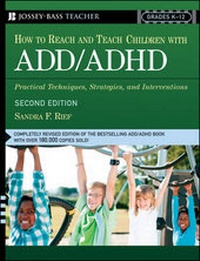
How to Reach and Teach Children with ADD/ADHD
Practical Techniques, Strategies, and Interventions
2nd Edition
Published on 17. March 2005
Book
Paperback/Softback
464 pages
978-0-7879-7295-0 (ISBN)
Description
Sandra Rief offers myriad real-life case studies, interviews, and student intervention plans for children with ADD/ADHD. In addition, the book contains best teaching practices and countless strategies for enhancing classroom performance for all types of students. This invaluable resource offers proven suggestions for: Engaging students' attention and active participation Keeping students on-task and productive Preventing and managing behavioral problems in the classroom Differentiating instruction and addressing students' diverse learning styles Building a partnership with parents and much more.
More details
Edition
2nd Revised edition
Language
English
Place of publication
New York
United States
Publishing group
John Wiley & Sons Inc
Edition type
Revised edition
Illustrations
illustrations
Dimensions
Height: 281 mm
Width: 216 mm
Thickness: 26 mm
Weight
1047 gr
ISBN-13
978-0-7879-7295-0 (9780787972950)
Copyright in bibliographic data and cover images is held by Nielsen Book Services Limited or by the publishers or by their respective licensors: all rights reserved.
Schweitzer Classification
Other editions
New editions
Sandra F. Rief
How to Reach and Teach Children and Teens with ADD/ADHD
Book
10/2016
3rd Edition
Wiley
€35.00
Article not available at the moment
Person
Sandra F. Rief , M.A., is a leading educational consultant, author, and speaker on effective strategies and interventions for helping students with learning, attention, and behavioral challenges. An award-winning educator with over twenty years experience teaching in public schools, she presents seminars, workshops, and keynotes nationally and internationally on this topic. Sandra is also the author of The ADHD Book of Lists and The ADD/ADHD Checklist, both from Jossey-Bass.
Content
Introduction. PART 1: KEY INFORMATION FOR UNDERSTANDING AND MANAGING ADHD. Section 1.1: Understanding Attention-Deficit/Hyperactivity Disorder. Section 1.2: Making the Diagnosis: A Comprehensive Evaluation for ADHD. Section 1.3: Multimodal Treatments for ADHD. Section 1.4: Medication Treatment and Management. Section 1.5: Do's and Don'ts for Teachers and Parents. Section 1.6: Critical Factors in the Success of Students with ADHD. Section 1.7: ADHD and Social Skills Interventions. Section 1.8: ADHD in Preschool and Kindergarten. Section 1.9: ADHD in Middle School and High School. Part 1: General References. Part 1: Recommended Resources. PART 2: MANAGING THE CHALLENGE OF ADHD BEHAVIORS. Section 2.1: Classroom Management and Positive Discipline Practices. Section 2.2: Preventing or Minimizing Behavior Problems During Transitions and Less Structured Times. Section 2.3: Individualized Behavior Management, Interventions, and Supports. Section 2.4: Strategies to Increase Listening, Following Directions, and Compliance. Section 2.5: Attention!! Strategies for Engaging, Maintaining, and Regulating Students' Attention. Part 2: General References. Part 2: Recommended Resources. PART 3: INSTRUCTIONAL AND ACADEMIC STRATEGIES AND SUPPORTS. Section 3.1: Reaching Students Through Differentiated Instruction. Section 3.2: Multisensory Instruction. Section 3.3: Reaching Students Through Their Learning Styles and Multiple Intelligences. Section 3.4: The Advantages of Cooperative Learning for Students with ADHD. Section 3.5: Organization, Time Management, and Study Skills. Section 3.6: Learning Strategies and Study Skills. Section 3.7: Writing and Reading Challenges for Students with ADHD. Section 3.8: Written Language Strategies, Accommodations, and Interventions: Pre-Planning/Organizing, Handwriting, Assistive Technology. Section 3.9: Strategies for Building Written Expression and Editing Skills. Section 3.10: Reading Strategies and Interventions: Building Decoding Skills, Vocabulary, and Fluency. Section 3.11: Reading Comprehension Strategies and Interventions. Section 3.12: Mathematics: Challenges and Strategies. Part 3: General References. Part 3: Recommended Resources. PART 4: PERSONAL STORIES AND CASE STUDIES. Section 4.1: A Parent's Story: What Every Teacher and Clinician Needs to Hear. Section 4.2: Case Studies and Interventions (Adam and Vincent). PART 5: COLLABORATIVE EFFORTS AND SCHOOL RESPONSIBILITIES IN HELPING CHILDREN WITH ADHD. Section 5.1: Teaming for Success: Communication, Collaboration, and Mutual Support. Section 5.2: The Role of the School's Multidisciplinary Team. Section 5.3: School Documentation and Communication with Medical Providers and Others. Section 5.4: Educational Laws and Rights of Students with ADHD. Section 5.5: Innovative Collaborative Programs for Helping Children with ADHD. Part 5: General References. Part 5: Recommended Resources. PART 6: ADDITIONAL SUPPORTS AND STRATEGIES. Section 6.1: Stress Reduction, Relaxation Strategies, Leisure Activities, and Exercise. Section 6.2: Music for Relaxation, Transitions, Energizing, and Visualization. Part 6: General References. Part 6: Recommended Resources.