

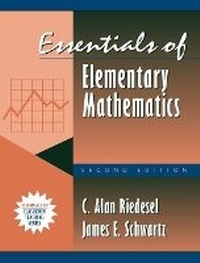
Essentials of Elementary Mathematics
(Part of the Essentials of Classroom Teaching Series)
2nd Edition
Published on 24. August 1998
Book
Paperback/Softback
240 pages
978-0-205-28750-5 (ISBN)
Description
The second edition of Essentials of Elementary Mathematics presents the essentials of pertinent research, valued classroom methodology, and current practice in teaching elementary math at a length, format, and price perfect for the undergraduate course in math methods. The text is ideal for "block" courses where more than one content area's methods are taught, or for general methods courses where the instructor would like more coverage of specific subjects.
More details
Other editions
Previous edition

James S. J. Schwartz | C.Alan Riedesel
Elementary Mathematics
Book
03/1999
Allyn & Bacon
€47.27
Article exhausted; check for reprint
Content
Most chapters include Looking Ahead, Can You?, Teacher Laboratory, Self-Test, Think About, Periodicals, and Selected References.
1.Today's Classroom.
Visiting Contemporary Classrooms.
Differences in Approach.
Some General Procedures.
Current Issues and Concerns.
Establishing a Balance.
A Philosophy of Teaching Elementary School Mathematics.
2.The Learner.
How Do Children Learn Mathematics?
What Can Be Done to Help Children with Special Needs?
What Are Some Organizational Plans for Providing for Individual Differences?
3.The Teacher - The Classroom Leader.
Planning for Large Groups/Small Groups/Individuals.
Calculators.
Computers.
Manipulatives, Games, and Bulletin Boards.
Assessment.
4.Problem Solving - The Key Element of the Mathematics Program.
Classroom Teaching of Problem Solving.
Situations for Problem Solving.
Using Strategies in Problem Solving.
The Role of Algebra in Problem Solving.
Characteristics of Good Problem-Solvers.
5.Number Concepts.
Number Foundations and Basic Facts.
Place Value with Whole Numbers.
Place-Value Concepts Extended to Decimals.
6.Number Algorithms: Primary.
Mathematical Background.
Readiness and Foundational Experiences.
7.Number Algorithms: Intermediate.
Multidigit Algorithms.
8.Fractions and Decimals.
Fractions and Rational Numbers.
Fundamental Ideas about Fractions.
Addition and Subtraction of Fractions.
Multiplication of Fractions.
Division of Fractions.
Simplification of Multiplication and Division.
Computation with Decimals: Addition and Subtraction.
Computation with Decimals: Multiplication and Division.
9.Ratio and Proportion, Percent, and Probability and Statistics.
Ratio and Proportion.
Teaching Ratio and Proportion.
Percent.
Goals in Teaching Probability and Statistics.
Teaching Probability and Statistics.
10.Measurement and Geometry.
The Heart Problem.
A Conceptual Framework.
Topics.
Active Learning.
Why Teach Geometry and Measurement?
Index.
1.Today's Classroom.
Visiting Contemporary Classrooms.
Differences in Approach.
Some General Procedures.
Current Issues and Concerns.
Establishing a Balance.
A Philosophy of Teaching Elementary School Mathematics.
2.The Learner.
How Do Children Learn Mathematics?
What Can Be Done to Help Children with Special Needs?
What Are Some Organizational Plans for Providing for Individual Differences?
3.The Teacher - The Classroom Leader.
Planning for Large Groups/Small Groups/Individuals.
Calculators.
Computers.
Manipulatives, Games, and Bulletin Boards.
Assessment.
4.Problem Solving - The Key Element of the Mathematics Program.
Classroom Teaching of Problem Solving.
Situations for Problem Solving.
Using Strategies in Problem Solving.
The Role of Algebra in Problem Solving.
Characteristics of Good Problem-Solvers.
5.Number Concepts.
Number Foundations and Basic Facts.
Place Value with Whole Numbers.
Place-Value Concepts Extended to Decimals.
6.Number Algorithms: Primary.
Mathematical Background.
Readiness and Foundational Experiences.
7.Number Algorithms: Intermediate.
Multidigit Algorithms.
8.Fractions and Decimals.
Fractions and Rational Numbers.
Fundamental Ideas about Fractions.
Addition and Subtraction of Fractions.
Multiplication of Fractions.
Division of Fractions.
Simplification of Multiplication and Division.
Computation with Decimals: Addition and Subtraction.
Computation with Decimals: Multiplication and Division.
9.Ratio and Proportion, Percent, and Probability and Statistics.
Ratio and Proportion.
Teaching Ratio and Proportion.
Percent.
Goals in Teaching Probability and Statistics.
Teaching Probability and Statistics.
10.Measurement and Geometry.
The Heart Problem.
A Conceptual Framework.
Topics.
Active Learning.
Why Teach Geometry and Measurement?
Index.