

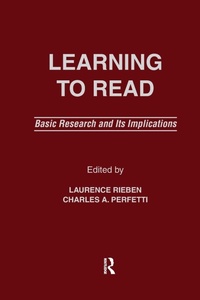
Learning To Read
Basic Research and Its Implications
1st Edition
Published on 13. May 2016
Book
Paperback/Softback
228 pages
978-1-138-97965-9 (ISBN)
Description
How does a young child begin to make sense out of squiggles on a page? Is learning to read a process of extending already acquired language abilities to print? What comprises this extension? How children learn to read, and especially how children are taught to read, are problems of sustained scientific interest and enduring pedagogical controversy. This volume presents conceptual and theoretical analyses of learning to read, research on the very beginning processes of learning to read, as well as research on phonological abilities and on children who have problems learning to read. In so doing, it reflects the important discovery that learning to read requires mastering the system by which print encodes the language. The editors hope that some of the work offered in this text will influence future research questions and will make a difference in the way instructional issues are formulated.
Reviews / Votes
"...provides glimpses into the minds of some of the leading researchers who have helped inform the debate. The chapters are short, focused, and thorough in their treatment of central issues in beginning reading."-Contemporary Psychology
"The research is important enough that it should be required reading for graduate students in elementary education and adminstration."
-Choice
More details
Language
English
Place of publication
London
United Kingdom
Publishing group
Taylor & Francis Ltd
Target group
Professional and scholarly
Dimensions
Height: 229 mm
Width: 152 mm
Thickness: 12 mm
Weight
337 gr
ISBN-13
978-1-138-97965-9 (9781138979659)
Copyright in bibliographic data and cover images is held by Nielsen Book Services Limited or by the publishers or by their respective licensors: all rights reserved.
Schweitzer Classification
Other editions
Additional editions
E-Book
12/2013
1st Edition
Routledge
€68.49
Available for download
E-Book
12/2013
1st Edition
Routledge
€68.49
Available for download
Book
03/1991
Routledge
€206.30
Shipment within 10-20 days
Persons
Rieben, Laurence; Perfetti, Charles A.
Content
Contents: Introduction. Part I: Principles and Theories.I.Y. Liberman, D. Shankweiler, Phonology and Beginning Reading: A Tutorial. K.E. Stanovich, Changing Models of Reading and Reading Acquisition. C.A. Perfetti, Representations and Awareness in the Acquisition of Reading Competence. Part II: Starting to Learn to Read.P.B. Gough, C. Juel, The First Stages of Word Recognition. L.C. Ehri, Learning to Read and Spell Words. B. Byrne, Experimental Analysis of the Child's Discovery of the Alphabetic Principle. L. Rieben, A. Meyer, C. Perregaux, Individual Differences and Lexical Representations: How Five 6-Year-Old Children Search for and Copy Words. Part III: Phonological Abilities.W.E. Tunmer, Phonological Awareness and Literacy Acquisition. V.A. Mann, Phonological Abilities: Effective Predictors of Future Reading Ability. J. Alegria, J. Morais, Segmental Analysis and Reading Acquisition. R. Treiman, The Role of Intrasyllabic Units in Learning to Read. Part IV: Reading Skill and Reading Problems.F.J. Morrison, Learning (and Not Learning) to Read: A Developmental Framework. L. Sprenger-Charolles, Word-Identification Strategies in a Picture Context: Comparisons Between "Good" and "Poor" Readers. F.R. Vellutino, D.M. Scanlon, The Effects of Instructional Bias on Word Identification.