

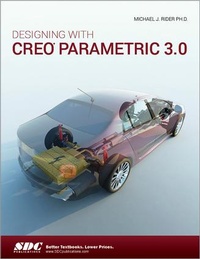
Designing with Creo Parametric 3.0
1st Edition
Published on 8. July 2015
Book
Paperback/Softback
978-1-58503-980-7 (ISBN)
Description
Designing with Creo Parametric 3.0 provides the high school student, college student, or practicing engineer with a basic introduction to engineering design while learning the 3D modeling Computer-Aided Design software called Creo Parametric from PTC. The topics are presented in tutorial format with exercises at the end of each chapter to reinforce the concepts covered. It is richly illustrated with computer screen shots throughout. Above all, this text is designed to help the reader expand their creative talents and communicate their ideas through the graphics language.
Because it is easier to learn new information if you have a reason for learning it, this textbook discusses design intent while you are learning Creo Parametric. At the same time, it shows how knowledge covered in basic engineering courses such as statics, dynamics, strength of materials, and design of mechanical components can be applied to design. You do not need an engineering degree nor be working toward a degree in engineering to use this textbook. Although FEA (Finite Element Analysis) is used in this textbook, its theory is not covered.
The first two chapters of this book describe the design process. The meat of this text, learning the basic Creo Parametric software, is found in Chapters 3 through 6. Chapters 7, 8, and 12 deal with dimensioning and tolerancing an engineering part. Chapters 9 and 10 deal with assemblies and assembly drawings. Chapter 11 deals with family tables used when similar parts are to be designed or used. Chapter 13 is an introduction to Creo Simulate and FEA.
Because it is easier to learn new information if you have a reason for learning it, this textbook discusses design intent while you are learning Creo Parametric. At the same time, it shows how knowledge covered in basic engineering courses such as statics, dynamics, strength of materials, and design of mechanical components can be applied to design. You do not need an engineering degree nor be working toward a degree in engineering to use this textbook. Although FEA (Finite Element Analysis) is used in this textbook, its theory is not covered.
The first two chapters of this book describe the design process. The meat of this text, learning the basic Creo Parametric software, is found in Chapters 3 through 6. Chapters 7, 8, and 12 deal with dimensioning and tolerancing an engineering part. Chapters 9 and 10 deal with assemblies and assembly drawings. Chapter 11 deals with family tables used when similar parts are to be designed or used. Chapter 13 is an introduction to Creo Simulate and FEA.
More details
Language
English
Place of publication
Mission, KS
United States
Target group
College/higher education
Professional and scholarly
Professional Training and Undergraduate Advanced
Dimensions
Height: 280 mm
Width: 210 mm
Weight
453 gr
ISBN-13
978-1-58503-980-7 (9781585039807)
Copyright in bibliographic data and cover images is held by Nielsen Book Services Limited or by the publishers or by their respective licensors: all rights reserved.
Schweitzer Classification
Person
Dr. Michael J. Rider Ph.D., Ohio Northern University.
Content
Preface, Chapter 1 Computer-Aided Design Chapter 2 Introduction Chapter 3 Sketcher Chapter 4 Extrusions Chapter 5 Revolves Chapter 6 Patterns Chapter 7 Dimensioning Chapter 8 Engineering Drawings Chapter 9 Assemblies Chapter 10 Assembly Drawings Chapter 11 Relations and Family Tables Chapter 12 Tolerancing and GD&T Chapter 13 Creo Simulate and FEA.