

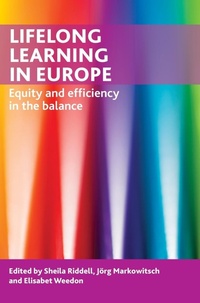
Lifelong Learning in Europe
Equity and Efficiency in the Balance
1st Edition
Published on 4. July 2012
Book
Hardback
224 pages
978-1-4473-0013-7 (ISBN)
Description
The ongoing economic crisis raises fundamental questions about the political and social goals of the European Union, particularly the feasibility of harmonising social and education policy across member states. The forward momentum of the European project is clearly faltering, raising the possibility that the high water mark of European integration has been achieved, with implications for many aspects of education and social policy, including lifelong learning.
This timely book makes a major and original contribution to the development of knowledge and understanding of lifelong learning in an expanded Europe. Its wide range of contributors look at the contribution of lifelong learning to economic growth and social cohesion across Europe, focusing its challenge to social exclusion. It draws on comparative data from the EU Sixth Framework Project Lifelong Learning Policy and Practice in Europe (LLL2010), which ran from 2005 - 2011 and involved twelve European countries and Russia. Very little research has been conducted to date on the nature of lifelong learning in post-Soviet countries, and this book provides important insights into their evolving education and lifelong learning systems.
The book will be of interest to researchers and academics in the UK and Europe, especially those from social policy, adult and comparative education, equality studies and practice of lifelong learning.
This timely book makes a major and original contribution to the development of knowledge and understanding of lifelong learning in an expanded Europe. Its wide range of contributors look at the contribution of lifelong learning to economic growth and social cohesion across Europe, focusing its challenge to social exclusion. It draws on comparative data from the EU Sixth Framework Project Lifelong Learning Policy and Practice in Europe (LLL2010), which ran from 2005 - 2011 and involved twelve European countries and Russia. Very little research has been conducted to date on the nature of lifelong learning in post-Soviet countries, and this book provides important insights into their evolving education and lifelong learning systems.
The book will be of interest to researchers and academics in the UK and Europe, especially those from social policy, adult and comparative education, equality studies and practice of lifelong learning.
Reviews / Votes
"This important study draws on rigorous international research, reviews key theoretical and policy debates, and presents new insights into the different meanings and practices of lifelong learning in Europe. It will appeal broadly to social scientists, and to policy makers and managers in the field."John Field, Professor of Lifelong Learning, University of Stirling
More details
Edition
First Edition
Language
English
Place of publication
Bristol
United Kingdom
Target group
College/higher education
Dimensions
Height: 250 mm
Width: 175 mm
Thickness: 15 mm
Weight
534 gr
ISBN-13
978-1-4473-0013-7 (9781447300137)
Copyright in bibliographic data and cover images is held by Nielsen Book Services Limited or by the publishers or by their respective licensors: all rights reserved.
Schweitzer Classification
Other editions
Additional editions
Sheila Riddell | Jorg Markowitsch | Elisabet Weedon
Lifelong Learning in Europe
Equity and Efficiency in the Balance
E-Book
07/2012
1st Edition
Policy Press
€124.09
Available for download
Persons
Sheila Riddell is the founding Director of the Centre for Research in Education, Inclusion and Diversity (CREID) at the University of Edinburgh. Her research interests are in equality and social inclusion in relation to education, employment and social care.
Joerg Markowitsch is founder and senior partner of 3s Unternehmensberatung GmbH. His research interests are vocational education and training, lifelong learning and European education policy.
Elisabet Weedon is a Senior Research Fellow at the University of Edinburgh. Her research interests are in the area of social justice and lifelong learning.
Joerg Markowitsch is founder and senior partner of 3s Unternehmensberatung GmbH. His research interests are vocational education and training, lifelong learning and European education policy.
Elisabet Weedon is a Senior Research Fellow at the University of Edinburgh. Her research interests are in the area of social justice and lifelong learning.
Content
Lifelong Learning and the Generation of Human and Social Capital ~ Sheila Riddell and Elisabet Weedon; Lifelong learning and the wider European socio-economic context ~ Sheila Riddell and Elisabet Weedon; Neoliberal and inclusive themes in European lifelong learning policy ~ John Holford and Vida A. Mohorcic Spolar; Formal adult education in the spotlight: profiles, motivations and experiences of participants in 12 European countries ~ Ellen Boeren, Eve-Liis Roosmaa, Ides Nicaise and Ellu Saar; The socio-demographic obstacles to participating in lifelong learning across Europe ~ Peter Robert; The qualification providing enterprise? Support for formal adult education in small and medium sized enterprises ~ Guenter Hefler and Joerg Markowitsch; Reducing or reinforcing inequality: assessing the impact of European policy on widening access to higher education ~ Elisabet Weedon and Sheila Riddell; Conclusion: The role of lifelong learning in reducing social inequality at a time of economic crisis ~ Sheila Riddell.