

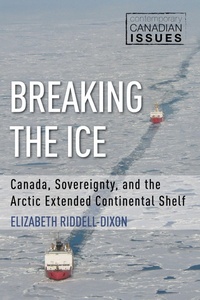
Breaking the Ice
Canada, Sovereignty, and the Arctic Extended Continental Shelf
Published on 29. June 2017
Book
Paperback/Softback
344 pages
978-1-4597-3897-3 (ISBN)
Description
The Hill Times: Best Books of 2017
The Arctic seabed, with its vast quantities of undiscovered resources, is the twenty-first century's frontier.
In Breaking the Ice: Canada, Sovereignty and the Arctic Extended Continental Shelf, Arctic policy expert Elizabeth Riddell-Dixon examines the political, legal, and scientific aspects of Canada's efforts to delineate its Arctic extended continental shelf. The quality and quantity of the data collected and analyzed by the scientists and legal experts preparing Canada's Arctic Submission for the Commission on the Limits of the Continental Shelf, and the extensive collaboration with Canada's Arctic neighbours is a good news story in Canadian foreign policy. As Arctic sovereignty continues to be a key concern for Canada and as the international legal regime is being observed by all five Arctic coastal states, it is crucial to continue to advance our understanding of the complex issues around this expanding area of national interest.
The Arctic seabed, with its vast quantities of undiscovered resources, is the twenty-first century's frontier.
In Breaking the Ice: Canada, Sovereignty and the Arctic Extended Continental Shelf, Arctic policy expert Elizabeth Riddell-Dixon examines the political, legal, and scientific aspects of Canada's efforts to delineate its Arctic extended continental shelf. The quality and quantity of the data collected and analyzed by the scientists and legal experts preparing Canada's Arctic Submission for the Commission on the Limits of the Continental Shelf, and the extensive collaboration with Canada's Arctic neighbours is a good news story in Canadian foreign policy. As Arctic sovereignty continues to be a key concern for Canada and as the international legal regime is being observed by all five Arctic coastal states, it is crucial to continue to advance our understanding of the complex issues around this expanding area of national interest.
Reviews / Votes
This book should appeal to historians and to the technically-minded alike. * Ron Macnab, Geological Survey of Canada (Retired) * An excellent resource for those who study the Arctic. * Publishers Weekly * In her preface, the author suggests that the book's title has a double meaning ... She succeeds admirably in both these efforts. * Maritime Engineering Journal *More details
Series
Language
English
Place of publication
Toronto
Canada
Product notice
Paperback (trade)
Illustrations
notes; Bibliography; Diagrams; Index; Maps; 47 Illustrations, color
Dimensions
Height: 224 mm
Width: 150 mm
Thickness: 18 mm
Weight
499 gr
ISBN-13
978-1-4597-3897-3 (9781459738973)
Copyright in bibliographic data and cover images is held by Nielsen Book Services Limited or by the publishers or by their respective licensors: all rights reserved.
Schweitzer Classification
Other editions
Additional editions
Elizabeth Riddell-Dixon
Breaking the Ice
Canada, Sovereignty, and the Arctic Extended Continental Shelf
E-Book
04/2017
Dundurn Press
€14.49
Available for download
Persons
Elizabeth Riddell-Dixon has spent three decades researching and writing about law of the sea policy. She is a Distinguished Senior Fellow with the Bill Graham Centre for Contemporary International History, University of Toronto, and Professor Emerita in the Department of Political Science at Western University.
Content
List of Diagrams
List of Maps
List of Acronyms and Terms
Foreword by John English
Preface
Prologue
Chapter 1: Introduction
Definition of Terms
A Caveat About Resources
Interdepartmental Cooperation
Cooperation Among Arctic Coastal States
Chapter Outline
A Methodological Note
Chapter 2: The Extended Continental Shelf Regime
Historical Evolution of the Regime
The Legal Regime
Conclusion
Chapter 3: Scientific Research and the Law of the Sea Convention
Bathymetry
Seismic Reflection and Refraction Data
Complementary Sources of Data
Data Processing
Bathymetric and Seismic Data and the ECS Regime
Conclusion
Chapter 4: Ice Camps and Icebreakers: The Human Experience
The Challenges of Mapping the Arctic Seabed
Physical Health and Safety
Mental Health and Teamwork
Ice Camps
Icebreakers
Conclusion
Chapter 5: The Arctic Extended Continental Shelf Surveys
Past and Concurrent Studies
Environmental Assessments and Relations with Indigenous Peoples
The UNCLOS Surveys, 2006-2016
Scientific Findings
Conclusion
Chapter 6: Canada's Submission and Other Outstanding Issues
The December 2013 Announcement
Article 82
Delimitation of Arctic Extended Continental Shelves
Conclusion
Chapter 7: Conclusion
Summary of Findings
Links to the Literature
A Final Word
Interviewees
Notes
Bibliography
Index
List of Maps
List of Acronyms and Terms
Foreword by John English
Preface
Prologue
Chapter 1: Introduction
Definition of Terms
A Caveat About Resources
Interdepartmental Cooperation
Cooperation Among Arctic Coastal States
Chapter Outline
A Methodological Note
Chapter 2: The Extended Continental Shelf Regime
Historical Evolution of the Regime
The Legal Regime
Conclusion
Chapter 3: Scientific Research and the Law of the Sea Convention
Bathymetry
Seismic Reflection and Refraction Data
Complementary Sources of Data
Data Processing
Bathymetric and Seismic Data and the ECS Regime
Conclusion
Chapter 4: Ice Camps and Icebreakers: The Human Experience
The Challenges of Mapping the Arctic Seabed
Physical Health and Safety
Mental Health and Teamwork
Ice Camps
Icebreakers
Conclusion
Chapter 5: The Arctic Extended Continental Shelf Surveys
Past and Concurrent Studies
Environmental Assessments and Relations with Indigenous Peoples
The UNCLOS Surveys, 2006-2016
Scientific Findings
Conclusion
Chapter 6: Canada's Submission and Other Outstanding Issues
The December 2013 Announcement
Article 82
Delimitation of Arctic Extended Continental Shelves
Conclusion
Chapter 7: Conclusion
Summary of Findings
Links to the Literature
A Final Word
Interviewees
Notes
Bibliography
Index