

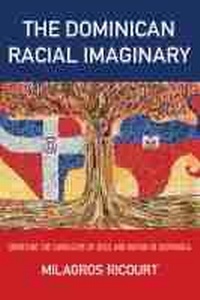
The Dominican Racial Imaginary
Surveying the Landscape of Race and Nation in Hispaniola
Published on 18. November 2016
Book
Hardback
240 pages
978-0-8135-8448-5 (ISBN)
Description
Honorable mention, 2017 Gordon K. and Sybil Lewis Award from the Caribbean Studies Association
This book begins with a simple question: why do so many Dominicans deny the African components of their DNA, culture, and history? Seeking answers, Milagros Ricourt uncovers a complex and often contradictory Dominican racial imaginary. Observing how Dominicans have traditionally identified in opposition to their neighbors on the island of Hispaniola-Haitians of African descent-she finds that the Dominican Republic's social elite has long propagated a national creation myth that conceives of the Dominican as a perfect hybrid of native islanders and Spanish settlers. Yet as she pores through rare historical documents, interviews contemporary Dominicans, and recalls her own childhood memories of life on the island, Ricourt encounters persistent challenges to this myth. Through fieldwork at the Dominican-Haitian border, she gives a firsthand look at how Dominicans are resisting the official account of their national identity and instead embracing the African influence that has always been part of their cultural heritage. Building on the work of theorists ranging from Edward Said to Edouard Glissant, this book expands our understanding of how national and racial imaginaries develop, why they persist, and how they might be subverted. As it confronts Hispaniola's dark legacies of slavery and colonial oppression, The Dominican Racial Imaginary also delivers an inspiring message on how multicultural communities might cooperate to disrupt the enduring power of white supremacy.
This book begins with a simple question: why do so many Dominicans deny the African components of their DNA, culture, and history? Seeking answers, Milagros Ricourt uncovers a complex and often contradictory Dominican racial imaginary. Observing how Dominicans have traditionally identified in opposition to their neighbors on the island of Hispaniola-Haitians of African descent-she finds that the Dominican Republic's social elite has long propagated a national creation myth that conceives of the Dominican as a perfect hybrid of native islanders and Spanish settlers. Yet as she pores through rare historical documents, interviews contemporary Dominicans, and recalls her own childhood memories of life on the island, Ricourt encounters persistent challenges to this myth. Through fieldwork at the Dominican-Haitian border, she gives a firsthand look at how Dominicans are resisting the official account of their national identity and instead embracing the African influence that has always been part of their cultural heritage. Building on the work of theorists ranging from Edward Said to Edouard Glissant, this book expands our understanding of how national and racial imaginaries develop, why they persist, and how they might be subverted. As it confronts Hispaniola's dark legacies of slavery and colonial oppression, The Dominican Racial Imaginary also delivers an inspiring message on how multicultural communities might cooperate to disrupt the enduring power of white supremacy.
Reviews / Votes
"A necessary book to rethink Dominican racial identities. Ricourt challenges the hegemonic national imaginary and brings forward alternative discourses and practices highlighting the presence of Dominican Black identities and culture." - Jose Itzigsohn (professor of sociology, Brown University) "By reconsidering Dominican Vodou as the living legacy of Indigenous-Black liberation projects, Ricourt manages to make sense of how Dominican history and culture create and sustain both black 'denial' and black 'existence.' I cannot emphasize enough how powerful, radical, and important an argument this is." - Ginetta E. B. Candelario (sociology and Latin American & Latino studies, Smith College) "Ricourt challenges the long-held idea of black denial in the Dominican Republic by highlighting examples from Afro-Dominican religion and other cultural practices where the African past is present. This book continues to move us forward in the ways race and blackness are discussed in the Dominican Republic." - Kimberly Eison Simmons (Anthropology and African American Studies, University of South Carolina) "A much-needed intervention in the historiography of Dominican racial and national identity." (Hispanic American Historical Review)More details
Series
Language
English
Place of publication
New Brunswick NJ
United States
Target group
College/higher education
Professional and scholarly
Illustrations
9 photographs, 2 figures, 2 maps, 8 tables
Dimensions
Height: 229 mm
Width: 152 mm
Thickness: 18 mm
Weight
454 gr
ISBN-13
978-0-8135-8448-5 (9780813584485)
Copyright in bibliographic data and cover images is held by Nielsen Book Services Limited or by the publishers or by their respective licensors: all rights reserved.
Schweitzer Classification
Other editions
Additional editions
E-Book
11/2016
1st Edition
Rutgers University Press
€99.99
Available for download
Person
MILAGROS RICOURT is a professor of Latin American and Puerto Rican studies at Lehman College, the City University of New York. She is the author of Women in Latin America and Dominicans in New York City: Power from the Margins, and coauthor of Hispanas de Queens: Latino Panethnicity in a New York City Neighborhood.
Content
Preface
Chapter 1 Introduction
Chapter 2 Border at the Crossroad
Chapter 3 The Creolization of Race
Chapter 4 Cimarrones: The Seed of Subversion
Chapter 5 Criollismo Religioso
Chapter 6 Race, Identity, and Nation
NotesBibliographyIndex
Chapter 1 Introduction
Chapter 2 Border at the Crossroad
Chapter 3 The Creolization of Race
Chapter 4 Cimarrones: The Seed of Subversion
Chapter 5 Criollismo Religioso
Chapter 6 Race, Identity, and Nation
NotesBibliographyIndex