

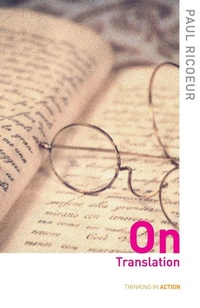
On Translation
Foreword by Translation by
1st Edition
Published on 18. October 2006
Book
Paperback/Softback
72 pages
978-0-415-35778-4 (ISBN)
Description
Paul Ricoeur was one of the most important philosophers of the twentieth century. In this short and accessible book, he turns to a topic at the heart of much of his work: What is translation and why is it so important?
Reminding us that The Bible, the Koran, the Torah and the works of the great philosophers are often only ever read in translation, Ricoeur reminds us that translation not only spreads knowledge but can change its very meaning. In spite of these risk, he argues that in a climate of ethnic and religious conflict, the art and ethics of translation are invaluable.
Drawing on interesting examples such as the translation of early Greek philosophy during the Renaissance, the poetry of Paul Celan and the work of Hannah Arendt, he reflects not only on the challenges of translating one language into another but how one community speaks to another. Throughout, Ricoeur shows how to move through life is to navigate a world that requires translation itself.
Paul Ricoeur died in 2005. He was one of the great contemporary French philosophers and a leading figure in hermeneutics, psychoanalytic thought, literary theory and religion. His many books include Freud and Philosophy and Time and Narrative.
Reminding us that The Bible, the Koran, the Torah and the works of the great philosophers are often only ever read in translation, Ricoeur reminds us that translation not only spreads knowledge but can change its very meaning. In spite of these risk, he argues that in a climate of ethnic and religious conflict, the art and ethics of translation are invaluable.
Drawing on interesting examples such as the translation of early Greek philosophy during the Renaissance, the poetry of Paul Celan and the work of Hannah Arendt, he reflects not only on the challenges of translating one language into another but how one community speaks to another. Throughout, Ricoeur shows how to move through life is to navigate a world that requires translation itself.
Paul Ricoeur died in 2005. He was one of the great contemporary French philosophers and a leading figure in hermeneutics, psychoanalytic thought, literary theory and religion. His many books include Freud and Philosophy and Time and Narrative.
Reviews / Votes
'One of the most distinguished and prolific philosophers of his generation' - The Daily Telegraph'Accessible and peppered with beautiful phrases, Ricoeur's is the kind of philosophical writing that provides an encounter with a feeling of transcendence and the sublime sometimes at odds with the philosophy it advocates' - M/C Reviews
'As should be evident from the foregoing, this slim volume packs an enormous quantity of important reflection on the process of translation and its two fundamnetal approaches: the translation of words and phrases or the interpretation of meaningful wholes' - Corrado Federici, Figures of Translation 'One of the most distinguished and prolific philosophers of his generation.' - The Daily Telegraph
More details
Series
Language
English
Place of publication
London
United Kingdom
Publishing group
Taylor & Francis Ltd
Target group
College/higher education
Professional and scholarly
Academic, Postgraduate, and Undergraduate Advanced
Dimensions
Height: 198 mm
Width: 129 mm
Thickness: 5 mm
Weight
90 gr
ISBN-13
978-0-415-35778-4 (9780415357784)
Copyright in bibliographic data and cover images is held by Nielsen Book Services Limited or by the publishers or by their respective licensors: all rights reserved.
Schweitzer Classification
Other editions
Additional editions
Book
10/2006
1st Edition
Routledge
€230.27
Shipment within 15-20 days
Persons
St Patrick's College, Dublin City University, Ireland
Content
Introduction: Ricoeur's philosophy of translation, 1. Translation as challenge and source of happiness, 2. The paradigm of translation, 3. A 'passage': translating the untranslatable, Notes, Index