

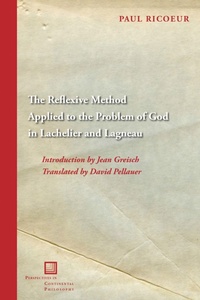
The Reflexive Method Applied to the Problem of God in Lachelier and Lagneau
Will be published approx. on 4. November 2025
Book
Paperback/Softback
160 pages
978-1-5315-1261-3 (ISBN)
Description
An engaging and thought-provoking translation of Paul Ricoeur's earliest work that is essential for understanding his philosophical development
The Reflexive Method Applied to the Problem of God in Lachelier and Lagneau, now held in the Ricoeur Archive in Paris, was a qualifying thesis Ricoeur wrote at the age of twenty-one when he was just beginning his advanced university studies. In it he examines the use of the reflexive method used by two important French philosophers from the nineteenth century, Jules Lachelier and Jules Lagneau. They both sought to develop an "integral metaphysics" that recognizes God as the principle underlying pure, impersonal thought and practical reason, and that requires a kind of philosophical faith. In his conclusion, Ricoeur criticizes their doctrine of God and philosophy of immanence for not being able to deal with the question of transcendence and for its failure to address concrete human existence yet concedes that it may be seen as a first truce in "the internecine war" between faith and reason.
Despite this criticism, Ricoeur later maintained that his own philosophy does stand "in the line of a reflexive philosophy" while remaining "within the sphere of Husserlian phenomenology" and striving to be "a hermeneutical variation of this phenomenology." He also continued to address the question of faith and reason in works like Figuring the Sacred and (with Andre LaCocque) Thinking Biblically, as well as in many other essays.
The Reflexive Method Applied to the Problem of God in Lachelier and Lagneau is necessary reading for anyone doing serious work on and with Ricoeur's philosophy.
The Reflexive Method Applied to the Problem of God in Lachelier and Lagneau, now held in the Ricoeur Archive in Paris, was a qualifying thesis Ricoeur wrote at the age of twenty-one when he was just beginning his advanced university studies. In it he examines the use of the reflexive method used by two important French philosophers from the nineteenth century, Jules Lachelier and Jules Lagneau. They both sought to develop an "integral metaphysics" that recognizes God as the principle underlying pure, impersonal thought and practical reason, and that requires a kind of philosophical faith. In his conclusion, Ricoeur criticizes their doctrine of God and philosophy of immanence for not being able to deal with the question of transcendence and for its failure to address concrete human existence yet concedes that it may be seen as a first truce in "the internecine war" between faith and reason.
Despite this criticism, Ricoeur later maintained that his own philosophy does stand "in the line of a reflexive philosophy" while remaining "within the sphere of Husserlian phenomenology" and striving to be "a hermeneutical variation of this phenomenology." He also continued to address the question of faith and reason in works like Figuring the Sacred and (with Andre LaCocque) Thinking Biblically, as well as in many other essays.
The Reflexive Method Applied to the Problem of God in Lachelier and Lagneau is necessary reading for anyone doing serious work on and with Ricoeur's philosophy.
Reviews / Votes
"Like an acorn, Ricoeur's master's thesis anticipates ideas that will mature several decades later in his philosophy of the will. Through a careful comparison of two lesser-known 19th century French spiritualists - Lagneau and Lachelier--Ricoeur explores the question of the relation between reason and faith, arriving at a conclusion that becomes a mantra for the rest of his career: "immanence always includes some transcendence." This book, superbly translated by David Pellauer, brings a fresh perspective that remaps our understanding of the entire trajectory of Ricoeur's thought." - Scott Davidson, University of Massachusetts Amherst, author of Pathos and Praxis: An Integrated Phenomenology of LifeMore details
Series
Edition
New edition
Language
English
Place of publication
New York
United States
Target group
College/higher education
Edition type
New edition
Product notice
Paperback (trade)
Dimensions
Height: 226 mm
Width: 153 mm
Thickness: 15 mm
Weight
252 gr
ISBN-13
978-1-5315-1261-3 (9781531512613)
Copyright in bibliographic data and cover images is held by Nielsen Book Services Limited or by the publishers or by their respective licensors: all rights reserved.
Schweitzer Classification
Persons
Paul Ricoeur (Author)
Paul Ricoeur is one of the most important twentieth-century French philosophers, who taught both in France and in the United States. He was the author of many books, including The Voluntary and the Involuntary, Fallible Man, and The Symbolism of Evil, Freud and Philosophy, The Rule of Metaphor, Time and Narrative, Oneself as Another, Memory History, Forgetting, and The Course of Recognition, as well as many essays, including ones on the philosophy of religion.
David Pellauer (Translator)
David Pellauer is professor emeritus of philosophy at DePaul University. He is the author of Paul Ricoeur: A Guide for the Perplexed and other essays on the work of Paul Ricoeur. He has also translated or co-translated many books and essays by Paul Ricoeur. He currently serves as a corresponding member on the Comite scientifique of the Ricoeur Archive in Paris.
Paul Ricoeur is one of the most important twentieth-century French philosophers, who taught both in France and in the United States. He was the author of many books, including The Voluntary and the Involuntary, Fallible Man, and The Symbolism of Evil, Freud and Philosophy, The Rule of Metaphor, Time and Narrative, Oneself as Another, Memory History, Forgetting, and The Course of Recognition, as well as many essays, including ones on the philosophy of religion.
David Pellauer (Translator)
David Pellauer is professor emeritus of philosophy at DePaul University. He is the author of Paul Ricoeur: A Guide for the Perplexed and other essays on the work of Paul Ricoeur. He has also translated or co-translated many books and essays by Paul Ricoeur. He currently serves as a corresponding member on the Comite scientifique of the Ricoeur Archive in Paris.
Content
Translator's Note ix
Foreword by Philippe Capelle-Dumont xi
Preface by Jean Greisch xiii
Editorial Note by Catherine Goldenstein xxiii
Author's Preface xxv
Introduction: Reflexive Method 1
PART I: LACHELIER
Introduction 15
Naturalism and the Problem of God 17
The Formal God or the Idea of God 35
The Living God 57
PART II: LAGNEAU
Introduction 73
I. Awakening Thought 75
II. The Conditions of Certainty: The Monism of Thought 88
III. Certainty and Action 103
Conclusion: The Method of Immanence and the Doctrine of Immanence 119
Notes 131
Index 141
Foreword by Philippe Capelle-Dumont xi
Preface by Jean Greisch xiii
Editorial Note by Catherine Goldenstein xxiii
Author's Preface xxv
Introduction: Reflexive Method 1
PART I: LACHELIER
Introduction 15
Naturalism and the Problem of God 17
The Formal God or the Idea of God 35
The Living God 57
PART II: LAGNEAU
Introduction 73
I. Awakening Thought 75
II. The Conditions of Certainty: The Monism of Thought 88
III. Certainty and Action 103
Conclusion: The Method of Immanence and the Doctrine of Immanence 119
Notes 131
Index 141