

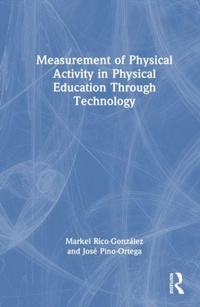
Measurement of Physical Activity in Physical Education Through Technology
1st Edition
Will be published approx. on 19. October 2026
Book
Hardback
344 pages
978-1-041-28662-2 (ISBN)
Description
Measurement of Physical Activity in Physical Education Through Technology provides a comprehensive, evidence-based guide for implementing technology to measure and enhance children's physical activity in educational settings. It includes physical activity and physical assessment methods in Physical Education with contemporary technologies and emerging AI applications to help educators optimize activity levels, prevent sedentary behaviour, support holistic child development, and address the global childhood physical inactivity crisis through accessible, practical, and ethically grounded approaches.
While sports science has extensively adopted monitoring technology for athletes and educational technology literature exists broadly, no comprehensive resource bridges these domains specifically for physical education. This cutting-edge new book addresses this critical knowledge gap at the intersection of technology, physical activity measurement, and educational pedagogy.
With contemporary and forward-looking content and a holistic developmental perspective: addressing multiple developmental outcomes such as motor, cognitive, social-emotional, and health, Measurement of Physical Activity in Physical Education Through Technology recognizes Physical Education's role beyond physical fitness to encompass whole-child development and broader educational objectives and, as such, is key reading for final year undergraduate and master students in PE teacher education, physical education pedagogy, children's physical activity, or educational technology programs.
While sports science has extensively adopted monitoring technology for athletes and educational technology literature exists broadly, no comprehensive resource bridges these domains specifically for physical education. This cutting-edge new book addresses this critical knowledge gap at the intersection of technology, physical activity measurement, and educational pedagogy.
With contemporary and forward-looking content and a holistic developmental perspective: addressing multiple developmental outcomes such as motor, cognitive, social-emotional, and health, Measurement of Physical Activity in Physical Education Through Technology recognizes Physical Education's role beyond physical fitness to encompass whole-child development and broader educational objectives and, as such, is key reading for final year undergraduate and master students in PE teacher education, physical education pedagogy, children's physical activity, or educational technology programs.
More details
Language
English
Place of publication
London
United Kingdom
Publishing group
Taylor & Francis Ltd
Target group
College/higher education
Professional and scholarly
General, Postgraduate, Professional Reference, and Undergraduate Advanced
Illustrations
5 s/w Photographien bzw. Rasterbilder, 11 s/w Zeichnungen, 29 s/w Tabellen, 16 s/w Abbildungen
29 Tables, black and white; 11 Line drawings, black and white; 5 Halftones, black and white; 16 Illustrations, black and white
Dimensions
Height: 229 mm
Width: 152 mm
ISBN-13
978-1-041-28662-2 (9781041286622)
Copyright in bibliographic data and cover images is held by Nielsen Book Services Limited or by the publishers or by their respective licensors: all rights reserved.
Schweitzer Classification
Other editions
Additional editions
Markel Rico-Gonzalez | Jose Pino-Ortega
Measurement of Physical Activity in Physical Education Through Technology
Book
approx. 10/2026
1st Edition
Routledge
€52.50
Not yet published
Persons
Markel Rico-Gonzalez is Assistant Professor in the Department of Didactics of Musical, Plastic and Corporal Expression, University of the Basque Country (EHU), Spain. He is the author of more than 100 scientific articles in journals and more than 25 book chapters. He is also the co-editor of the book 'The Use of Applied Technology in Team Sport' (Routledge, 2021, with Jose Pino-Ortega), editor of the book "Physical Education in Early Childhood: Movement and Development from 3 to 6 Years" (Routledge, 2025), and co-editor of the book "Physical Education in Primary Education: Movement and Development from 6 to 12 Years" (Routledge, 2026).
Jose Pino-Ortega is a university professor in the Department of Sport Sciences, University of Murcia, Spain. His main research area is technology applied to physical activity. He is the author of nearly 200 scientific articles in high-impact journals and co-editor of the book "The Use of Applied Technology in Team Sports" (Routledge, 2021, with Markel Rico-Gonzalez). Currently, Jose Pino-Ortega is now main researcher in the Research Chair of Education, Activity and Cancer.
Jose Pino-Ortega is a university professor in the Department of Sport Sciences, University of Murcia, Spain. His main research area is technology applied to physical activity. He is the author of nearly 200 scientific articles in high-impact journals and co-editor of the book "The Use of Applied Technology in Team Sports" (Routledge, 2021, with Markel Rico-Gonzalez). Currently, Jose Pino-Ortega is now main researcher in the Research Chair of Education, Activity and Cancer.
Content
Section 1: Introduction 1. Introduction Markel Rico-Gonzalez and Jose Pino-Ortega. 2. History, Evolution, and Importance of Technology in Current PE Alexandra Martin Rodriguez and Juan Delgado Basterrechea 3. Curricular Opportunities for the Implementation of Technologies. How Technology Can Help in Meeting Curricular Requirements: An Universal Viewpoint Alejandro Sal-de-Rellan, Adrian Moreno-Villanueva, Enrique Florez-Gil and Ariadna Hernaiz-Sanchez Section 2: Types, Classification, and Manual of Wearable Technologies 4. Positioning Technologies: GNSS and LPS Carlos D. Gomez-Carmona and Alejandro Soler-Lopez 5. Pedometers Luca Paolo Ardigo, Ake Elden and Ursula Smaland Goth 6. Smart Bracelets and Smartwatches John Oginni, Zarmina Amin and Jessh Mavoungou 7. Other Wearables (Smart Rings, Mobile Apps...) 8. Validity, Reliability, Precision, Sensitivity and Criteria for Choosing the Most Suitable Technology Section 3: Types, Classification, and Manual Technologies for Assessment Children`s Conditioning 9. Technologies for Evaluating Strength 10. Technologies for Evaluating Aerobic Conditioning 11. Technologies for Evaluating Velocity 12. Technologies for Evaluating Other Variables: Physiology, Kinematic, and Biomechanic Section 4: Different Types of Technologies of Data Processing 13. Software Applied to Physical Education 14. Manual of Statistics 15. New Trends of Data Processing: Artificial Intelligence Section 5: Developing Health, and Motor, Cognitive, Social, and Emotional Competencies throught Technology 16. Motor Competence: Related Variables and How to Interpret Them 17. Cognitive Competence: Related Variables and How to Interpret Them 18. Socioemotional Competence: Related Variables and How to Interpret Them 19. Health Related Variables and How They Can Be Interpreted in Educational Contexts 20. Consideration for an Inclusive Implementation of Technological Devices 21. Principles for Design Strategies for Enhancing Participation and Motivation Section 6: General Considerations: A Universal Viewpoint 22. Ethical and Legal Principles for Using Technologies in Educational Settings 23. Recommendations for Teachers, Institutions, and Policy Markers 24. Technology and Market: How Much Does Each Technology Cost?