

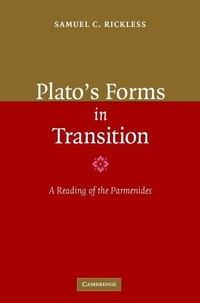
Plato's Forms in Transition
A Reading of the Parmenides
Published on 23. November 2006
Book
Hardback
292 pages
978-0-521-86456-5 (ISBN)
Description
There is a mystery at the heart of Plato's Parmenides. In the first part, Parmenides criticizes what is widely regarded as Plato's mature theory of Forms, and in the second, he promises to explain how the Forms can be saved from these criticisms. Ever since the dialogue was written, scholars have struggled to determine how the two parts of the work fit together. Did Plato mean us to abandon, keep or modify the theory of Forms, on the strength of Parmenides' criticisms? Samuel Rickless offers something that has never been done before: a careful reconstruction of every argument in the dialogue. He concludes that Plato's main aim was to argue that the theory of Forms should be modified by allowing that forms can have contrary properties. To grasp this is to solve the mystery of the Parmenides and understand its crucial role in Plato's philosophical development.
Reviews / Votes
"A novel and logically rigorous exposition of Plato's most enigmatic dialog"Kenneth M. Sayre, Journal of the History of Philosophy
More details
Language
English
Place of publication
Cambridge
United Kingdom
Target group
Professional and scholarly
Illustrations
1 Line drawings, unspecified
Dimensions
Height: 235 mm
Width: 157 mm
Thickness: 22 mm
Weight
628 gr
ISBN-13
978-0-521-86456-5 (9780521864565)
Copyright in bibliographic data and cover images is held by Nielsen Book Services Limited or by the publishers or by their respective licensors: all rights reserved.
Schweitzer Classification
Other editions
Additional editions
E-Book
01/2007
1st Edition
Cambridge University Press
€38.49
Available for download
Person
Samuel C. Rickless is Associate Professor, Department of Philosophy, University of California, San Diego.
Content
Introduction; 1. The theory of forms; 2. The theory criticized; 3. The theory modified: methodology; 4. The first deduction; 5. The second deduction; 6. From the appendix to the fourth deduction; 7. From the fifth to the eighth deduction; Conclusion.