

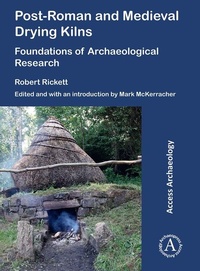
Post-Roman and Medieval Drying Kilns
Foundations of Archaeological Research
Published on 7. October 2021
Book
Paperback/Softback
156 pages
978-1-80327-070-8 (ISBN)
Description
Drying kilns, corn-dryers and malting ovens are increasingly familiar features in post-Roman, Anglo-Saxon and medieval archaeology. Their forms, functions and distributions offer critical insights into agricultural, technological, economic and dietary history across the British Isles. Despite the significance and growing corpus of these structures, exceptionally few works of synthesis have been published. Yet such a foundational study was produced by Robert Rickett as early as 1975: an undergraduate dissertation which, for the first time, assembled a gazetteer of drying kilns from across the British Isles, critically examined this archaeological evidence in the light of documentary research, and established a typology and uniform terminology for drying kiln studies. This pioneering and oft-cited dissertation is here published for the first time, providing a foundation for the future study of drying kilns in Britain, Ireland and beyond. A new introduction and notes by Mark McKerracher set the original work within the context of drying kiln research since 1975.
Reviews / Votes
'Overall, this is a fascinating and valuable study for which the author, editor and publisher are to be congratulated for making so widely available.' - Stephen Rippon (2022): Medieval Archaeology, 66/1, 2022 'There is no up to date overview of medieval kilns for England or Scotland. I can only hope that future researchers will build on Rickett's work, by creating a national database and adding to this the growing number of drying kilns discovered each year. This would then facilitate research and help reveal chronological changes in the distribution, prevalence, and function of these kilns in relation to the changing environmental and socio-political climate of each period and region, and thus help identify more clearly the role these structures played in the agricultural realities of the people living in the British Isles.' - Marijke van der Veen (2023): Agricultural History ReviewMore details
Language
English
Place of publication
United Kingdom
Publishing group
Archaeopress
Target group
Professional and scholarly
Illustrations
45 figures, 1 table (2 figures in colour)
Dimensions
Height: 276 mm
Width: 203 mm
Thickness: 8 mm
Weight
540 gr
ISBN-13
978-1-80327-070-8 (9781803270708)
Copyright in bibliographic data and cover images is held by Nielsen Book Services Limited or by the publishers or by their respective licensors: all rights reserved.
Schweitzer Classification
Persons
Robert Rickett became interested in archaeology while he was at school in Stamford, Lincolnshire. After participating in several excavations, he went to University College, Cardiff, to study Archaeology and graduated in 1975. He worked on excavations in East Anglia before becoming a Research Officer for the Spong Hill Project (North Elmham, Norfolk), from 1977 to 1989. This included excavation supervision, archiving and publication work. Meanwhile his work in education with all age groups inspired him to study at U.E.A., Norwich, and from 1991 he taught in Primary Education.
Mark McKerracher is a Postdoctoral Researcher in the School of Archaeology at the University of Oxford, where he completed his DPhil - studying Mid Saxon agriculture - in 2014. After working in museum archiving, software development and freelance archaeobotany, he is currently researching medieval farming practices as part of the ERC-funded Feeding Anglo- Saxon England project (FeedSax). His interests include archaeobotany, database development, agricultural production and Anglo-Saxon archaeology.
Mark McKerracher is a Postdoctoral Researcher in the School of Archaeology at the University of Oxford, where he completed his DPhil - studying Mid Saxon agriculture - in 2014. After working in museum archiving, software development and freelance archaeobotany, he is currently researching medieval farming practices as part of the ERC-funded Feeding Anglo- Saxon England project (FeedSax). His interests include archaeobotany, database development, agricultural production and Anglo-Saxon archaeology.
Content
Introduction
Post-Roman and Medieval Drying Kilns
Identifying drying kilns in archaeology
Evidence of function
Other functions, and relationship of kiln type to function
Purposes of kiln drying
Evidence of fuel
Siting, and materials and methods of construction
Construction of superstructure and drying floors
Distribution, dating and origins
Historical context
Gazetteer of Drying Kilns
Introduction to the Gazetteer
Summary of types
Type I
Type II
Type III
Type IV
Type V
Type VI
Type VII
Insufficient Evidence for Type
Not Drying Kilns
Appendix: The Brewhouse and Bakehouse at Grafton Regis, Northamptonshire
Bibliography
Post-Roman and Medieval Drying Kilns
Identifying drying kilns in archaeology
Evidence of function
Other functions, and relationship of kiln type to function
Purposes of kiln drying
Evidence of fuel
Siting, and materials and methods of construction
Construction of superstructure and drying floors
Distribution, dating and origins
Historical context
Gazetteer of Drying Kilns
Introduction to the Gazetteer
Summary of types
Type I
Type II
Type III
Type IV
Type V
Type VI
Type VII
Insufficient Evidence for Type
Not Drying Kilns
Appendix: The Brewhouse and Bakehouse at Grafton Regis, Northamptonshire
Bibliography