

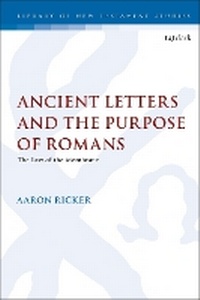
Ancient Letters and the Purpose of Romans
The Law of the Membrane
Published on 17. September 2020
Book
Hardback
200 pages
978-0-567-69398-3 (ISBN)
Description
Aaron Ricker locates the purpose of Romans in its function as a tool of community identity definition. Ricker employs a comparative analysis of the ways in which community identity definition is performed in first-century association culture, including several ancient network letters comparable to Romans.
Ricker's examination of the community advice found in Rom 12-15 reveals in this new context an ancient example of the ways in which an inscribed addressee community can be invited in a letter to see and comport itself as a "proper" association network community. The ideal community addressed in the letter to the Romans is defined as properly unified and orderly, as well accommodating to - and clearly distinct from - cultures "outside." Finally, it is defined as linked to a proper network with recognised leadership (i.e., the inscribed Paul of the letter and his network). Paul's letter to the Romans is in many ways a baffling and extraordinary document. In terms of its community-defining functions and strategies, however, Ricker shows its purpose to be perfectly clear and understandable.
Ricker's examination of the community advice found in Rom 12-15 reveals in this new context an ancient example of the ways in which an inscribed addressee community can be invited in a letter to see and comport itself as a "proper" association network community. The ideal community addressed in the letter to the Romans is defined as properly unified and orderly, as well accommodating to - and clearly distinct from - cultures "outside." Finally, it is defined as linked to a proper network with recognised leadership (i.e., the inscribed Paul of the letter and his network). Paul's letter to the Romans is in many ways a baffling and extraordinary document. In terms of its community-defining functions and strategies, however, Ricker shows its purpose to be perfectly clear and understandable.
Reviews / Votes
[W]ell-researched and well-argued ... [Ricker] successfully shows how the norms of ancient subcultural association network letters illuminate much of Rom 12-15. His thesis goes a long way toward clarifying why Romans appears generic in comparison to Paul's other letters despite being addressed to a specific community ... Ricker's study does much to illuminate the paraenetic material of Rom 12-15 and to explain a number of the particularities of this letter in comparison to the rest of the undisputed Paulines. Any scholar interested in Romans would do well to spend time with this book. * Society of Biblical Literature *More details
Series
Language
English
Place of publication
Edinburgh
United Kingdom
Publishing group
Bloomsbury Publishing PLC
Target group
College/higher education
Dimensions
Height: 234 mm
Width: 156 mm
Weight
454 gr
ISBN-13
978-0-567-69398-3 (9780567693983)
Copyright in bibliographic data and cover images is held by Nielsen Book Services Limited or by the publishers or by their respective licensors: all rights reserved.
Schweitzer Classification
Other editions
Additional editions
E-Book
09/2020
1st Edition
T.& T.Clark Ltd
€122.99
Available for download
E-Book
09/2020
1st Edition
T.& T.Clark Ltd
€122.99
Available for download
Person
Aaron Ricker is a lecturer in Religious Studies at McGill University in Montreal, Canada.
Content
Preface
Acknowledgements
Abbreviations
1. Introduction
2. Community Identity Definition in Association Network Letters
3. Community Identity Definition in Ancient Jewish Letters
4. Romans 12-15, Ancient Association-Epistolary Culture, and the Purpose of Romans
5. Conclusion
Index
Acknowledgements
Abbreviations
1. Introduction
2. Community Identity Definition in Association Network Letters
3. Community Identity Definition in Ancient Jewish Letters
4. Romans 12-15, Ancient Association-Epistolary Culture, and the Purpose of Romans
5. Conclusion
Index