

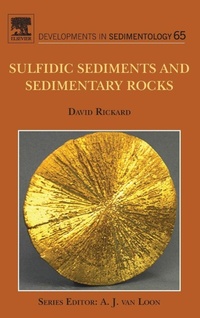
Sulfidic Sediments and Sedimentary Rocks: Volume 65
Published on 19. November 2012
Book
Hardback
816 pages
978-0-444-52989-3 (ISBN)
Description
This book deals with sedimentary sulfides which are the most abundant authigenic minerals in sediments. Special emphasis is given to the biogeochemistry that plays such a central role in the formation of sedimentary sulfides. It will be of interest to scientists in a number of disciplines, including geology, microbiology, chemistry and environmental science. The sulfur system is important to environmental scientists considering the present and future effects of pollution and anoxia. The development of the sulfur system - particularly the characteristics of ocean anoxia over the last 200 Ma - is useful in predicting the future fate of the Earth surface system as well as in understanding the past. The biochemistry and microbiology of the sulfur system are key to understanding microbial ecology and the evolution of life.
More details
Series
Language
English
Place of publication
Oxford
United Kingdom
Publishing group
Elsevier Science & Technology
Target group
Professional and scholarly
Geochemists, biogeochemists, microbiologists, especially microbial ecologists, geologists and environmental scientists in academia, government and industry
Product notice
Laminated cover
Dimensions
Height: 236 mm
Width: 159 mm
Thickness: 38 mm
Weight
1429 gr
ISBN-13
978-0-444-52989-3 (9780444529893)
Copyright in bibliographic data and cover images is held by Nielsen Book Services Limited or by the publishers or by their respective licensors: all rights reserved.
Schweitzer Classification
Other editions
Additional editions
David Rickard
Sulfidic Sediments and Sedimentary Rocks
E-Book
12/2012
Elsevier
€147.00
Available for download
Person
David Rickard has been one of the world's leading sulfide experts for over 40 years. He was a pioneer in geomicrobiology. He started his career as a senior undergraduate at Imperial College, London, with a thesis on pyrite framboids. He was awarded a GBP10,000 grant by the UK scientific research council in 1965 to set up a geomicrobiology laboratory in Imperial College and completed his PhD thesis in 1968 on the Chemistry and Microbiology of Iron Sulphide Formation. His work with the Swedish Natural Science Research Council was particularly focussed on geochemical kinetics and constituted some of the earliest contributions to this subject. At the same time he worked on Economic Geology and founded the largest ore geology research group of the time in Stockholm. He was appointed to a Chair in Cardiff University in 1983 and has continued to contribute to sulfide geochemistry and ore geology.He has over 300 publications including over 150 research journal papers and two edited books. He published his first paper in Nature in 1968. He was Chief Editor of Chemical Geology and Mineralium Deposita. His latest interests have involved characterizing nanoparticulate metal sulfides and their interactions with biochemical molecules, including nucleic acid polymers. He has received a number of awards including Fellowships of the Geochemical Society and the European Association of Geochemistry and Honorary Membership of the Society of Geology Applied to Mineral Deposits. He is a Fellow of the Learned Society of Wales. His multidisciplinary contributions have been recognized by his election to Fellowship of the Royal Society of Chemistry, the Society of Biology and the Geological Society.
Content
1. Introduction to sedimentary sulfide biogeochemistry2. Sulfur chemistry in aqueous solutions3. Sedimentary iron biogeochemistry4. Aqueous metal sulfide chemistry: complexes and clusters5. Metastable sulfides6. Pyrite formation 7. Adsorption on iron sulfides8. Microbial sulfide generation in sediments9. Microbial sulfide oxidation in sediments10. Microbial ecology 11. Sulfur stable isotope geochemistry12. Iron isotope fractionation in sedimentary sulfides13. Euxinic systems14. Sulfur in sediments15. Black shales16. Evolution of the sulfur biome17. The global biogeochemical sulfur cycle18. Epilogue