

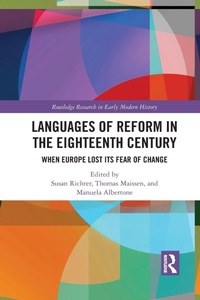
Languages of Reform in the Eighteenth Century
When Europe Lost Its Fear of Change
1st Edition
Published on 30. June 2021
Book
Paperback/Softback
452 pages
978-1-032-08759-7 (ISBN)
Description
Societies perceive "Reform" or "Reforms" as substantial changes and significant breaks which must be well-justified. The Enlightenment brought forth the idea that the future was uncertain and could be shaped by human beings. This gave the concept of reform a new character and new fields of application. Those who sought support for their plans and actions needed to reflect, develop new arguments, and offer new reasons to address an anonymous public. This book aims to compile these changes under the heuristic term of "languages of reform." It analyzes the structures of communication regarding reforms in the 18th century through a wide variety of topics.
More details
Series
Language
English
Place of publication
London
United Kingdom
Publishing group
Taylor & Francis Ltd
Target group
College/higher education
Postgraduate and Undergraduate
Illustrations
4 s/w Abbildungen
4 Illustrations, black and white
Dimensions
Height: 229 mm
Width: 152 mm
Thickness: 24 mm
Weight
650 gr
ISBN-13
978-1-032-08759-7 (9781032087597)
Copyright in bibliographic data and cover images is held by Nielsen Book Services Limited or by the publishers or by their respective licensors: all rights reserved.
Schweitzer Classification
Other editions
Additional editions

Susan Richter | Thomas Maissen | Manuela Albertone
Languages of Reform in the Eighteenth Century
When Europe Lost Its Fear of Change
Book
10/2019
1st Edition
Routledge
€207.80
Shipment within 15-20 days
Susan Richter | Thomas Maissen | Manuela Albertone
Languages of Reform in the Eighteenth Century
When Europe Lost Its Fear of Change
E-Book
10/2019
1st Edition
Routledge
€60.49
Available for download
Susan Richter | Thomas Maissen | Manuela Albertone
Languages of Reform in the Eighteenth Century
When Europe Lost Its Fear of Change
E-Book
10/2019
1st Edition
Routledge
€60.49
Available for download
Persons
Susan Richter is Full Professor of Early Modern History at Christian-Albrechts-University Kiel.
Thomas Maissen is Professor of Early Modern History at Heidelberg University.
Manuela Albertone is Professor of Early Modern History at the University of Turin.
Thomas Maissen is Professor of Early Modern History at Heidelberg University.
Manuela Albertone is Professor of Early Modern History at the University of Turin.
Content
Introduction: Languages of Reform and the European Enlightenment Section I: Semantics of Languages of Reform 1. The Concept of Reform in Polyglot European Enlightenment 2. The Dawning of the Age of Reform: Epistemic and Semantic Shifts in Georgian Britain 3. The Making of "Federalism" in Eighteenth-Century France: Between Reform and Revolution 4. Ambiguity in Translation: Communicating Economic Reform in the Multilingual Republic of Berne Section II: Strategies and Rhetoric of Reform 5. Change and Improvement to Save the State: Administrative Reforms in Maria Theresian Austria 6. Reform as Verbesserung: Argumentative Patterns and the Role of Models in German Cameralism 7. Luxury as an Eighteenth-Century Language of Reform of Society Between France and Italy: Jean-Francois Melon, Antonio Genovesi and Georges-Marie Butel-Dumont 8. A Useful Public Institution?: Languages of University Reform in the German Territories, 1750-1800 Section III: Thematic Vocabularies in Specific Contexts 9. A Kind of Sovereignty?: Legitimising Freedom of Contract in the 18th Century 10. From Economic Reform to Political Revolution: The Language of Dutch Patriotism 11. Mending the Boat While Sailing: Languages of Linguistic Reform in the German Territories, c. 1750-1815 12. From a Reform-Language of Speculation to a Speculative Language of Reform: Liberalising Trade in Mid-18th-Century France 13. From the Civic Improvement of the Jews to the Separation of State and Church: Languages of Political Reform in Brandenburg-Prussia, 1781-1799 Section IV: Adaption and Translation of Reform Languages 14. The Difficult Reform of Military Discipline in the Latter Half of Eighteenth-Century France 15. Writing on "The New Order": Ottoman Approaches to Late Eighteenth-Century Reforms Section V: Reflecting on Reform 16. Reform, Revolution, and the Republican Tradition: The Case of the Batavian Republic 17. Words and Things: The Language of Reform in Wilhelm Traugott Krug and Karl Ludwig von Haller. Conclusion: Bringing a Despotic Agenda into the Public Sphere - Concluding Remarks on Languages of Reform