

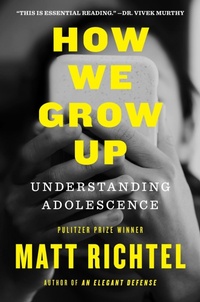
How We Grow Up
Understanding Adolescence
Published on 28. August 2025
Book
Hardback
336 pages
978-0-06-328206-3 (ISBN)
Description
"This is essential reading for parents." - Dr. Vivek Murthy, former U.S. Surgeon General
Greatly expanding his award-winning New York Times series on the contemporary teen mental-health crisis, Pulitzer Prize-winning science reporter Matt Richtel delivers a groundbreaking investigation into the psychology of adolescence, the pivotal life stage undergoing profound-and often confounding-transformation.
One of The New Yorker's Best Books of 2025
The transition from childhood to adulthood is a natural, evolution-honed cycle that now faces radical change and challenge. The adolescent brain, sculpted for this transition over eons of evolution, confronts a modern world that creates so much social pressure as to regularly exceed the capacities of the evolving mind. The problem comes as a bombardment of screen-based information pelts the brain just as adolescence is undergoing a second key change: puberty is hitting earlier. The result is a neurological mismatch between an ultra-potent environment and a still-maturing brain that can lead to anxiety and depression in teens and other mental health challenges. It is a crisis that is part of modern life but can only be truly grasped through the broad, grounded lens of the science of adolescence itself. Through this lens, Richtel shows us how adolescents can understand themselves, and parents and educators can better help.
For decades, this transition to adulthood has been defined by hormonal shifts that trigger the onset of puberty. But Richtel takes us where science now understands so much of the action is: the fascinating topic of adolescent brain development. A growing body of research that looks for the first time into budding adult neurobiology explains with untold clarity the emergence of the "social brain," a craving for peer connection, and how the behaviors that follow pave the way for economic and social survival. This period necessarily involves testing-as the adolescent brain is programmed from birth to take risks and explore themselves and their environment-so that they may be able to thrive as they leave the insulated care of childhood.
Richtel, diving deeply into new research and gripping personal stories, offers accessible, scientifically grounded answers to the most pressing questions about generational change. What explains adolescent behaviors, risk-taking, reward-seeking, and the ongoing mental health crisis? How does adolescence shape the future of the species? What is the nature of adolescence itself?
The Teen Mental Health Crisis: Explore the neurological mismatch between a still-maturing brain and a high-pressure modern world that is contributing to soaring rates of anxiety and depression.
Neurobiology of Puberty: Go beyond hormones to understand the science of the developing "social brain," the craving for peer connection, and the evolutionary drive for risk-taking.
A Guide for Parenting Teenagers: Gain a scientifically grounded lens to understand the adolescent in your life, offering accessible answers and effective ways to help them navigate this pivotal stage.
Compelling Narrative Nonfiction: Journey through the latest research, brought to life by the gripping personal stories of adolescents grappling with the challenges of growing up today.
Greatly expanding his award-winning New York Times series on the contemporary teen mental-health crisis, Pulitzer Prize-winning science reporter Matt Richtel delivers a groundbreaking investigation into the psychology of adolescence, the pivotal life stage undergoing profound-and often confounding-transformation.
One of The New Yorker's Best Books of 2025
The transition from childhood to adulthood is a natural, evolution-honed cycle that now faces radical change and challenge. The adolescent brain, sculpted for this transition over eons of evolution, confronts a modern world that creates so much social pressure as to regularly exceed the capacities of the evolving mind. The problem comes as a bombardment of screen-based information pelts the brain just as adolescence is undergoing a second key change: puberty is hitting earlier. The result is a neurological mismatch between an ultra-potent environment and a still-maturing brain that can lead to anxiety and depression in teens and other mental health challenges. It is a crisis that is part of modern life but can only be truly grasped through the broad, grounded lens of the science of adolescence itself. Through this lens, Richtel shows us how adolescents can understand themselves, and parents and educators can better help.
For decades, this transition to adulthood has been defined by hormonal shifts that trigger the onset of puberty. But Richtel takes us where science now understands so much of the action is: the fascinating topic of adolescent brain development. A growing body of research that looks for the first time into budding adult neurobiology explains with untold clarity the emergence of the "social brain," a craving for peer connection, and how the behaviors that follow pave the way for economic and social survival. This period necessarily involves testing-as the adolescent brain is programmed from birth to take risks and explore themselves and their environment-so that they may be able to thrive as they leave the insulated care of childhood.
Richtel, diving deeply into new research and gripping personal stories, offers accessible, scientifically grounded answers to the most pressing questions about generational change. What explains adolescent behaviors, risk-taking, reward-seeking, and the ongoing mental health crisis? How does adolescence shape the future of the species? What is the nature of adolescence itself?
The Teen Mental Health Crisis: Explore the neurological mismatch between a still-maturing brain and a high-pressure modern world that is contributing to soaring rates of anxiety and depression.
Neurobiology of Puberty: Go beyond hormones to understand the science of the developing "social brain," the craving for peer connection, and the evolutionary drive for risk-taking.
A Guide for Parenting Teenagers: Gain a scientifically grounded lens to understand the adolescent in your life, offering accessible answers and effective ways to help them navigate this pivotal stage.
Compelling Narrative Nonfiction: Journey through the latest research, brought to life by the gripping personal stories of adolescents grappling with the challenges of growing up today.
Reviews / Votes
"Insightfully explored ... [an] intriguing exploration of a pressing topic." - Publishers Weekly"Richtel approaches his experience as well as that of parents with sensitivity. Rather than casting kids as zombies or aliens, How We Grow Up insists on the continuity between young people and the adults around them, while acknowledging that the relationships involved aren't always easy. The book's warmth and sympathy distinguish it on the crowded shelf it occupies." - Molly Fischer, The New Yorker
"Matt Richtel takes us on a powerful journey to understand the forces shaping the lives of adolescents. As we navigate a profound youth mental health crisis, this book could not be more important or timely. This is essential reading for parents, policymakers, educators and anyone who cares about helping our kids live their best lives." - Dr. Vivek Hallegere Murthy, 19th and 21st Surgeon General of the United States
"This book should be at the bedside of every parent who believes they are alone but really aren't. A vivid set of inquiries into the science, social history, and personal experience of adolescence." - Kirkus Reviews
"A timely and essential consideration of the science of adolescence...The compassion of Richtel's book equals the rigor of his research....Should be on all library shelves alongside Jonathan Haidt's bestselling The Anxious Generation." - Library Journal (starred review)
"A new understanding of what it takes to raise resilient, emotionally grounded kids." - Maria Shriver's Sunday Paper
"In today's rapidly changing world, we've created fearful children instead of resilient ones. With this powerful new book, Matt Richtel addresses the mounting challenges that adolescents face, offering a path to transform anxiety into resourcefulness and opportunity. His insights give parents and educators practical tools to help young people navigate their complex reality and build the strength they will need for tomorrow. If you care about young people, this is one of the best books you'll ever read." - James P. Steyer, Founder and CEO, Common Sense Media
More details
Language
English
Place of publication
New York
United States
Publishing group
HarperCollins Publishers Inc
Product notice
sewn/stitched
Cloth over boards
Dimensions
Height: 233 mm
Width: 155 mm
Thickness: 29 mm
Weight
460 gr
ISBN-13
978-0-06-328206-3 (9780063282063)
Copyright in bibliographic data and cover images is held by Nielsen Book Services Limited or by the publishers or by their respective licensors: all rights reserved.
Schweitzer Classification
Other editions
Additional editions
E-Book
07/2025
HarperCollins
€20.42
Available for download
Person
MATT RICHTEL is a health and science reporter at the New York Times. He spent nearly two years reporting on the teenage mental-health crisis for the paper's acclaimed multipart series Inner Pandemic, which won first place in public-health reporting from the Awards for Excellence in Health Care Journalism and inspired his book How We Grow Up: Understanding Adolescence. He received the Pulitzer Prize for national reporting for a series of articles about distracted driving, which he expanded into his first nonfiction book, A Deadly Wandering, a New York Times bestseller. His second nonfiction book, An Elegant Defense, on the human immune system, was a national bestseller and chosen by Bill Gates for his annual Summer Reading List.