

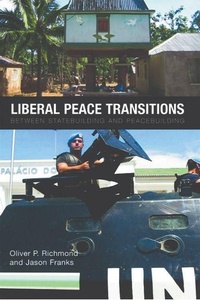
Liberal Peace Transitions
Between Statebuilding and Peacebuilding
Published on 6. April 2011
Book
Paperback/Softback
240 pages
978-0-7486-4297-7 (ISBN)
Description
This book, newly available in paperback, examines the nature of 'liberal peace': the common aim of the international community's approach to post-conflict statebuilding. Adopting a particularly critical stance on this one-size-fits-all paradigm, it explores the process by breaking down liberal peace theory into its constituent parts: democratisation, free market reform and development, human rights, civil society, and the rule of law.Readers are provided with critically and theoretically informed empirical access to the 'technology' of the liberal peacebuilding process, particularly in regard to Cambodia, Kosovo, East Timor, Bosnia and the Middle East.Key Features*critically interrogates the theory, experience, and current outcomes of liberal peacebuilding*includes five empirically-informed case studies: Cambodia, Kosovo, East Timor, Bosnia and the Middle East*focuses on the key institutional aspects of liberal peacebuilding and key international actors*assesses the local outcomes of liberal peacebuilding
Reviews / Votes
This book provides a set of illuminating insights (both empirical and theoretical) from the study of a series of post-Cold War 'liberal peace' interventions. -- David Chandler, University of Westminster * International Affairs * This critique of liberal peacebuilding strategies, based on fieldwork in five war-torn societies, reveals variations of approach that are nevertheless commonly based on statebuilding rather than affording justice and livelihoods to populations. Richmond and Franks have identified the dysfunctionalism of these virtual states and the local resistances that give rise to hybrid and diffuse forms of social contract. It is an interrogation of the enlightenment project that leads to revisionist thinking about peacebuilding and causes us to wonder just how emancipatory liberalism really is. -- Michael Pugh, Department of Peace Studies, University of BradfordMore details
Language
English
Place of publication
Edinburgh
United Kingdom
Target group
Professional and scholarly
Product notice
Paperback (trade)
Unsewn / adhesive bound
Dimensions
Height: 231 mm
Width: 155 mm
Thickness: 15 mm
Weight
386 gr
ISBN-13
978-0-7486-4297-7 (9780748642977)
Copyright in bibliographic data and cover images is held by Nielsen Book Services Limited or by the publishers or by their respective licensors: all rights reserved.
Schweitzer Classification
Other editions
Additional editions
E-Book
04/2011
Edinburgh University Press
€28.49
Available for download
Previous edition
Book
09/2009
Edinburgh University Press
€163.42
Shipment within 15-20 days
Persons
Oliver P. Richmond is Research Professor of IR, Peace and Conflict Studies at the Humanitarian and Conflict Response Institute & Department of Politics, University of Manchester. His recent publications include Peace in IR (Routledge, 2008), Challenges to Peacebuilding: Managing Spoilers During Conflict Resolution (co-edited with Edward Newman) (UNU Press, 2006), and The Transformation of Peace (Palgrave, 2005). Jason Franks has been a Research Fellow in the Centre for Peace and Conflict Studies at the University of St Andrews. He is author of Rethinking the Roots of Terrorism (Palgrave, 2006).s
Content
Introduction: A Framework to Assess Liberal Peace Transitions; 1. Cambodia: Liberal Hubris and Virtual Peace; 2. Bosnia: Between Partition and Pluralism; 3. Liberal Peace in East Timor: The Emperors' New Clothes?; 4. Co-opting the Liberal Peace: Untying the Gordian Knot in Kosovo; 5. Building/ Rejecting the Liberal Peace: State Consolidation and Liberal Failure in the Middle East; Conclusion: Evaluating the Achievements of the Liberal Peace and Revitalising a Virtual Peace; Bibliography.