

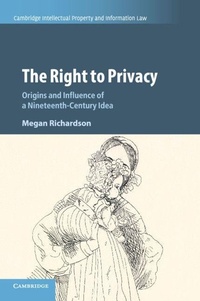
The Right to Privacy
Origins and Influence of a Nineteenth-Century Idea
Published on 23. January 2020
Book
Paperback/Softback
186 pages
978-1-108-41168-4 (ISBN)
Description
Using original and archival material, The Right to Privacy traces the origins and influence of the right to privacy as a social, cultural and legal idea. Richardson argues that this right had emerged as an important legal concept across a number of jurisdictions by the end of the nineteenth century, providing a basis for its recognition as a universal human right in later centuries. This book is a unique contribution to the history of the modern right to privacy. It covers the transition from Georgian to Victorian England, developments in Second Empire France, insights in the lead up to the Buergerliches Gesetzbuch (BGB) of 1896, and the experience of a rapidly modernising America around the turn of the twentieth century. It will appeal to an audience of academic and postgraduate researchers, as well as to the judiciary and legal practice.
More details
Series
Language
English
Place of publication
Cambridge
United Kingdom
Target group
Professional and scholarly
Product notice
Paperback (trade)
Illustrations
Worked examples or Exercises; 10 Halftones, black and white
Dimensions
Height: 229 mm
Width: 152 mm
Thickness: 10 mm
Weight
279 gr
ISBN-13
978-1-108-41168-4 (9781108411684)
Copyright in bibliographic data and cover images is held by Nielsen Book Services Limited or by the publishers or by their respective licensors: all rights reserved.
Schweitzer Classification
Other editions
Additional editions
Book
09/2017
Cambridge University Press
€139.90
Article not available at the moment
E-Book
09/2017
Cambridge University Press
€105.99
Available for download
Person
Megan Richardson is a Professor of Law at the Melbourne Law School, University of Melbourne. Her fields of research and publication include privacy and personality rights, law reform and legal theory. She is Joint Director of the Melbourne Law School's Centre for Media and Communications Law (CMCL) and Director of the Intellectual Property Research Institute of Australia (IPRIA).
Content
Preface; Acknowledgments; Introduction; 1. Authorship, secrecy, privacy; 2. Creative self-fashioning; 3. Intimate images; 4. Resisting spectacle; 5. Make it new!; Appendix: documentation; Index.