

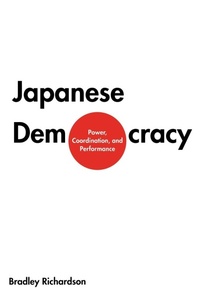
Japanese Democracy
Power, Coordination, and Performance
Will be published approx. on 2. November 1998
Book
Paperback/Softback
336 pages
978-0-300-07664-6 (ISBN)
Description
In this new analysis of democracy in Japan, Bradley Richardson refutes the widely accepted hypothesis that postwar Japan has been a semiauthoritarian and consensual state, heavily influenced by corporations and led by the government bureaucracy. On the contrary, Richardson's extensive newspaper and documentary research shows that Japanese political life has been extremely fragmented and discordant at all levels--in the bureaucracy, legislatures, parties, and interest groups, and in business and industry. Even the seemingly invulnerable Liberal Democratic Party (LDP), which ruled Japan for thirty-eight years, experienced rampant internal conflict. Now, the author contends, despite changes in political alignments since the collapse of the LDP in 1993, politics continues much as before.
In Japanese Democracy, Richardson explores power relationships and demonstrates how Japan's political system is unlike Great Britain's and similar to those of the United States and Italy, where politics is decentralized and decisions are made at many levels. He draws some important conclusions: that Japan's postwar industrial policy has not always been successful, that the country is as much an economic welfare state as it is an economic "miracle," and that the lack of strong leadership has kept Japan from playing a more assertive role in the international arena. As in the United States, private interests hold central policymaking processes hostage, and weak leadership prevails.
In Japanese Democracy, Richardson explores power relationships and demonstrates how Japan's political system is unlike Great Britain's and similar to those of the United States and Italy, where politics is decentralized and decisions are made at many levels. He draws some important conclusions: that Japan's postwar industrial policy has not always been successful, that the country is as much an economic welfare state as it is an economic "miracle," and that the lack of strong leadership has kept Japan from playing a more assertive role in the international arena. As in the United States, private interests hold central policymaking processes hostage, and weak leadership prevails.
More details
Language
English
Place of publication
United States
Target group
College/higher education
Professional and scholarly
Product notice
Paperback (trade)
Dimensions
Height: 235 mm
Width: 157 mm
Thickness: 19 mm
Weight
463 gr
ISBN-13
978-0-300-07664-6 (9780300076646)
Copyright in bibliographic data and cover images is held by Nielsen Book Services Limited or by the publishers or by their respective licensors: all rights reserved.
Schweitzer Classification
Person
Bradley Richardson is professor of political science at Ohio State University and coauthor of The Japanese Voter, published by Yale University Press.