

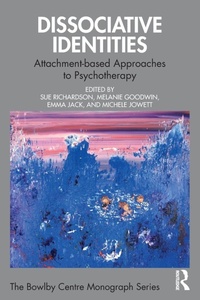
Dissociative Identities
Attachment-based Approaches to Psychotherapy
1st Edition
Published on 31. March 2025
Book
Paperback/Softback
174 pages
978-1-032-69665-2 (ISBN)
Description
Dissociative Identities draws on expertise from practitioners and survivors to explore therapeutic approaches to dissociation resulting from complex trauma. The contributors provide a vivid insight into what it is like for therapist and survivor to be alongside one another in the therapy room. They highlight the challenges of work with the fragmented internal worlds of those who have survived attachment trauma and explore together what approaches can promote healing and repair.
Dissociative identity is reframed from being a disorder to an essential survival skill, and the book includes an open recognition from the perspective of both therapist and survivor of relational challenges, pitfalls, and their impact on the healing process.
Dissociative Identities will be invaluable for all professionals working with survivors of complex trauma, including psychotherapists, nurses, social workers, clinical psychologists, and counsellors. It will also be of interest to survivors and their networks.
Dissociative identity is reframed from being a disorder to an essential survival skill, and the book includes an open recognition from the perspective of both therapist and survivor of relational challenges, pitfalls, and their impact on the healing process.
Dissociative Identities will be invaluable for all professionals working with survivors of complex trauma, including psychotherapists, nurses, social workers, clinical psychologists, and counsellors. It will also be of interest to survivors and their networks.
Reviews / Votes
"What a wonderful book! I thoroughly enjoyed every chapter. This book embraces an attachment-focussed conceptualisation of dissociative identities, and uniquely combines both professional and lived experience perspectives. The diverse chapters richly explore theoretical conceptualisation, personal and professional experiences of therapy, and allow space for detailed explanation of clinical process. This includes cases rarely discussed in clinical and teaching literature, such as clients with organised abuse and ongoing abuse. The final two chapters, which contain reflections from those with lived experience, complete the book beautifully."Kate McMaugh, Psychologist, Sydney, Australia
"Dissociative Identities: Attachment-based Approaches to Psychotherapy is worth reading, for clinicians, family members, those with dissociated selves, and anyone interested in the effects of trauma. The chapters by individuals with dissociative identity disorder are particularly compelling, well written, and illuminating. Overall, the book provides the best available explanation of the attachment-based treatment of dissociated identities. The chapters are readable, nuanced and detailed. I highly recommend the book."
Dr Colin Ross MD, President of The Ross Institute for Psychological Trauma; Past and President of The International Society for the Study of Trauma and Dissociation
"Since Janet's pioneering descriptions, dissociative identity difficulties remain one of mental health's many orphans. In this rich and multifaceted collection, attachment-oriented therapists and those with dissociative identity collaborate to paint a vivid account of the family origins, current experiences, and therapeutic possibilities offered by an attachment approach to psychotherapy with this condition. Compassion, hope, and understanding shine throughout the text. A must-read for therapists at all levels.!
Professor Jeremy Holmes, MD FRCPsych, University of Exeter, UK
"Attachment traumas and post-traumatic dissociation are widespread, impacting a significant portion of the population. Dissociative Identities: Attachment-based Approaches to Therapy is a must-read for any mental health professional looking to deepen their understanding and treatment of trauma survivors through attachment-informed techniques. The editors have curated a rich tapestry of practical knowledge, clinical insights, and therapeutic approaches applicable to any trauma-informed practice. Offering a unique perspective, this book explores the lived experience of dissociation through the combined wisdom of expert practitioners and empowered survivors of relational trauma. I highly recommend this book to all mental health practitioners regardless of theoretical orientation!"
Marlene Steinberg, M.D., author, The SCID-D Interview: Dissociation Assessment in Therapy, Forensics and Research; The Stranger in the Mirror; Dissociation: The Hidden Epidemic; and The Handbook for the Assessment of Dissociation: A Clinical Guide
More details
Series
Language
English
Place of publication
London
United Kingdom
Publishing group
Taylor & Francis Ltd
Target group
College/higher education
Professional and scholarly
Postgraduate, Professional Practice & Development, Professional Reference, and Professional Training
Illustrations
1 s/w Tabelle, 4 s/w Abbildungen, 4 s/w Zeichnungen
1 Tables, black and white; 4 Line drawings, black and white; 4 Illustrations, black and white
Dimensions
Height: 234 mm
Width: 156 mm
Thickness: 11 mm
Weight
310 gr
ISBN-13
978-1-032-69665-2 (9781032696652)
Copyright in bibliographic data and cover images is held by Nielsen Book Services Limited or by the publishers or by their respective licensors: all rights reserved.
Schweitzer Classification
Other editions
Additional editions
Sue Richardson | Melanie Goodwin | Emma Jack
Dissociative Identities
Attachment-based Approaches to Psychotherapy
E-Book
03/2025
1st Edition
Routledge
€37.99
Available for download
Sue Richardson | Melanie Goodwin | Emma Jack
Dissociative Identities
Attachment-based Approaches to Psychotherapy
E-Book
03/2025
1st Edition
Routledge
€37.99
Available for download
Sue Richardson | Melanie Goodwin | Emma Jack
Dissociative Identities
Attachment-based Approaches to Psychotherapy
Book
03/2025
1st Edition
Routledge
€206.10
Shipment within 10-20 days
Persons
Sue Richardson is a member of The Bowlby Centre and a UKCP-registered attachment-based psychotherapist and supervisor.
Melanie Goodwin is an expert by experience and co-founder of First Person Plural, an organisation which raised awareness and provided training and support for people with dissociative conditions and their allies from 1997 until its closure in 2023.
Emma Jack is a Minster Centre-trained relational psychotherapist. She is Clinical Director for The Clinic for Dissociative Studies.
Michele Jowett is an expert by experience as a person living with a formal diagnosis of dissociative identity disorder. Committed to sharing her experiences of dissociation and informing professionals through writing for the ESTD, ISSTD, and FPP newsletters, she was instrumental in producing The Survivors Trust resources website.
Melanie Goodwin is an expert by experience and co-founder of First Person Plural, an organisation which raised awareness and provided training and support for people with dissociative conditions and their allies from 1997 until its closure in 2023.
Emma Jack is a Minster Centre-trained relational psychotherapist. She is Clinical Director for The Clinic for Dissociative Studies.
Michele Jowett is an expert by experience as a person living with a formal diagnosis of dissociative identity disorder. Committed to sharing her experiences of dissociation and informing professionals through writing for the ESTD, ISSTD, and FPP newsletters, she was instrumental in producing The Survivors Trust resources website.
Content
1. Using an Attachment-Based Model to Understand and Work with People with Dissociative Identity 2. Exploration of the Relational Dialogue Between Client and Therapist 3. What Are We Doing? Stabilisation Work with a Mind Control System of Altered Identities 4. On Being With: Working Creatively with Clients with Dissociative Identity 5. When the Alleged Abuser Is Famous: Some of the Problems in Dealing with Alleged VIP Abuse 6. The Parts, the Whole and the Real Person: An Attachment Perspective 7. The Perspective of an Expert by Experience: Learning to Thrive - So Many Cogs in the Wheel 8. The Perspective of an Expert by Experience: Clinical Theory and Practice