

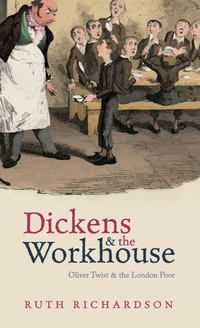
Dickens and the Workhouse
Oliver Twist and the London Poor
1st Edition
Published on 2. February 2012
Book
Hardback
392 pages
978-0-19-964588-6 (ISBN)
Description
The recent discovery that as a young man Charles Dickens lived only a few doors from a major London workhouse made headlines worldwide, and the campaign to save the workhouse from demolition caught the public imagination.
Internationally, the media immediately grasped the idea that Oliver Twist's workhouse had been found, and made public the news that both the workhouse and Dickens's old home were still standing, near London's Telecom Tower. This book, by the historian who did the sleuthing behind these exciting new findings, presents the story for the first time, and shows that the two periods Dickens lived in that part of London - before and after his father's imprisonment in a debtors' prison - were profoundly important to his subsequent writing career.
Internationally, the media immediately grasped the idea that Oliver Twist's workhouse had been found, and made public the news that both the workhouse and Dickens's old home were still standing, near London's Telecom Tower. This book, by the historian who did the sleuthing behind these exciting new findings, presents the story for the first time, and shows that the two periods Dickens lived in that part of London - before and after his father's imprisonment in a debtors' prison - were profoundly important to his subsequent writing career.
Reviews / Votes
Richardson has set out where others will follow ... by sprinkling a fairy dust of creativity and imagination over mundane primary sources like maps, books, directories and newspapers, she has breathed new life into Dickens's early years This is a delight of a book, fresh and stimulating. * Michael Allen, Dickens Quarterly * Historian Dr Ruth Richardson's meticulously researched book paints a lively portrait of every day life in 19th century London. * Alice Coke, Absolutely Chelsea * Richardson's enthusiasm for her subject shines throughout this hugely engaging and informative book * BBC History Magazine * The important discoveries in this surprising book come from an intimate knowledge of Dickens and London, coupled with a historian's passion. We're seized by the hand of a detective and walked into Dickens's world. Unputdownable. * Miriam Margolyes * The book offers a detailed study of the Dickens's family home and its surrounding neighbourhood, as well as an evocative and damning portrait of Britain's de-facto 'prison system to punish poverty'. * New Yorker * Gives an intimately evoked view of Dickens's childhood and the New Poor Law of 1834 by which workhouses became 'a sort of prison system to punish [the poor]. * New York Review of Books *More details
Language
English
Place of publication
Oxford
United Kingdom
Target group
All those interested in the writings of Charles Dickens, nineteenth century English literature, and the history of Victorian London.
Illustrations
25 black and white halftones
Dimensions
Height: 222 mm
Width: 145 mm
Thickness: 25 mm
Weight
623 gr
ISBN-13
978-0-19-964588-6 (9780199645886)
Copyright in bibliographic data and cover images is held by Nielsen Book Services Limited or by the publishers or by their respective licensors: all rights reserved.
Schweitzer Classification
Other editions
Additional editions
Book
11/2013
Oxford University Press
€18.56
Shipment within 15-20 days
Person
Ruth Richardson is a historian and the author of a number of books. The Wall Street Journal described her last book, The Making of Mr. Gray's Anatomy (Oxford University Press) as 'one of those rarities, history that reads like a novel'. That book won the 2009 Medical Journalists' Open Book Award.
Content
Introduction ; 1. Discovery: threat, silences, discovery, Dickens' first London home ; 2. Vicinity: environs of gentility, Norfolk-street, medical charity, environs of poverty ; 3. Home: house, landlord, inside, views: upstairs/downstairs ; 4. Street: looking down, and around ; 5. Calamity: gap years, catastrophe, blacking factory, Marshalsea, Somers Town, schooling ; 6. Young Dickens: Return to Norfolk Street: clerk, young professional, Parliament, first essays ; 7. Workhouse: government/management ; 8. Works: family moves, Sketches by Boz, Oliver Twist, Marylebone borders, human heaps ; 9. Poor Law: visitor, doctor, master, commission, change ; 10. The Most Famous Workhouse in the World ; Notes ; Index