

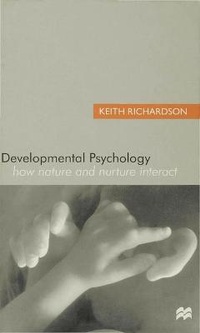
Developmental Psychology
How Nature and Nurture Interact
Published on 20. December 1999
Book
Paperback/Softback
272 pages
978-0-333-74043-9 (ISBN)
Description
The last twenty years of research on human development have seen a revolution in our view of the human infant. A newborn baby looks at his mother and imitates her actions, without learning. How does he know how to poke his tongue out? Why does he know? Mostof us still assume representations in the mind to be the condition of intelligent action, even though simple robots with no central representations at all can navigate around cluttered environments and draw maps of them. Nearly everyone wants to retain the term 'innate' even though we are finding that supposedly 'innate' behaviours are not determined and depend upon experience. We want to treat genetic selection as basic evolution, so how did genes evolve? How can all this be? Psychology is caught in a conflict of paradigms. We all claim to be interactionists, yet we continue to accept the language and the thinking of traditional dichotomies: nature/nurture, innate/learned, mind/body, organism/environment. This clear and refreshingly-written authoritative text explores these confusions and provides a trenchant critique of dichotomous thinking.
It moves on to offer an alternative view of development, first describing in an accessible way ecological and dynamic systems perspectives and then combining them to provide a more coherent and powerful critique of recent research and major issues.
It moves on to offer an alternative view of development, first describing in an accessible way ecological and dynamic systems perspectives and then combining them to provide a more coherent and powerful critique of recent research and major issues.
Reviews / Votes
'Keith Richardson has an obvious gift for conveying difficult ideas in a reader-friendly fashion... This is a very important and timely contribution to theory-building in developmental psychology at both undergraduate and graduate level.' - Brian Hopkins, Professor of Psychology, Lancaster University 'Authoritative in his approach, the author has a strong grasp of a wide range of theories and research, and I found his treatment of them to be clear, coherent and consistent. It is a text which...will be accessible to second and third year students, and immensely helpful to them for its presentation of a perspective which is not always easily grasped at this level, but which, in one way or another, informs much recent work in developmental psychology.' - Gerard Duveen, University of CambridgeMore details
Language
English
Place of publication
Basingstoke
United Kingdom
Target group
College/higher education
Product notice
Paperback (UK-trade)
Illustrations
glossary, references, index
Dimensions
Height: 216 mm
Width: 140 mm
Thickness: 15 mm
Weight
345 gr
ISBN-13
978-0-333-74043-9 (9780333740439)
Copyright in bibliographic data and cover images is held by Nielsen Book Services Limited or by the publishers or by their respective licensors: all rights reserved.
Schweitzer Classification
Other editions
Additional editions
Book
12/1999
Palgrave Macmillan
€39.58
Article not available at the moment
Person
DR KEITH RICHARDSON is Associate Lecturer on the Open University course in Child Development and Senior Lecturer in Education at Whitefield Schools and Centre, London, incorporating liaison with Kingston University on four postgraduate diplomas.
Content
Introduction: The Traditional View and its Alternative, A Summary Darwinian Dichotomies and Their Dissolution Towards the Alternative: Ecological, Dynamic Systems Dynamic Systems Theories The Ecological Perspective: Gibson's Legacy The Creation of Knowledge A Sample of the Evidence: Wise Owls, Accurate Ants Origins of Knowledge Glossary References Index