

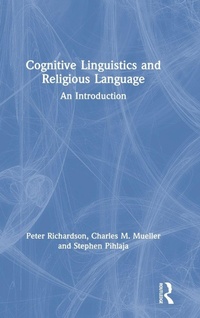
Cognitive Linguistics and Religious Language
An Introduction
1st Edition
Published on 29. March 2021
Book
Hardback
164 pages
978-0-367-48462-0 (ISBN)
Description
This book comprehensively introduces Cognitive Linguistics and applies its tools to religious language. Drawing on authentic samples from a range of faiths, text types, and modes of interactive discourse, the authors accessibly define concepts like embodied cognition, agency, metaphor analysis, and Dynamic Systems Theory; illustrate how they can be used in analyzing religious language; and offer thorough pedagogical material to aid learning and application. Advanced students and scholars of linguistics, discourse analysis, cognitive science, and religious and biblical studies will benefit from this practical guide to understanding and conducting research on religious discourse.
More details
Language
English
Place of publication
London
United Kingdom
Publishing group
Taylor & Francis Ltd
Target group
College/higher education
Illustrations
21 s/w Abbildungen, 21 s/w Zeichnungen
21 Line drawings, black and white; 21 Illustrations, black and white
Dimensions
Height: 235 mm
Width: 157 mm
Thickness: 14 mm
Weight
412 gr
ISBN-13
978-0-367-48462-0 (9780367484620)
Copyright in bibliographic data and cover images is held by Nielsen Book Services Limited or by the publishers or by their respective licensors: all rights reserved.
Schweitzer Classification
Other editions
Additional editions
Peter Richardson | Charles M. Mueller | Stephen Pihlaja
Cognitive Linguistics and Religious Language
An Introduction
Book
03/2021
1st Edition
Routledge
€60.80
Shipment within 15-20 days
Peter Richardson | Charles M. Mueller | Stephen Pihlaja
Cognitive Linguistics and Religious Language
An Introduction
E-Book
03/2021
1st Edition
Routledge
€53.99
Available for download
Peter Richardson | Charles M. Mueller | Stephen Pihlaja
Cognitive Linguistics and Religious Language
An Introduction
E-Book
03/2021
1st Edition
Routledge
€53.99
Available for download
Persons
Peter Richardson is Professor of Linguistics at Hokkaido Bunkyo University, Japan. His research focuses on Cognitive Linguistics, theology, and religious language.
Charles M. Mueller is Professor of English Language and Culture at Fuji Women's University, Hokkaido, Japan. His research focuses on applied linguistics, Cognitive Linguistics, metaphor, and religious language.
Stephen Pihlaja is Reader in Stylistics at Newman University, Birmingham, UK. His research focuses on discourse analysis and inter-religious interaction.
Charles M. Mueller is Professor of English Language and Culture at Fuji Women's University, Hokkaido, Japan. His research focuses on applied linguistics, Cognitive Linguistics, metaphor, and religious language.
Stephen Pihlaja is Reader in Stylistics at Newman University, Birmingham, UK. His research focuses on discourse analysis and inter-religious interaction.
Content
Table of Contents
Title Page *
Table of Contents *
Table of Figures *
Acknowledgements *
1 Chapter One: Introduction *
1.1 Defining religion *
1.2 Ways of being religious *
1.3 Religious language *
1.4 Cognitive Linguistics and religion *
1.5 Overview of the book *
Discussion questions *
2 Chapter Two: Categorization *
2.1 Categories in cognitive science *
2.2 Elements of idealized cognitive models *
2.3 LCCM theory and religious language *
Discussion questions *
3 Chapter Three: Conceptual Metaphor *
3.1 Defining and identifying conceptual metaphor *
3.1.1 Mapping across two domains *
3.1.2 Identifying metaphor *
3.2 The function of metaphor in religious language *
3.2.1 Accessibility and understanding of mystery *
3.2.2 Conveying perspective and marking membership *
3.2.3 Construing the abstract as concrete and tangible *
3.2.4 Providing structure to an ultimate purpose *
3.2.5 Light metaphors *
Discussion questions *
4 Chapter 4: Metonymy *
4.1 Identifying metonymy *
4.2 Types of metonymy *
4.3 The function of metonymy *
4.4 The origins of metaphor and metonymy *
4.5 Metonymy and metaphor in religious language *
Discussion questions *
5 Chapter Five: Agency *
5.1 Agency in discourse analysis *
5.2 Figurative and literal conceptions of divine agency *
5.3 Levels and types of agency *
5.3.1 Levels of agency *
5.3.2 Agency and frames *
Discussion questions *
6 Chapter Six: Force Dynamics *
6.1 Force dynamics basics *
6.2 Force dynamics and religious language *
6.3 Agency and force dynamics in mystical language *
Discussion questions *
7 Chapter Seven: Conceptual Blending *
7.1 Types of conceptual blends *
7.2 Blending in religious language *
7.3 Strategic use of blends within discourse *
7.4 The Ritual of the Four Instruments *
7.5 Elaborate blends in ritual *
Discussion questions *
8 Complex System Theory *
8.1 Complex Systems Theory *
8.2 Discourse Dynamics Approach *
8.3 Applying the DDA *
Discussion questions *
9 Conclusion *
Discussion questions *
References *
Index *
Title Page *
Table of Contents *
Table of Figures *
Acknowledgements *
1 Chapter One: Introduction *
1.1 Defining religion *
1.2 Ways of being religious *
1.3 Religious language *
1.4 Cognitive Linguistics and religion *
1.5 Overview of the book *
Discussion questions *
2 Chapter Two: Categorization *
2.1 Categories in cognitive science *
2.2 Elements of idealized cognitive models *
2.3 LCCM theory and religious language *
Discussion questions *
3 Chapter Three: Conceptual Metaphor *
3.1 Defining and identifying conceptual metaphor *
3.1.1 Mapping across two domains *
3.1.2 Identifying metaphor *
3.2 The function of metaphor in religious language *
3.2.1 Accessibility and understanding of mystery *
3.2.2 Conveying perspective and marking membership *
3.2.3 Construing the abstract as concrete and tangible *
3.2.4 Providing structure to an ultimate purpose *
3.2.5 Light metaphors *
Discussion questions *
4 Chapter 4: Metonymy *
4.1 Identifying metonymy *
4.2 Types of metonymy *
4.3 The function of metonymy *
4.4 The origins of metaphor and metonymy *
4.5 Metonymy and metaphor in religious language *
Discussion questions *
5 Chapter Five: Agency *
5.1 Agency in discourse analysis *
5.2 Figurative and literal conceptions of divine agency *
5.3 Levels and types of agency *
5.3.1 Levels of agency *
5.3.2 Agency and frames *
Discussion questions *
6 Chapter Six: Force Dynamics *
6.1 Force dynamics basics *
6.2 Force dynamics and religious language *
6.3 Agency and force dynamics in mystical language *
Discussion questions *
7 Chapter Seven: Conceptual Blending *
7.1 Types of conceptual blends *
7.2 Blending in religious language *
7.3 Strategic use of blends within discourse *
7.4 The Ritual of the Four Instruments *
7.5 Elaborate blends in ritual *
Discussion questions *
8 Complex System Theory *
8.1 Complex Systems Theory *
8.2 Discourse Dynamics Approach *
8.3 Applying the DDA *
Discussion questions *
9 Conclusion *
Discussion questions *
References *
Index *