

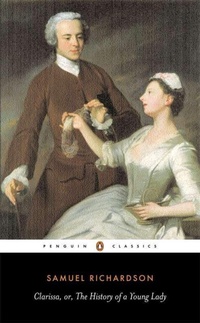
Clarissa, or the History of A Young Lady
Published on 29. August 1985
Book
Paperback/Softback
1536 pages
978-0-14-043215-2 (ISBN)
Description
Pressured by her unscrupulous family to marry a wealthy man she detests, the young Clarissa Harlowe is tricked into fleeing with the witty and debonair Robert Lovelace and places herself under his protection. Lovelace, however, proves himself to be an untrustworthy rake whose vague promises of marriage are accompanied by unwelcome and increasingly brutal sexual advances. And yet, Clarissa finds his charm alluring, her scrupulous sense of virtue tinged with unconfessed desire. Told through a complex series of interweaving letters, Clarissa is a richly ambiguous study of a fatally attracted couple and a work of astonishing power and immediacy. A huge success when it first appeared in 1747, and translated into French and German, it remains one of the greatest of all European novels.
Reviews / Votes
"Harrowing, unforgiving and extreme . . . A graphic study of the pathologies endemic to a culture that treats women as property. It's also a passionate celebration of female friendship and of the written word-storytelling as means of power and transcendence." -Jennifer Egan, Lit HubMore details
Language
English
Place of publication
London
United Kingdom
Publishing group
Penguin Books Ltd
Product notice
Paperback (UK-trade)
Dimensions
Height: 236 mm
Width: 146 mm
Thickness: 68 mm
Weight
1302 gr
ISBN-13
978-0-14-043215-2 (9780140432152)
Copyright in bibliographic data and cover images is held by Nielsen Book Services Limited or by the publishers or by their respective licensors: all rights reserved.
Schweitzer Classification
Other editions
Additional editions
Samuel Richardson | Angus Ross
Clarissa, or the History of A Young Lady
E-Book
02/2004
1st Edition
Penguin Books Ltd
€17.99
Available for download
Persons
Samuel Richardson (1689 - 1761) was born in Derbyshire, the son of a joiner. He received little formal education and in 1706 was apprenticed to a printer in London. Thirteen years later he set himself up as a stationer and printer and became of the leading figures in the trade. He printed political material, newspapers and literature. He began writing Pamela as a result of a suggestion from friends that he should compile a book of model letters for use by unskilled writers. Pamela was a great success and went on to write Clarissa, one of the masterpieces of European literature.
Angus Ross is Emeritus Professor of English at the University of Sussex. He writes on eighteenth-century and other literature and has edited Swift as well as a number of anthologies.
Angus Ross is Emeritus Professor of English at the University of Sussex. He writes on eighteenth-century and other literature and has edited Swift as well as a number of anthologies.