

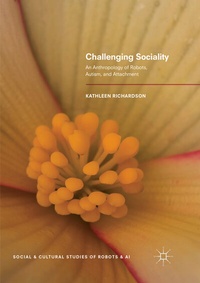
Challenging Sociality
An Anthropology of Robots, Autism, and Attachment
Published on 14. December 2018
Book
Paperback/Softback
XVI, 156 pages
978-3-030-09069-2 (ISBN)
Description
This book explores the development of humanoid robots for helping children with autism develop social skills based on fieldwork in the UK and the USA. Robotic scientists propose that robots can therapeutically help children with autism because there is a "special" affinity between them and mechanical things. This idea is supported by autism experts that claim those with autism have a preference for things over other persons. Autism is also seen as a gendered condition, with men considered less social and therefore more likely to have the condition. The author explores how these experiments in cultivating social skills in children with autism using robots, while focused on a unique subsection, is the model for a new kind of human-thing relationship for wider society across the capitalist world where machines can take on the role of the "you" in the relational encounter. Moreover, underscoring this is a form of consciousness that arises out of specific forms of attachment styles.
More details
Series
Edition
Softcover Reprint of the Original 1st 2018 ed.
Language
English
Place of publication
Cham
Switzerland
Publishing group
Springer International Publishing
Target group
Professional and scholarly
Illustrations
XVI, 156 p.
Dimensions
Height: 210 mm
Width: 148 mm
Thickness: 10 mm
Weight
231 gr
ISBN-13
978-3-030-09069-2 (9783030090692)
DOI
10.1007/978-3-319-74754-5
Schweitzer Classification
Other editions
Additional editions
Book
07/2018
Palgrave Macmillan
€139.09
Shipment within 10-15 days
Person
Kathleen Richardson is Professor of Ethics and Culture of Robots and AI at the Centre for Computing and Social Responsibility, De Montfort University, UK.
Content
1. Challenging Sociality?.- 2. Autism, Social Attachment and Things.- 3. The Experiment: The Effectiveness of a Humanoid Robot for Helping Children.- 4. Reversing Roles with an Other: Echolalia and Pronoun Reversal.- 5. Attachment Theory and Autism.- 6. Psychiatry, Autism and the Machine.- 7. Sex Differences, Machines and Autism.- 8. A Multiple-Whole Approach to Autism.