

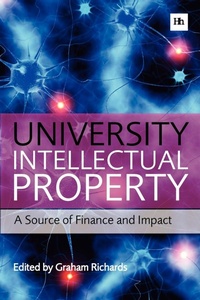
University Intellectual Property
A Source of Finance and Impact
Published on 9. July 2012
Book
Paperback/Softback
162 pages
978-0-85719-232-5 (ISBN)
Description
The traditional role of the university has been to teach and conduct original research, but this situation is changing. As governments judge universities on new criteria - including the 'impact' they have - and as universities are driven to search for finance from new sources, those that run universities are increasingly looking to exploit the intellectual property created by their researchers to help deliver this impact and income. How this should be done, and whether it should be done at all, is subject to much debate.
The key issues are:
- What constitutes intellectual property?
- Do academics or universities own IP?
- Does the commercialisation of IP impact academic freedom?
- How can IP best be exploited and who should be financially rewarded when it is?
- What assistance can governments and other bodies provide?
This book investigates these issues. After a review of how the current situation came to be, the views and experiences of a range of experts are presented, including those of a former high court judge, a senior lawyer, a patent attorney and professionals involved in technology transfer. The contributors examine whether the roles of higher education institutions have changed, what academics and universities should be doing, and how technology transfer can be made more effective and efficient. To conclude, a provocative look at the ethics of the situation is presented.
This insightful and thought-provoking book will help readers to understand more about an increasingly important aspect of academia and business.
The key issues are:
- What constitutes intellectual property?
- Do academics or universities own IP?
- Does the commercialisation of IP impact academic freedom?
- How can IP best be exploited and who should be financially rewarded when it is?
- What assistance can governments and other bodies provide?
This book investigates these issues. After a review of how the current situation came to be, the views and experiences of a range of experts are presented, including those of a former high court judge, a senior lawyer, a patent attorney and professionals involved in technology transfer. The contributors examine whether the roles of higher education institutions have changed, what academics and universities should be doing, and how technology transfer can be made more effective and efficient. To conclude, a provocative look at the ethics of the situation is presented.
This insightful and thought-provoking book will help readers to understand more about an increasingly important aspect of academia and business.
More details
Language
English
Place of publication
Petersfield
United Kingdom
Target group
Interest Age: From 18 years
Product notice
Paperback (UK-trade)
Illustrations
black & white illustrations
Dimensions
Height: 234 mm
Width: 156 mm
Thickness: 9 mm
Weight
260 gr
ISBN-13
978-0-85719-232-5 (9780857192325)
Copyright in bibliographic data and cover images is held by Nielsen Book Services Limited or by the publishers or by their respective licensors: all rights reserved.
Schweitzer Classification
Other editions
Additional editions
E-Book
07/2012
1st Edition
Harriman House
€30.99
Available for download
Person
Professor Graham Richards has worked with spin-out companies since 1988, when he was involved in founding the University of Oxford's technology transfer company, Isis Innovation Ltd, which he went on to be a director of for 20 years. Professor Richards founded his own spin-out company, Oxford Molecular Ltd, in 1989 and was heavily involved with running this company for 11 years, until it was sold in 2000. He has also been a director of Catalyst Biomedica Ltd and a chairman of IP2IPO Group Plc, which later became the publicly quoted IP Group Plc. He is now a senior non-executive director of that company. Professor Richards has recently retired from Oxford University, where he was Head of the Chemistry Department.
Content
About the Contributors Preface 1. Introduction by Graham Richards 2. The Confused Situation by Graham Richards 3. Bayh-Dole-Thatcher by Graham Richards 4. Academic Rogues by Graham Richards 5. A Judge's View by The Rt. Hon. Sir Robin Jacob 6. The Viewpoint of a Patent Attorney by Ian Bingham 7. Technology Transfer Office: The Next Step by Patricia Barclay 8. Waking a Sleeping Giant: Commercialising University Research by Roya Ghafele 9. Academic Research and Commercialisation by Alexander Weedon 10. University Patenting and the Advancement of Knowledge by Catherine Rhodes 11. Some Final Thoughts by Graham Richards Index