

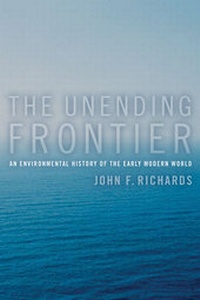
The Unending Frontier
An Environmental History of the Early Modern World
1st Edition
Published on 19. January 2006
Book
Paperback/Softback
696 pages
978-0-520-24678-2 (ISBN)
Description
It was the age of exploration, the age of empire and conquest, and human beings were extending their reach - and their numbers - as never before. In the process, they were intervening in the world's natural environment in equally unprecedented and dramatic ways. A sweeping work of environmental history, "The Unending Frontier" offers a truly global perspective on the profound impact of humanity on the natural world in the early modern period. John F. Richards identifies four broadly shared historical processes that speeded environmental change from roughly 1500 to 1800 c.e.: intensified human land use along settlement frontiers; biological invasions; commercial hunting of wildlife; and problems of energy scarcity. "The Unending Frontier" considers each of these trends in a series of case studies, sometimes of a particular place, such as Tokugawa Japan and early modern England and China, sometimes of a particular activity, such as the fur trade in North America and Russia, cod fishing in the North Atlantic, and whaling in the Arctic.
Throughout, Richards shows how humans - whether clearing forests or draining wetlands, transporting bacteria, insects, and livestock; hunting species to extinction, or reshaping landscapes - altered the material well-being of the natural world along with their own.
Throughout, Richards shows how humans - whether clearing forests or draining wetlands, transporting bacteria, insects, and livestock; hunting species to extinction, or reshaping landscapes - altered the material well-being of the natural world along with their own.
Reviews / Votes
"Richards steers a calm course between these extremes [of the catastrophic and the celebratory view of environmental history], but it is as clear from his choice of examples as from his language that he inclines more to the celebratory than the apocalyptic view. . . . Richards advances beyond a purely Eurocentric approach to the dynamics of change and presents the frontier as an evolving, interactive process influenced by both human and non-human factors. That is no mean achievement." * Times Literary Supplement * "Richards has an economical way of surveying vast amounts of evidence which makes it an easy and rewarding read." -- Felipe Fernandez-Armesto, * History Today * "This is a major work of world and environmental history that experts and nonexperts will be consulting and quoting for years to come." * American Historical Review * "This is more than a good textbook for a world history course. . . . It is a work that should be required reading for all early modernists, because it makes the strongest case to date for the importance of environmental history to the broader field." * Journal of Modern History * "An excellent addition to the literature of world environmental history and a valuable aid to teaching." * International History Review * "Richards's book is an admirable success and an intellectual adventure. Completely dependable in its scholarship, it undoubtedly will be one of the few that environmental historians place on a shelf within reach for ready consultation. . . . All in all, this work is a masterpiece that will stand the test of time." * Environmental History *More details
Series
Edition
First Edition
Language
English
Place of publication
Berkerley
United States
Target group
Professional and scholarly
Product notice
Paperback (trade)
Illustrations
27 maps, 6 tables
Dimensions
Height: 229 mm
Width: 152 mm
Thickness: 46 mm
Weight
1043 gr
ISBN-13
978-0-520-24678-2 (9780520246782)
Copyright in bibliographic data and cover images is held by Nielsen Book Services Limited or by the publishers or by their respective licensors: all rights reserved.
Schweitzer Classification
Other editions
Additional editions
E-Book
05/2003
1st Edition
Naval Institute Press
€38.99
Available for download
Person
John F. Richards is Professor of History at Duke University. He is the author of The Mughal Empire (1993) and Mughal Administration in Golconda (1975) and the editor of Land, Property and the Environment (2001). He is coeditor of World Deforestation in the Twentieth Century (1988) and Global Deforestation and the Nineteenth-Century World Economy (1983).
Content
List of Maps List of Tables Preface Introduction Part I. The Global Context 1. The Early Modern World 2. Climate and Early Modern World Environmental History Part II. Eurasia and Africa 3. Pioneer Settlement on Taiwan 4. Internal Frontiers and Intensified Land Use in China 5. Ecological Strategies in Tokugawa Japan 6. Landscape Change and Energy Transformation in the British Isles 7. Frontier Settlement in Russia 8. Wildlife and Livestock in South Africa Part III. The Americas 9. The Columbian Exchange: The West Indies 10. Ranching, Mining, and Settlement Frontiers in Colonial Mexico 11. Sugar and Cattle in Portuguese Brazil 12. Landscapes of Sugar in the Antilles Part IV. The World Hunt 13. Furs and Deerskins in Eastern North America 14. The Hunt for Furs in Siberia 15. Cod and the New World Fisheries 16. Whales and Walruses in the Northern Oceans Conclusion Bibliography Index