

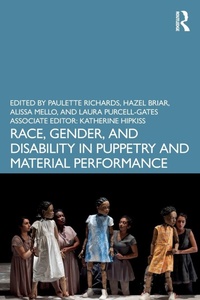
Race, Gender, and Disability in Puppetry and Material Performance
1st Edition
Published on 31. December 2025
Book
Paperback/Softback
268 pages
978-1-032-13951-7 (ISBN)
Description
Race, Gender, and Disability in Puppetry and Material Performance investigates and expands the multifaceted how and what of puppetry and material performance.
This engaging collection explores how puppetry and material performance challenge and transform representations of race, gender, and disability through the powerful medium of object and effigy forms. The book also examines gender roles within puppetry and how puppetry addresses societal anxieties about the other and bodies traditionally excluded from normative spaces. Part 1: Reframing Puppetry Through Race, Gender, and Disability establishes a theoretical foundation for understanding puppetry as a site of intervention-whether in political protests, theatrical productions, or educational contexts. Part 2: Negotiating Identities builds on this foundation by examining how puppetry operates as a tool for reshaping identities and expanding representation. Part 3: Performances of the Other emphasizes how puppetry challenges established norms of embodiment and inclusion, offering possibilities for cultural reclamation and the redefinition of marginalized identities. Featuring nineteen chapters by leading experts, this collection illustrates how puppetry can challenge conventions, articulate nuanced identities, and illuminate complexities of race, gender, and disability.
Race, Gender, and Disability in Puppetry and Material Performance is ideal for students of theatre and performance studies, theatre artists, scholars, and anyone seeking a deeper understanding of puppetry and material performance.
This engaging collection explores how puppetry and material performance challenge and transform representations of race, gender, and disability through the powerful medium of object and effigy forms. The book also examines gender roles within puppetry and how puppetry addresses societal anxieties about the other and bodies traditionally excluded from normative spaces. Part 1: Reframing Puppetry Through Race, Gender, and Disability establishes a theoretical foundation for understanding puppetry as a site of intervention-whether in political protests, theatrical productions, or educational contexts. Part 2: Negotiating Identities builds on this foundation by examining how puppetry operates as a tool for reshaping identities and expanding representation. Part 3: Performances of the Other emphasizes how puppetry challenges established norms of embodiment and inclusion, offering possibilities for cultural reclamation and the redefinition of marginalized identities. Featuring nineteen chapters by leading experts, this collection illustrates how puppetry can challenge conventions, articulate nuanced identities, and illuminate complexities of race, gender, and disability.
Race, Gender, and Disability in Puppetry and Material Performance is ideal for students of theatre and performance studies, theatre artists, scholars, and anyone seeking a deeper understanding of puppetry and material performance.
More details
Language
English
Place of publication
London
United Kingdom
Publishing group
Taylor & Francis Ltd
Target group
College/higher education
Postgraduate and Undergraduate Advanced
Illustrations
24 s/w Photographien bzw. Rasterbilder, 24 s/w Abbildungen
24 Halftones, black and white; 24 Illustrations, black and white
Dimensions
Height: 234 mm
Width: 156 mm
Thickness: 16 mm
Weight
447 gr
ISBN-13
978-1-032-13951-7 (9781032139517)
Copyright in bibliographic data and cover images is held by Nielsen Book Services Limited or by the publishers or by their respective licensors: all rights reserved.
Schweitzer Classification
Other editions
Additional editions
Paulette Richards | Hazel Briar | Alissa Mello
Race, Gender and Disability in Puppetry and Material Performance
E-Book
12/2025
1st Edition
Routledge
€55.49
Available for download
Paulette Richards | Hazel Briar | Alissa Mello
Race, Gender and Disability in Puppetry and Material Performance
E-Book
12/2025
1st Edition
Routledge
€55.49
Available for download
Paulette Richards | Hazel Briar | Alissa Mello
Race, Gender and Disability in Puppetry and Material Performance
Book
approx. 12/2025
1st Edition
Routledge
€211.70
Not yet published
Persons
Paulette Richards is an independent researcher and co-curator of the Living Objects: African American Puppetry exhibit at the University of Connecticut's Ballard Institute and Museum with Dr. John Bell.
Hazel Briar is an independent scholar with a PhD in theatre historiography from the University of Minnesota, USA. Her research examines performances of the dead, considering practices involving spiritualism and matter.
Alissa Mello is an award-winning editor, scholar, theatre artist, and Marie Sklodowska-Curie individual fellow (2022-2025) at the University of Exeter, UK. Their interests include women and performance, gender, identity, and practice.
Laura Purcell-Gates is a reader in theatre and performance at Bath Spa University in the UK and co-artistic director of Wattle and Daub, through which she conducts practice-based research on puppetry and non-normative bodies.
Hazel Briar is an independent scholar with a PhD in theatre historiography from the University of Minnesota, USA. Her research examines performances of the dead, considering practices involving spiritualism and matter.
Alissa Mello is an award-winning editor, scholar, theatre artist, and Marie Sklodowska-Curie individual fellow (2022-2025) at the University of Exeter, UK. Their interests include women and performance, gender, identity, and practice.
Laura Purcell-Gates is a reader in theatre and performance at Bath Spa University in the UK and co-artistic director of Wattle and Daub, through which she conducts practice-based research on puppetry and non-normative bodies.
Content
Foreword
Introduction
Part 1: Reframing Puppetry Through Race, Gender, and Disability
1. Puppets on Plinths: Disrupting Gender and Hegemonic Narratives with General Baquedano's Monument During the 2019 Chilean Uprising
2. A Real American Wife, a Japanese Object: Critical Puppetry and the Construction of the Orient in Minghella's Madam Butterfly
3. Performing Emergenc(e)y: Puppetry, Gender, Race, and Madness in Plot 99
4. Global Perspectives to Elevate Diversity in Puppetry
5. The Galilee Deaf Theatre Project
Part 2: Negotiating Identities
6. Don't It Make My Brown Eyes Blue: Kids on the Block and the Intersectionality of Oppressions
7. Black Bodies in White Spaces: Reflections on Men/toring in Puppetry
8. Crip Ventriloquism as a Means of Coping with a Hidden Disability
9. Beyond Representation: A Conversation with Jummy Faruq on Decentering Puppetry Practice and Design
10. Pancha la Parda: A New Myth for an Ancient Tradition
11. Colored Feels of Felt
12. The "Other" Karagoez: The Kurdish Qeregoz
13. Resisting Objects: << Refugee >> Visibility in Theatre
Part 3: Performances of the Other
14. What Happened to the Room of Forgotten Voices: Challenging the Flawed Vision of Human and Puppet Movement from the Past That Left Out Disabled People
15. When Goiters Are Your Family Jewels: Maladies and the Grotesque in Regional Heroic Glove Puppet Characters of Northern Italy
16. Intervening with Institutional Patriarchy: Woman Karagoez Puppeteers in Turkey
17. Puppetry, Race, and Identity in The Bluest Eye
18. Remote Representation: A Puppetry Sensitization Project in Nairobi
19. Making Seen/Sounding Difference: Performing Black at a Majority White Institution
Introduction
Part 1: Reframing Puppetry Through Race, Gender, and Disability
1. Puppets on Plinths: Disrupting Gender and Hegemonic Narratives with General Baquedano's Monument During the 2019 Chilean Uprising
2. A Real American Wife, a Japanese Object: Critical Puppetry and the Construction of the Orient in Minghella's Madam Butterfly
3. Performing Emergenc(e)y: Puppetry, Gender, Race, and Madness in Plot 99
4. Global Perspectives to Elevate Diversity in Puppetry
5. The Galilee Deaf Theatre Project
Part 2: Negotiating Identities
6. Don't It Make My Brown Eyes Blue: Kids on the Block and the Intersectionality of Oppressions
7. Black Bodies in White Spaces: Reflections on Men/toring in Puppetry
8. Crip Ventriloquism as a Means of Coping with a Hidden Disability
9. Beyond Representation: A Conversation with Jummy Faruq on Decentering Puppetry Practice and Design
10. Pancha la Parda: A New Myth for an Ancient Tradition
11. Colored Feels of Felt
12. The "Other" Karagoez: The Kurdish Qeregoz
13. Resisting Objects: << Refugee >> Visibility in Theatre
Part 3: Performances of the Other
14. What Happened to the Room of Forgotten Voices: Challenging the Flawed Vision of Human and Puppet Movement from the Past That Left Out Disabled People
15. When Goiters Are Your Family Jewels: Maladies and the Grotesque in Regional Heroic Glove Puppet Characters of Northern Italy
16. Intervening with Institutional Patriarchy: Woman Karagoez Puppeteers in Turkey
17. Puppetry, Race, and Identity in The Bluest Eye
18. Remote Representation: A Puppetry Sensitization Project in Nairobi
19. Making Seen/Sounding Difference: Performing Black at a Majority White Institution