

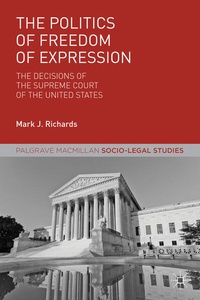
The Politics of Freedom of Expression
The Decisions of the Supreme Court of the United States
Published on 6. August 2013
Book
Hardback
XIV, 220 pages
978-1-137-27757-2 (ISBN)
Description
The principle of content-neutrality is the cornerstone of freedom of expression jurisprudence, protecting the core values of freedom of speech set out in the first amendment, whilst also enabling the government to place reasonable restrictions on protected speech.
The Politics of Freedom of Express i on examines the US Supreme Court's decision-making in freedom of expression cases, from the Earl Warren Court in 1953 to the 2012 decisions of the John Roberts Court, assessing the extent to which the justices take into consideration their own political attitudes, jurisprudence and external factors such as federal government participation. In doing so, the book highlights the role of the civil rights movement in developing the content-neutrality jurisprudential regime.
Establishing 'jurisprudential regime theory' as a framework for incorporating the various factors that can affect decision-making, the author draws on quantitative, qualitative and interpretive methods in order to analyse the justices' changing treatment of content-based and content-neutral cases over time. This unique theoretical approach allows the text to push beyond the traditional 'law versus politics' debate in order to critically evaluate the importance of content-neutrality to the Supreme Court's decision-making, and to compare decision-making in the US with Canada, Germany, Japan and the UK.
The Politics of Freedom of Express i on examines the US Supreme Court's decision-making in freedom of expression cases, from the Earl Warren Court in 1953 to the 2012 decisions of the John Roberts Court, assessing the extent to which the justices take into consideration their own political attitudes, jurisprudence and external factors such as federal government participation. In doing so, the book highlights the role of the civil rights movement in developing the content-neutrality jurisprudential regime.
Establishing 'jurisprudential regime theory' as a framework for incorporating the various factors that can affect decision-making, the author draws on quantitative, qualitative and interpretive methods in order to analyse the justices' changing treatment of content-based and content-neutral cases over time. This unique theoretical approach allows the text to push beyond the traditional 'law versus politics' debate in order to critically evaluate the importance of content-neutrality to the Supreme Court's decision-making, and to compare decision-making in the US with Canada, Germany, Japan and the UK.
Reviews / Votes
In this book Mark Richards addresses the debate about the role of legal considerations in the Supreme Court's decisions and presents a close examination of the Court's decisions on freedom of expression. His thoughtful and insightful analyses make important contributions to our understanding of both these subjects and the connections between them.' - Lawrence Baum, Emeritus Professor of Political Science, Ohio State University, USA.More details
Series
Edition
2013 edition
Language
English
Place of publication
London
United Kingdom
Product notice
sewn/stitched
Cloth over boards
Illustrations
XIV, 220 p.
Dimensions
Height: 234 mm
Width: 155 mm
Thickness: 18 mm
Weight
476 gr
ISBN-13
978-1-137-27757-2 (9781137277572)
DOI
10.1057/9781137277589
Schweitzer Classification
Other editions
Additional editions
M. Richards
The Politics of Freedom of Expression
The Decisions of the Supreme Court of the United States
Book
08/2014
Palgrave Macmillan
€53.49
Article exhausted; check different version
Person
Mark J Richards is Professor and Chair of the Department of Political Science at Grand Valley State University, Michigan, USA.
Content
1. Introduction.- 2. Jurisprudential Regime Theory.- 3. The Content-Neutrality Jurisprudential Regime.- 4. Statistical Methodology and Results.- 5. The Changing Treatment of Content-based Cases.- 6. The Contours and Limits of the Content-neutral Cases.- 7. Conclusion.