

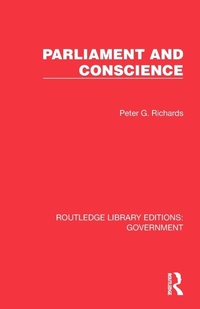
Parliament and Conscience
1st Edition
Will be published approx. on 1. April 2026
Book
Paperback/Softback
230 pages
978-1-032-78277-5 (ISBN)
Description
Originally published in 1970, this book has a dual purpose. Firstly, it is a study of how Parliament works when the party whips are withdrawn. The author shows how backbenchers can create legislation of great importance; he demonstrates the obstacles, political and procedural to social reform; he relates the votes of MPs to their personal characteristics e.g. age, religion and occupation, and he argues that Parliament achieves a fresh vigour and authority when MPs think and act independently of party policy. Secondly, Parliament and Conscience analyses 6 major controversies in British society in the late 20th Century: the death penalty, homosexuality, abortion, theatre censorship, divorce and Sunday entertainment.
More details
Series
Language
English
Place of publication
London
United Kingdom
Publishing group
Taylor & Francis Ltd
Target group
College/higher education
Postgraduate and Undergraduate Advanced
Dimensions
Height: 216 mm
Width: 140 mm
Thickness: 13 mm
Weight
296 gr
ISBN-13
978-1-032-78277-5 (9781032782775)
Copyright in bibliographic data and cover images is held by Nielsen Book Services Limited or by the publishers or by their respective licensors: all rights reserved.
Schweitzer Classification
Other editions
Additional editions
Peter G. Richards
Parliament and Conscience
E-Book
06/2024
1st Edition
Routledge
€39.49
Available for download
Peter G. Richards
Parliament and Conscience
Book
06/2024
1st Edition
Routledge
€126.00
Shipment within 10-20 days
Peter G. Richards
Parliament and Conscience
E-Book
06/2024
1st Edition
Routledge
€39.49
Available for download
Content
1.Introduction Through History 2. The Basis of the Present System 3. Central Control of Local Government 4. Finance 5. The Constitution of a Local Authority 6. Committees 7. The Quest for Efficiency 8. The Reorganization of Structure 9. Local Government and Society. Appendices: A: Distribution of Functions B: Local Authority Populations C: Representation on Outside Bodies: The Association of Municipal Corporations