

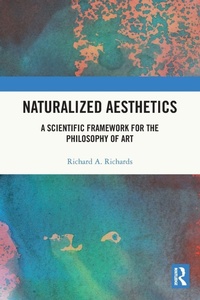
Naturalized Aesthetics
A Scientific Framework for the Philosophy of Art
1st Edition
Published on 27. May 2024
Book
Paperback/Softback
294 pages
978-1-032-24542-3 (ISBN)
Description
This book bridges the gap between the many insights into art provided by research in evolutionary theory, psychology and neuroscience and those enduring normative issues best addressed by philosophy. The sciences have helped us understand how art functions, our art preferences, and the neurological systems underlying our engagement with art. But we continue to rely on philosophy to tell us what is truly good in art, how we should engage with art, and the conceptual basis for this engagement. Naturalized Aesthetics: A Scientific Framework for the Philosophy of Art integrates a systematic and comprehensive naturalism, grounded in the sciences, with an "ecology" of art. It shows how the environments in which we make and experience art - our "engineered art niches" - affect the practice and experience of art and generate normativity - the goods and the shoulds - in our engagement with art. There are, in effect, two "streams" of normativity, according to this book: a niche-dependent, social, impersonal and objective stream and a niche-independent, individual, personal and subjective stream. Recognition of these two streams allows us to make progress in long-standing and unresolved philosophical disputes about how to interpret, evaluate and conceive art.
Key Features:
Provides a structured and critical introduction to the scientific accounts of art based on evolutionary thinking, psychology and neuroscience.
Develops an "ecology" of art based on the insight that we engage with art in engineered niches.
Presents a naturalistic account of normativity based on the recognition of two streams: a niche-dependent, social, impersonal and objective stream; and a niche-independent, individual, personal and subjective stream.
Serves as an introduction and critical analysis of the debates about the interpretation, evaluation and definitions of art.
Key Features:
Provides a structured and critical introduction to the scientific accounts of art based on evolutionary thinking, psychology and neuroscience.
Develops an "ecology" of art based on the insight that we engage with art in engineered niches.
Presents a naturalistic account of normativity based on the recognition of two streams: a niche-dependent, social, impersonal and objective stream; and a niche-independent, individual, personal and subjective stream.
Serves as an introduction and critical analysis of the debates about the interpretation, evaluation and definitions of art.
More details
Language
English
Place of publication
London
United Kingdom
Publishing group
Taylor & Francis Ltd
Target group
College/higher education
Postgraduate and Undergraduate Advanced
Dimensions
Height: 229 mm
Width: 152 mm
Thickness: 17 mm
Weight
449 gr
ISBN-13
978-1-032-24542-3 (9781032245423)
Copyright in bibliographic data and cover images is held by Nielsen Book Services Limited or by the publishers or by their respective licensors: all rights reserved.
Schweitzer Classification
Other editions
Additional editions
E-Book
06/2022
1st Edition
Routledge
€55.49
Available for download
E-Book
06/2022
1st Edition
Routledge
€55.49
Available for download
Book
06/2022
1st Edition
Routledge
€208.10
Shipment within 15-20 days
Person
Richard A. Richards, Professor at the University of Alabama, received his Ph.D. in Philosophy from The Johns Hopkins University with a certificate in the History and Philosophy of Science. He has wide-ranging research interests, writing on a variety of topics in the history and philosophy of biology and aesthetics. He has published three books through Cambridge University Press: The Species Problem: A Philosophical Analysis (2010), Biological Classification: A Philosophical Introduction (2016) and The Biology of Art (2019).
Content
1. Aesthetics and Naturalism
2. The Evolution of Art
3. The Psychology of Art
4. The Ecology of Art
5. Art Criticism
6. Interpreting Art
7. Evaluating Art
8. Defining Art
9. Conclusion
2. The Evolution of Art
3. The Psychology of Art
4. The Ecology of Art
5. Art Criticism
6. Interpreting Art
7. Evaluating Art
8. Defining Art
9. Conclusion