

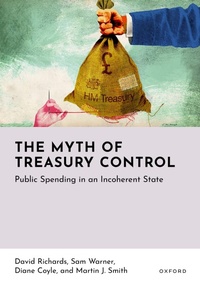
The Myth of Treasury Control
Public Spending in an Incoherent State
Will be published approx. on 16. July 2026
Book
Hardback
384 pages
978-0-19-893775-3 (ISBN)
Description
In an era of fiscal constraint, rising public demand, and fragmented governance, the UK's approach to public spending is under unprecedented strain. At the centre of this system sits HM Treasury, long regarded as the most powerful department in British government yet questioned for its ability to deliver effective financial control in an increasingly complex and fragmented policy landscape.
This book offers a bold and timely reassessment of the Treasury's role in shaping the UK's public finances over the last thirty years. Drawing on over 150 interviews with senior officials, policymakers, and frontline practitioners, it reveals how the Treasury's traditional model of top-down control has failed to adapt to the realities of modern governance over the last three decades. Through detailed case studies of prisons, special educational needs, and homelessness, the authors expose the systemic consequences of short-termism, siloed budgeting, inadequate evaluation, centralised performance budgeting, and accountability deficits that undermine both fiscal sustainability and public service outcomes.
This book offers a bold and timely reassessment of the Treasury's role in shaping the UK's public finances over the last thirty years. Drawing on over 150 interviews with senior officials, policymakers, and frontline practitioners, it reveals how the Treasury's traditional model of top-down control has failed to adapt to the realities of modern governance over the last three decades. Through detailed case studies of prisons, special educational needs, and homelessness, the authors expose the systemic consequences of short-termism, siloed budgeting, inadequate evaluation, centralised performance budgeting, and accountability deficits that undermine both fiscal sustainability and public service outcomes.
More details
Language
English
Place of publication
Oxford
United Kingdom
Target group
College/higher education
Product notice
sewn/stitched
Cloth over boards
Dimensions
Height: 234 mm
Width: 156 mm
ISBN-13
978-0-19-893775-3 (9780198937753)
Copyright in bibliographic data and cover images is held by Nielsen Book Services Limited or by the publishers or by their respective licensors: all rights reserved.
Schweitzer Classification
Persons
David Richards is Diamond Professor of Public Policy at the University of Manchester and former Head of the Department of Politics. His research interests span political institutions, governance, British politics, public policy, and political biography. He has authored or edited six books and over 70 articles and chapters. He previously held academic posts at the Universities of Birmingham, Liverpool, and Sheffield, and has been a Visiting Fellow at both Sydney University and the Australian National University. He is a Fellow of the Academy of Social Sciences.
Sam Warner is a Lecturer in Politics in the School of Sociology, Politics and International Studies at the University of Bristol. He is the author of Who governs Britain? Trade Unions, the Conservative Party and the failure of the Industrial Relations Act 1971. His research focusses on the study of power in British politics, drawing on models of (multi-level) governance and theories of state management to explore the big distributional questions of public policy and political economy. He has previously held posts at the Universities of Manchester, York and Birmingham.
Diane Coyle is Bennett Professor of Public Policy at the University of Cambridge. She was previously Professor of Economics at Manchester University and she is a member of the UK Government's Industrial Strategy Council and advises the Competition and Markets Authority. She has served previously in various public service roles, and began her career at HM Treasury. Diane was awarded a DBE in 2023 for her contribution to economics and public policy. She was a student at Brasenose College, Oxford, reading PPE (1978) and has a PhD in Economics from Harvard (1985).
Martin J. Smith is Anniversary Professor of Politics at the University of York where has been Head of Department and Pro-vice chancellor. He is also a visiting fellow at the Institut Barcelona Estudis Internacionals. He has published widely on British politics, public policy, and state reform and is author/editor of 14 books and over 70 articles and book chapters. He is currently holder of a Leverhulme Major Fellowship on the rise of the chaotic state. He has previously held positions at the Universities of Kent, Brunel, and Sheffield.
Sam Warner is a Lecturer in Politics in the School of Sociology, Politics and International Studies at the University of Bristol. He is the author of Who governs Britain? Trade Unions, the Conservative Party and the failure of the Industrial Relations Act 1971. His research focusses on the study of power in British politics, drawing on models of (multi-level) governance and theories of state management to explore the big distributional questions of public policy and political economy. He has previously held posts at the Universities of Manchester, York and Birmingham.
Diane Coyle is Bennett Professor of Public Policy at the University of Cambridge. She was previously Professor of Economics at Manchester University and she is a member of the UK Government's Industrial Strategy Council and advises the Competition and Markets Authority. She has served previously in various public service roles, and began her career at HM Treasury. Diane was awarded a DBE in 2023 for her contribution to economics and public policy. She was a student at Brasenose College, Oxford, reading PPE (1978) and has a PhD in Economics from Harvard (1985).
Martin J. Smith is Anniversary Professor of Politics at the University of York where has been Head of Department and Pro-vice chancellor. He is also a visiting fellow at the Institut Barcelona Estudis Internacionals. He has published widely on British politics, public policy, and state reform and is author/editor of 14 books and over 70 articles and book chapters. He is currently holder of a Leverhulme Major Fellowship on the rise of the chaotic state. He has previously held positions at the Universities of Kent, Brunel, and Sheffield.
Author
Diamond Professor of Public PolicyDiamond Professor of Public Policy, University of Manchester
Lecturer in PoliticsLecturer in Politics, University of Bristol
Bennett Professor of Public PolicyBennett Professor of Public Policy, University of Cambridge
Anniversary Professor of PoliticsAnniversary Professor of Politics, University of York
Content
Part I. The Treasury, Fragmentation, and Spending Control 1: Introduction 2: De-mystifying Treasury Control: From Micro-Manager to Meta-Governor 3: Treasury Control, Fragmented Governance, and the Incoherent State Part II. The Six Challenges of Public Spending Planning and Control 4: The Treasury as a Meta-Governor: Over-Control and Under-Control 5: The Consequences of Short-Termism 6: The Challenge of Cross-Government Working 7: The Treasury and Evidence-Based Policy-Making 8: The Inefficiency of Treasury 'Input Control' in Performance Budgeting 9: The Failure of Accountability for Public Money in an Era of Fragmented Governance 10: Conclusion Appendix: Full Breakdown of Interviewees