

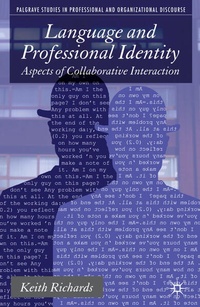
Language and Professional Identity
Aspects of Collaborative Interaction
Published on 23. May 2006
Book
Paperback/Softback
X, 245 pages
978-0-230-58011-4 (ISBN)
Description
This book explores the ways in which professional groups develop specific interactional procedures for conducting and representing their activities, all of which contribute to a distinctive collaborative identity. It highlights the drawbacks as well as the advantages of collaborative talk, pointing to ways of improving professional performance.
Reviews / Votes
'The writing style is clear and accessible. Concepts are carefully explained and the transcripts are readable and illuminating. I would highly recommend this book to researchers and postgraduate students, and trainers and managers, who are interested in talk and collaboration at work.' - Janet Maybin, Applied Linguistics
More details
Series
Edition
2006 edition
Language
English
Place of publication
London
United Kingdom
Target group
Professional and scholarly
Product notice
Paperback (trade)
Unsewn / adhesive bound
Illustrations
X, 245 p.
Dimensions
Height: 229 mm
Width: 152 mm
Thickness: 15 mm
Weight
381 gr
ISBN-13
978-0-230-58011-4 (9780230580114)
DOI
10.1057/9780230505049
Schweitzer Classification
Other editions
Additional editions
Book
05/2006
Palgrave Macmillan
€106.99
Shipment within 10-20 days
Person
Keith Richards is an Associate Professor at the University of Warwick, UK. His main research interests lie in the area of professional interaction and his recent publications include Qualitative Inquiry in TESOL, Applying Conversation Analysis (edited with Paul Seedhouse), and Professional Encounters in TESOL (edited with Sue Garton).
Content
Acknowledgements Transcription Conventions Introduction Collaborative Identity: The Power of the Group Staying Onside: The Negotiation of Argument The Joke's on Them: Varieties of Humour in Collaborative Talk The Interactional Dynamic: Stories From the Back Region Seeing Things Our Way: The Establishment of Common Perspectives Us and Them: Constructing the Other Conclusion References Index