

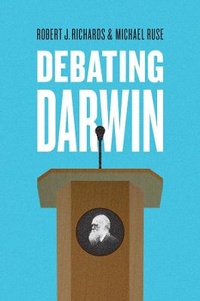
Debating Darwin
Published on 10. September 2016
Book
Hardback
320 pages
978-0-226-38442-9 (ISBN)
Description
Charles Darwin is easily the most famous scientist of the modern age, and his theory of evolution is constantly referenced in many contexts by scientists and nonscientist alike. And yet, despite how frequently his ideas are evoked, there remains a surprising amount we don't know about the father of modern evolutionary thinking, his intellectual roots, and the science he produced. Debating Darwin seeks to change that, bringing together two leading Darwin scholars Robert J. Richards and Michael Ruse to engage in a spirited and insightful dialogue, offering their interpretations of Darwin and their critiques of each other's thinking. Examining key disagreements about Darwin that continue to confound even committed Darwinists, Richards and Ruse offer divergent views on the origins and nature of Darwin and his ideas. Ruse argues that Darwin was quintessentially British and that the roots of his thought can be traced back to the eighteenth century, particularly to the Industrial Revolution and thinkers such as Adam Smith and Thomas Robert Malthus. Ruse argues that when these influences are appreciated, we can see how Darwin's work in biology is an extension of their theories.
In contrast, Richards presents Darwin as a more cosmopolitan, self-educated man, influenced as much by French and particularly German thinkers. Above all, argues Richards, it was Alexander von Humboldt who both inspired Darwin and gave him the conceptual tools that he needed to find and formulate his evolutionary hypotheses. Together, the authors show how the reverberations of the contrasting views on Darwin's influences can be felt in theories about the nature of natural selection, the role of metaphor in science, and the place of God in Darwin's thought. Revealing how much there still is to investigate and interrogate about Darwin's ideas, Debating Darwin contributes to our understanding of evolution itself. The book concludes with a jointly authored chapter that brings this debate into the present, focusing on human evolution, consciousness, religion, and morality. This will be powerful, essential reading for anyone seeking a comprehensive understanding of modern-day evolutionary science and philosophy.
In contrast, Richards presents Darwin as a more cosmopolitan, self-educated man, influenced as much by French and particularly German thinkers. Above all, argues Richards, it was Alexander von Humboldt who both inspired Darwin and gave him the conceptual tools that he needed to find and formulate his evolutionary hypotheses. Together, the authors show how the reverberations of the contrasting views on Darwin's influences can be felt in theories about the nature of natural selection, the role of metaphor in science, and the place of God in Darwin's thought. Revealing how much there still is to investigate and interrogate about Darwin's ideas, Debating Darwin contributes to our understanding of evolution itself. The book concludes with a jointly authored chapter that brings this debate into the present, focusing on human evolution, consciousness, religion, and morality. This will be powerful, essential reading for anyone seeking a comprehensive understanding of modern-day evolutionary science and philosophy.
More details
Language
English
Place of publication
Chicago
United States
Publishing group
The University of Chicago Press
Target group
Professional and scholarly
Dimensions
Height: 24 mm
Width: 17 mm
Thickness: 3 mm
Weight
680 gr
ISBN-13
978-0-226-38442-9 (9780226384429)
Copyright in bibliographic data and cover images is held by Nielsen Book Services Limited or by the publishers or by their respective licensors: all rights reserved.
Schweitzer Classification
Other editions
Additional editions
Robert J. Richards | Michael Ruse
Debating Darwin
E-Book
03/2020
1st Edition
University of Chicago Press
€18.18
Available for download
Persons
Robert J. Richards is the Morris Fishbein Distinguished Service Professor in History of Science at the University of Chicago, where he is professor in the department of History, Philosophy, and Psychology and in the Committee on Conceptual and Historical Studies of Science and directs the Fishbein Center for the History of Science and Medicine. His books include, most recently, Was Hitler a Darwinian? Disputed Questions in the History of Evolutionary Theory, also published by the University of Chicago Press. Michael Ruse is director of the Program in the History and Philosophy of Science at Florida State University. His books include The Gaia Hypothesis: Science on a Pagan Planet, also published by the University of Chicago Press.