

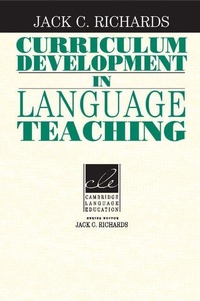
Curriculum Development in Language Teaching
Published on 12. March 2001
Book
Paperback/Softback
336 pages
978-0-521-80491-2 (ISBN)
Description
This text provides a systematic introduction to the issues involved in planning, developing, and managing effective language programs. The paperback edition provides a systematic introduction to the issues involved in developing, managing, and evaluating effective second and foreign language programs and teaching materials. Key stages in the curriculum development process are examined, including situation analysis, needs analysis, goal setting, syllabus design, materials development and adaptation, teaching and teacher support, and evaluation. Discussion activities throughout the book enable it to be used as a reference text for teachers and administrators.
More details
Series
Language
English
Place of publication
Cambridge
United Kingdom
Target group
ELT/ESL
Product notice
Paperback (trade)
Illustrations
20 Tables, unspecified; 10 Maps; 10 Halftones, unspecified
Dimensions
Height: 229 mm
Width: 152 mm
Thickness: 18 mm
Weight
488 gr
ISBN-13
978-0-521-80491-2 (9780521804912)
Copyright in bibliographic data and cover images is held by Nielsen Book Services Limited or by the publishers or by their respective licensors: all rights reserved.
Schweitzer Classification
Other editions
Additional editions
Jack C. Richards
Curriculum Development in Language Teaching
E-Book
04/2009
1st Edition
Cambridge University Press
€19.99
Available for download

Jack C. Richards
Curriculum Development in Language Teaching
Book
03/2001
Cambridge University Press
€87.89
Article exhausted; check for reprint
Previous edition
Jack C. Richards
Curriculum Development in Language Teaching
Book
03/2001
Cambridge University Press
€87.89
Article exhausted; check for reprint
Person
Content
1. The origins of language curriculum development; 2 .From syllabus design to curriculum development; 3. Needs analysis; 4. Situation analysis; 5. Planning goals and learning outcomes; 6. Course planning and syllabus design; 7. Providing for effective teaching; 8 The role and design of instructional materials; 9. Approaches to evaluation.