

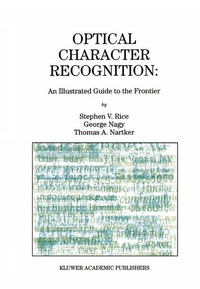
Optical Character Recognition
An Illustrated Guide to the Frontier
Published on 31. May 1999
Book
Hardback
VII, 196 pages
978-0-7923-8492-2 (ISBN)
Description
Optical character recognition (OCR) is the most prominent and successful example of pattern recognition to date. There are thousands of research papers and dozens of OCR products.
Optical Character
Rcognition: An Illustrated Guide to the Frontier
offers a perspective on the performance of current OCR systems by illustrating and explaining actual OCR errors. The pictures and analysis provide insight into the strengths and weaknesses of current OCR systems, and a road map to future progress.
Optical Character Recognition: An Illustrated Guide to the Frontier will pique the interest of users and developers of OCR products and desktop scanners, as well as teachers and students of pattern recognition, artificial intelligence, and information retrieval. The first chapter compares the character recognition abilities of humans and computers. The next four chapters present 280 illustrated examples of recognition errors, in a taxonomy consisting of Imaging Defects, Similar Symbols, Punctuation, and Typography. These examples were drawn from large-scale tests conducted by the authors. The final chapter discusses possible approaches for improving the accuracy of today's systems, and is followed by an annotated bibliography.
Optical Character Recognition: An Illustrated Guide to the Frontier is suitable as a secondary text for a graduate level course on pattern recognition, artificial intelligence, and information retrieval, and as a reference for researchers and practitioners in industry.
Optical Character Recognition: An Illustrated Guide to the Frontier will pique the interest of users and developers of OCR products and desktop scanners, as well as teachers and students of pattern recognition, artificial intelligence, and information retrieval. The first chapter compares the character recognition abilities of humans and computers. The next four chapters present 280 illustrated examples of recognition errors, in a taxonomy consisting of Imaging Defects, Similar Symbols, Punctuation, and Typography. These examples were drawn from large-scale tests conducted by the authors. The final chapter discusses possible approaches for improving the accuracy of today's systems, and is followed by an annotated bibliography.
Optical Character Recognition: An Illustrated Guide to the Frontier is suitable as a secondary text for a graduate level course on pattern recognition, artificial intelligence, and information retrieval, and as a reference for researchers and practitioners in industry.
More details
Series
Edition
1999 ed.
Language
English
Place of publication
New York
United States
Target group
Professional and scholarly
Research
Edition type
Annotated edition
Product notice
sewn/stitched
Cloth over boards
Illustrations
VII, 196 p.
Dimensions
Height: 254 mm
Width: 178 mm
Thickness: 13 mm
Weight
581 gr
ISBN-13
978-0-7923-8492-2 (9780792384922)
DOI
10.1007/978-1-4615-5021-1
Schweitzer Classification
Other editions
Additional editions
Stephen V. Rice | George Nagy | Thomas A. Nartker
Optical Character Recognition
An Illustrated Guide to the Frontier
Book
01/2013
Springer
€171.19
Shipment within 7-9 days
Stephen V. Rice | George Nagy | Thomas A. Nartker
Optical Character Recognition
An Illustrated Guide to the Frontier
E-Book
12/2012
Springer
€149.79
Available for download
Content
1: Introduction.- 2: Imaging Defects.- 2.1 Heavy Print.- 2.2 Light Print.- 2.3 Heavy and Light Print.- 2.4 Stray Marks.- 2.5 Curved Baselines.- 3: Similar Symbols.- 3.1 Similar Vertical Symbols.- 3.2 Other Similar Symbols.- 4: Punctuation.- 4.1 Commas and Periods.- 4.2 Quotation Marks.- 4.3 Special Symbols.- 5: Typography.- 5.1 Italics and Spacing.- 5.2 Underlining.- 5.3 Shaded Backgrounds.- 5.4 Reverse Video.- 5.5 Unusual Typefaces.- 5.6 Very Large Print.- 5.7 Very Small Print.- 6: Conclusion.- Further Reading.- Appendix: Source of Examples.