

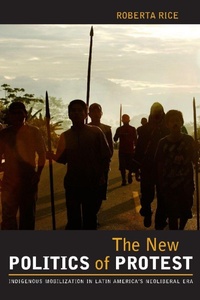
The New Politics of Protest
Indigenous Mobilization in Latin America's Neoliberal Era
3rd Edition
Will be published approx. on 30. March 2012
Book
Hardback
168 pages
978-0-8165-2875-2 (ISBN)
Description
In June 1990, Ecuador saw the first major indigenous rebellion within its borders since the colonial era. For weeks, indigenous protesters participated in marches, staged demonstrations, seized government offices, and blockaded roads. Since this insurrection, indigenous movements have become increasingly important in the fight against Latin American Neoliberalism.
Roberta Rice's New Politics of Protest seeks to analyze when, where, and why indigenous protests against free-market reforms have occurred in Latin America. Comparing cases in Ecuador, Peru, Bolivia, and Chile, this book details the emergence of indigenous movements under and against Neoliberal governments. Rice uses original field research and interviews with indigenous leaders to examine long-term patterns of indigenous political activism and overturn accepted theories on the role of the Indian in democracy.
A useful and engaging study, The New Politics of Protest seeks to determine when indigenous movements become viable political parties. It covers the most recent rounds of protest to demonstrate how a weak and unresponsive government is more likely to experience revolts against unpopular reforms. This influential work will be of interest to scholars of Latin American politics and indigenous studies as well as anyone studying oppressed peoples who have organized nationwide strikes and protests, blocked economic reforms, toppled corrupt leaders, and even captured presidencies.
Roberta Rice's New Politics of Protest seeks to analyze when, where, and why indigenous protests against free-market reforms have occurred in Latin America. Comparing cases in Ecuador, Peru, Bolivia, and Chile, this book details the emergence of indigenous movements under and against Neoliberal governments. Rice uses original field research and interviews with indigenous leaders to examine long-term patterns of indigenous political activism and overturn accepted theories on the role of the Indian in democracy.
A useful and engaging study, The New Politics of Protest seeks to determine when indigenous movements become viable political parties. It covers the most recent rounds of protest to demonstrate how a weak and unresponsive government is more likely to experience revolts against unpopular reforms. This influential work will be of interest to scholars of Latin American politics and indigenous studies as well as anyone studying oppressed peoples who have organized nationwide strikes and protests, blocked economic reforms, toppled corrupt leaders, and even captured presidencies.
More details
Edition
3rd edition
Language
English
Place of publication
Tucson
United States
Product notice
sewn/stitched
Cloth over boards
Illustrations
5 line, 6 tables
Dimensions
Height: 244 mm
Width: 161 mm
Thickness: 23 mm
Weight
394 gr
ISBN-13
978-0-8165-2875-2 (9780816528752)
Copyright in bibliographic data and cover images is held by Nielsen Book Services Limited or by the publishers or by their respective licensors: all rights reserved.
Schweitzer Classification
Person
Roberta Rice is an assistant professor at the University of Toronto, Scarborough. Her work has appeared in the Canadian Journal of Latin American and Caribbean Studies, Comparative Political Studies, Latin American Research Review, and Party Politics.