

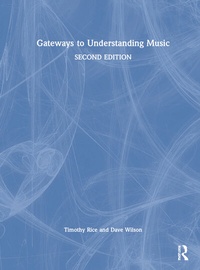
Gateways to Understanding Music
2nd Edition
Published on 14. November 2022
Book
Hardback
478 pages
978-1-032-21630-0 (ISBN)
Description
Gateways to Understanding Music, Second Edition, explores music in all the categories that constitute contemporary musical experience: European classical, popular, jazz, and world music. Covering the oldest forms of human music making to the newest, this chronology presents music from a global rather than a Eurocentric perspective. Each of 60 "gateways" addresses a particular genre, style, or period of music. Every gateway opens with a guided listening example that unlocks a world of music through careful study of its structural elements. How did the piece come to be composed or performed? How did it respond to the social and cultural issues at the time, and what does that music mean today? Students learn to listen to, explain, understand, and ultimately value all the music they encounter in their world.
New to this edition is a broader selection of musical examples that reflect the values of diversity, equity, and inclusion advocated by North American universities. Eight gateways have been replaced. A timeline of gateways helps students see the book's historical narrative at a glance.
Features
Values orientation - Diverse, equitable, and inclusive approach to music history.
All genres of music - Presents all music as worthy of study, including classical, world, popular, and jazz.
Global scope within a historical narrative - Begins with small-scale forager societies up to the present, with a shifting focus from global to European to American influences.
Recurring themes - Aesthetics, emotion, social life, links to culture, politics, economics, and technology.
Modular framework - 60 gateways - each with a listening example - allow flexibility to organize chronologically or by the seven themes.
Consistent structure - With the same step-by-step format, students learn through repeated practice how to listen and how to think about music.
Anthology of scores - For those courses that use the textbook in a music history sequence.
Gateways to Understanding Music continues to employ a website to host the audio examples and instructor's resources.
New to this edition is a broader selection of musical examples that reflect the values of diversity, equity, and inclusion advocated by North American universities. Eight gateways have been replaced. A timeline of gateways helps students see the book's historical narrative at a glance.
Features
Values orientation - Diverse, equitable, and inclusive approach to music history.
All genres of music - Presents all music as worthy of study, including classical, world, popular, and jazz.
Global scope within a historical narrative - Begins with small-scale forager societies up to the present, with a shifting focus from global to European to American influences.
Recurring themes - Aesthetics, emotion, social life, links to culture, politics, economics, and technology.
Modular framework - 60 gateways - each with a listening example - allow flexibility to organize chronologically or by the seven themes.
Consistent structure - With the same step-by-step format, students learn through repeated practice how to listen and how to think about music.
Anthology of scores - For those courses that use the textbook in a music history sequence.
Gateways to Understanding Music continues to employ a website to host the audio examples and instructor's resources.
Reviews / Votes
"At last! An innovative, practical, and inclusive approach to studying music of Europe, North America, and beyond that puts popular and world music, American jazz, and European classical music into conversation with one another by looking at their origins and interrelationships through the lens of World history."-Anne K. Rasmussen, Professor, The College of William and Mary
"Gateways to Understanding Music provides a profoundly new and refreshingly original approach to examining the music of the world's cultures in cohesive, comparable, and contrasting ways that illuminate the power and meaning of all of the musics."
-Tayloe Harding, Dean, School of Music, University of South Carolina
More details
Edition
2nd edition
Language
English
Place of publication
London
United Kingdom
Publishing group
Taylor & Francis Ltd
Target group
College/higher education
Illustrations
335 farbige Abbildungen, 287 Farbfotos bzw. farbige Rasterbilder, 60 farbige Tabellen, 48 farbige Zeichnungen
60 Tables, color; 48 Line drawings, color; 287 Halftones, color; 335 Illustrations, color
Dimensions
Height: 280 mm
Width: 210 mm
Weight
1920 gr
ISBN-13
978-1-032-21630-0 (9781032216300)
Copyright in bibliographic data and cover images is held by Nielsen Book Services Limited or by the publishers or by their respective licensors: all rights reserved.
Schweitzer Classification
Other editions
Additional editions
Timothy Rice | Dave Wilson
Gateways to Understanding Music
E-Book
11/2022
2nd Edition
Routledge
€128.99
Available for download
Timothy Rice | Dave Wilson
Gateways to Understanding Music
Book
11/2022
2nd Edition
Routledge
€136.66
Shipment within 10-20 days
Previous edition
Timothy Rice | Dave Wilson
Gateways to Understanding Music
Book
01/2019
1st Edition
Routledge
€237.70
Article exhausted; check for reprint
Persons
Timothy Rice is Distinguished Professor, Emeritus, and founding director of the Herb Alpert School of Music at the University of California, Los Angeles (UCLA).
Dave Wilson is Senior Lecturer in Music at the New Zealand School of Music-Te Koki, Te Herenga Waka-Victoria University of Wellington.
Dave Wilson is Senior Lecturer in Music at the New Zealand School of Music-Te Koki, Te Herenga Waka-Victoria University of Wellington.
Content
Introduction / PART I: MUSIC HISTORY TO 1500 CE / Chapter 1: Music of Small-Scale Societies / Chapter 2: Ancient and Medieval Religious Music / Chapter 3: Ancient and Medieval Secular Music / PART II: MUSIC HISTORY FROM 1500 TO 1890 / Chapter 4: Music from the European Age of Discovery (1500-1600) / Chapter 5: Music from the Age of Global Commerce (1600-1750) / Chapter 6: Music from the Age of Enlightenment and Revolution (1750-1815) / Chapter 7: Music from the Early Nineteenth Century (1815-1850) / Chapter 8: Music from the Late Nineteenth Century (1850-1890) / PART III: MUSIC HISTORY IN THE AGE OF RECORDINGS / Chapter 9: Music from the Turn of the Twentieth Century (1890-1918) / Chapter 10: Music from the Interwar Period (1918-1939) / Chapter 11: Music during World War II and its Aftermath (1939-1950) / Chapter 12: Music from an Age of Disenchantment and Protest (1950-1975) / Chapter 13: Music and Community (1975-1994) / Chapter 14: Music Today / Where Will You Go from Here? / Glossary / Sources / Index