

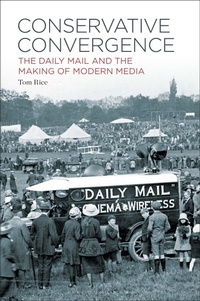
Conservative Convergence
The Daily Mail and the Making of Modern Media
Will be published approx. on 26. November 2026
Book
Hardback
288 pages
979-8-7651-8821-7 (ISBN)
Description
Conservative Convergence highlights and examines the integral role of British newspapers in the development of media technologies across the 20th century, from early radio to commercial television, from newsreels to educational filmstrips.
The newspaper today is an intermedial enterprise, circulating news and generating revenues through its websites, videos, podcasts, and events. This is not a new phenomenon. In foregrounding the work of the Daily Mail since its establishment in 1896, Tom Rice reveals how conservative newspapers pioneered, produced, and progressively adopted new technological innovations and new forms of media to boost their readership and revenue and to consolidate, project, and extend their own broadly conservative values. Rice uncovers surprising episodes across the 20th century, whether exploring early film screenings through the Daily Mail cinema van, the journey of the Daily Mail broadcasting yacht to seaside towns in the 1920s, or the newspaper's foray into cable television in the 1990s.
This expansive, often messy, history positions the newspaper beyond the printed page-reaching audiences in schools, exhibitions, and overseas through loudspeakers, election screens, or 16mm projectors-and, through extensive archival research, invites us to reexamine how these related media technologies came to be. In illuminating the historical connections between the Daily Mail and new forms of media, Conservative Convergence ultimately charts the emergence, evolution, and endurance of Britain's modern media system.
The newspaper today is an intermedial enterprise, circulating news and generating revenues through its websites, videos, podcasts, and events. This is not a new phenomenon. In foregrounding the work of the Daily Mail since its establishment in 1896, Tom Rice reveals how conservative newspapers pioneered, produced, and progressively adopted new technological innovations and new forms of media to boost their readership and revenue and to consolidate, project, and extend their own broadly conservative values. Rice uncovers surprising episodes across the 20th century, whether exploring early film screenings through the Daily Mail cinema van, the journey of the Daily Mail broadcasting yacht to seaside towns in the 1920s, or the newspaper's foray into cable television in the 1990s.
This expansive, often messy, history positions the newspaper beyond the printed page-reaching audiences in schools, exhibitions, and overseas through loudspeakers, election screens, or 16mm projectors-and, through extensive archival research, invites us to reexamine how these related media technologies came to be. In illuminating the historical connections between the Daily Mail and new forms of media, Conservative Convergence ultimately charts the emergence, evolution, and endurance of Britain's modern media system.
Reviews / Votes
Conservative Convergence shows how the U.K.'s Daily Mail has always deployed other media to engage its readers. For over a century, from its origins in 1896, Britain's highest-circulation paper has gone "beyond the newspaper" with a "media ensemble" of film, radio, television - and more! Tom Rice redefines the history of Fleet Street by focusing on the paper's audio-visual tactics, rather than its journalism and politics. In Daily Mail publisher Harmsworth, Rice finds the precedent for multimedia news barons like Murdoch and Berlusconi, tapping the power of moving pictures and broadcasting to transform the printed page into "a coordination of media forms and technologies." * Paul Moore, Professor, Toronto Metropolitan University, Canada, and co-author of The Sunday Paper: A Media History (2022) * There are two central arguments of this impressive book: The first is that the Daily Mail - arguably the most influential British newspaper of the 20th century - was not just a print publication, but was constantly innovating with other media forms to consolidate and extend the brand, reach new audiences and contain threats to the press. The second is that conservative media organizations used this type of innovation to further disseminate traditional values, particularly conservative versions of national identity. The result is an original and significant intervention that changes the way that we look at the media landscape. * Adrian Bingham, Professor of Modern British History, University of Sheffield, UK *More details
Language
English
Place of publication
New York
United States
Publishing group
Bloomsbury Publishing Plc
Target group
Professional and scholarly
Product notice
sewn/stitched
Cloth over boards
With dust jacket
Illustrations
48 bw illus
Dimensions
Height: 229 mm
Width: 152 mm
Thickness: 28 mm
Weight
503 gr
ISBN-13
979-8-7651-8821-7 (9798765188217)
Copyright in bibliographic data and cover images is held by Nielsen Book Services Limited or by the publishers or by their respective licensors: all rights reserved.
Schweitzer Classification
Person
Tom Rice is Professor of Film Studies at the University of St Andrews, UK. He is the author of Films for the Colonies: Cinema and the Preservation of the British Empire (2019) and White Robes, Silver Screens: Movies and the Making of the Ku Klux Klan (2015).
Content
List of Illustrations
Acknowledgements
Introduction
1. Hold the Big Screen: Selling Newspapers through Film, 1896-1922
2. Radio, Public Broadcasting and the Sounds of the Daily Mail, 1920-1932
3. Mobile Media: Wireless, Film, and the Transatlantic Circulation of News, 1920-1932
4. The Talkie Newspaper: The Daily Mail, British Movietone News, and the Rise of Fascism, 1929-1939
5. Amateur Film for the Ideal Home: New Media, Old Values, 1920-1939
6. Learn All About It: The Daily Mail, Filmstrips, and Post-War Visual Education, 1946-1955
7. Conservative with a Small Screen: The Daily Mail and Commercial Television, 1955-2000
8. How to do Business on Film: The British Newspaper and Portable Film, 1960-2000
And Finally...
Bibliography
Index
Acknowledgements
Introduction
1. Hold the Big Screen: Selling Newspapers through Film, 1896-1922
2. Radio, Public Broadcasting and the Sounds of the Daily Mail, 1920-1932
3. Mobile Media: Wireless, Film, and the Transatlantic Circulation of News, 1920-1932
4. The Talkie Newspaper: The Daily Mail, British Movietone News, and the Rise of Fascism, 1929-1939
5. Amateur Film for the Ideal Home: New Media, Old Values, 1920-1939
6. Learn All About It: The Daily Mail, Filmstrips, and Post-War Visual Education, 1946-1955
7. Conservative with a Small Screen: The Daily Mail and Commercial Television, 1955-2000
8. How to do Business on Film: The British Newspaper and Portable Film, 1960-2000
And Finally...
Bibliography
Index