

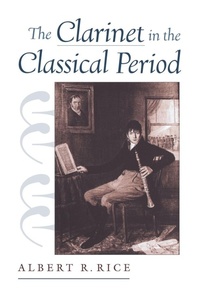
The Clarinet in the Classical Period
Published on 27. December 2007
Book
Paperback/Softback
336 pages
978-0-19-534299-4 (ISBN)
Description
Acclaimed author of The Baroque Clarinet, Albert R. Rice, now presents a comprehensive study of the clarinet in use through the classical period, from 1760 to 1830. During the early part of this intensive period of musical experimentation, the clarinet was transformed from a typically baroque instrument to an essential piece of the classical ensemble. Barely a half century later, in 1812, Ivan Mueller developed the thirteen-keyed clarinet, which brought the instrument into the Romantic age.
The Clarinet in the Classical Period provides a detailed review of the achievements of the period's most important clarinet makers, including James Wood, Teobaldo Monzani, Jean-Francois Simiot, as well as the innovations of creative performers such as Ivan Mueller and Cesar Janssen. Rice offers new research regarding the practice of clef notation by Italian, French, and German composers, clarifying their use of transposing clarinets. The book also explores the creative relationships of two key trios of composer, maker, and performer - Carl Maria von Weber, Heinrich Baermann, and Jean-Jacques Baumann; and Mozart, Anton Stadler, and Theodore Lotz - examining how clarinet construction and performance practice developed in tandem with musical styles.
Essential reading for clarinetists and for those who love their music, The Clarinet in the Classical Period recounts a fascinating chapter in the instrument's history.
The Clarinet in the Classical Period provides a detailed review of the achievements of the period's most important clarinet makers, including James Wood, Teobaldo Monzani, Jean-Francois Simiot, as well as the innovations of creative performers such as Ivan Mueller and Cesar Janssen. Rice offers new research regarding the practice of clef notation by Italian, French, and German composers, clarifying their use of transposing clarinets. The book also explores the creative relationships of two key trios of composer, maker, and performer - Carl Maria von Weber, Heinrich Baermann, and Jean-Jacques Baumann; and Mozart, Anton Stadler, and Theodore Lotz - examining how clarinet construction and performance practice developed in tandem with musical styles.
Essential reading for clarinetists and for those who love their music, The Clarinet in the Classical Period recounts a fascinating chapter in the instrument's history.
More details
Language
English
Place of publication
New York
United States
Target group
College/higher education
Illustrations
7 halftones, 64 line illustrations
Dimensions
Height: 234 mm
Width: 156 mm
Thickness: 18 mm
Weight
518 gr
ISBN-13
978-0-19-534299-4 (9780195342994)
Copyright in bibliographic data and cover images is held by Nielsen Book Services Limited or by the publishers or by their respective licensors: all rights reserved.
Schweitzer Classification
Other editions
Additional editions
Albert R. Rice
The Clarinet in the Classical Period
E-Book
01/2008
1st Edition
OUP eBook
€49.99
Available for download
Albert R. Rice
The Clarinet in the Classical Period
E-Book
01/2008
1st Edition
OUP eBook
€49.99
Available for download
Albert Rice
The Clarinet in the Classical Period
Book
12/2003
Oxford University Press Inc
€213.56
Shipment within 15-20 days
Person
Albert R. Rice has been an active performer on historic and modern clarinets for over thirty years. He is the author of The Baroque Clarinet as well as more than 60 articles and reviews on the clarinet's history. The curator of the Fiske Collection of Musical Instruments in Claremont, California, Rice is also an independent appraiser of musical instruments and works as a professional librarian.
Content
Introduction ; 1. General Design and Construction Characteristics ; 2. Historical Development ; 3. Playing Techniques ; 4. Music for the Classical Clarinet ; 5. The Clarinet in Performing Groups ; Notes ; Bibliography