

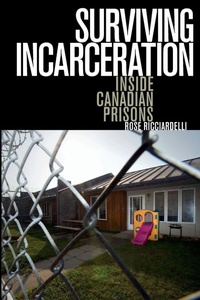
Surviving Incarceration
Inside Canadian Prisons
Published on 30. May 2014
Book
Paperback/Softback
258 pages
978-1-77112-053-1 (ISBN)
Description
Is prison a humane form of punishment and an effective means of rehabilitation? Are current prison policies, such as shifting resources away from rehabilitation toward housing more offenders, improving the safety and lives of incarcerated populations?
Considering that many Canadians have served time, are currently incarcerated, or may one day be incarcerated-and will be released back into society-it is essential for the functioning and betterment of communities that we understand the realities that shape the prison experience for adult male offenders. Surviving Incarceration reveals the unnecessary and omnipresent violence in prisons, the heterogeneity of the prisoner population, and the realities that different prisoners navigate in order to survive.
Ricciardelli draws on interviews with almost sixty former federal prisoners to show how their criminal convictions, masculinity, and sexuality determined their social status in prison and, in consequence, their potential for victimization. The book outlines the modern ""inmate code"" that governs prisoner behaviours, the formal controls put forth by the administration, the dynamics that shape sex-offender experiences of incarceration, and the personal growth experiences of many prisoners as they cope with incarceration.
Considering that many Canadians have served time, are currently incarcerated, or may one day be incarcerated-and will be released back into society-it is essential for the functioning and betterment of communities that we understand the realities that shape the prison experience for adult male offenders. Surviving Incarceration reveals the unnecessary and omnipresent violence in prisons, the heterogeneity of the prisoner population, and the realities that different prisoners navigate in order to survive.
Ricciardelli draws on interviews with almost sixty former federal prisoners to show how their criminal convictions, masculinity, and sexuality determined their social status in prison and, in consequence, their potential for victimization. The book outlines the modern ""inmate code"" that governs prisoner behaviours, the formal controls put forth by the administration, the dynamics that shape sex-offender experiences of incarceration, and the personal growth experiences of many prisoners as they cope with incarceration.
Reviews / Votes
"We are accustomed to the perceived risks associated with prisoners being released but lack sufficient information on the risks of imprisonment and release as experienced by offenders. In a careful and well-crafted account Rose Ricciardelli has brought to the forefront the lived experiences of prisoners and in doing so challenges the data-narratives created by the criminal justice system. In centring on the ways prisoners negotiate their prison time and respond to the pressures of re-entry Dr. Ricciardelli provides us with an informative and insightful perspective on prison life in Canada." -- Donald G. Evans, executive editor, 'Journal of Community Corrections'; past president of the American Probation and Parole Association and of the International Community Corrections Association "Rose Ricciardelli's study of Canadian prisoners is one of the best I've ever read on the subject of prisons. In the tradition of John Irwin and Donald Clemmer, she provides an excellent update on inmate culture and provides keen insights into the penal environment, which she calls 'largely homophobic' and 'built on power relationships with aggression and violence presented as acceptable platforms to express or enact masculine dominance.' A must-read." -- Randall G. Shelden, professor, Criminal Justice Department, University of Nevada, Las Vegas; author or co-author of several books, including 'Girls, Delinquency and Juvenile Justice' (4th ed.) with Meda Chesney-Lind. www.sheldensays.com "Ricciardelli walks the reader through the correctional system in Canada and explains well the trajectory created by a classification system which operates from reception through to the various security levels until release. Her overview of the penal apparatus's processes are deftly handled and, as with the remainder of the text, written in a way which is accessible to a wide audience.... One of the main contributions of Surviving Incarceration is the way that Ricciardelli integrates the ever-present risk discourse into her analysis of life in prison. Her consideration of how risk management rationalities by the state permeate the prison environment is not new, but her discussion of how risk mitigation is employed by the incarcerated adds a layer to the discourse. Ricciardelli manages to expose the ways that the idea of riskiness has created a shift in the prison culture. For example, in her discussion of the ainmate code,a the author notes that there has been a shift from using the code as a tool of convict solidarity to being individualistically instrumental to surviving prison; this transformation is a profound one which has dramatically altered how people "do time," and represents an important contribution to the literature." -- Melissa Munn, Okanagan College, UBC -- Criminal Law and Criminal Justice Books (Rutgers), 2015 "Ricciardelli's interviewing skills are enviable. She evidently put her subjects well at ease, appearing, if not supportive, then certainly non-judgemental.... Ricciardelli sometimes conveys personal views about the politics of incarceration; observations that are both welcome and rendered more credible by her general recalcitrance. For instance, she speaks with weary conviction about the failure of "get tough" sentencing measures and the costly repercussions they have had, observing that the Harper government's signal item of tough, correctional legislation-Bill C-10- has had serious after-effects and "was not met with the opposition it warranted."... Ricciardelli also identifies breath-taking cynicism on the part of a federal government that cashes in on uninformed public sentiment by stuffing too many inmates into too small a space and ignoring the needs of the mentally ill. In addition, correctional policy all too often plays to those who believe criminals can be effectively deterred by the prospect of lengthy sentences, that punishment alone is a fitting central goal for correctional policy.... Federal policy also runs counter to another Conservative tenet-budget reduction. Ricciardelli notes that federal correctional budgets have shot up an astonishing 36.6 percent between 2005 and 2009, reaching a total of $2.3 billion. Much of the increase is owed to the inmate population having grown from 12,000 to about 15,000 in the past decade-notwithstanding a steady decrease in crime rates. Prisoners who are supplied with effective rehabilitation programs and employment skills would be less likely to recidivate, Ricciardelli reasons, a fact that is, "overlooked or simply ignored." The inescapable inference one comes away with from Surviving Incarceration is that the penitentiary service toleratesaand to some extent, even facilitates-the hell of inmate existence so that inmates who are transitioned to lower security settings will toe the line and do whatever they can to avoid being sent back. Why have these cynical mechanics not been effectively conveyed to voters, taxpayers and opinion leaders?... Ricciardelli may or may not find a wide audience for her book, but the expertise she acquired in writing it has made her a very useful resource for journalists and researchers hoping to tackle this most closed of systems. One hopes her authoritative voice will be heard often." -- Kirk Makin -- Literary Review of CanadaMore details
Language
English
Place of publication
Waterloo, Ontario
Canada
Target group
Professional and scholarly
Product notice
Paperback (trade)
Unsewn / adhesive bound
Dimensions
Height: 232 mm
Width: 153 mm
Thickness: 16 mm
Weight
381 gr
ISBN-13
978-1-77112-053-1 (9781771120531)
Copyright in bibliographic data and cover images is held by Nielsen Book Services Limited or by the publishers or by their respective licensors: all rights reserved.
Schweitzer Classification
Person
Rose Ricciardelli is an assistant professor at Memorial University. She has published in academic journals such as Sex Roles, Criminal Justice Review, Qualitative Sociological Review, Journal of Crime and Justice, and Journal of Criminal Justice Education. Her research explores prisoner culture, wrongful conviction, desistance, and the coping strategies, gender identity, and risk perception of prisoners and correctional officers.
Content
Surviving Incarceration: Inside Canadian Prisons by Rose Ricciardelli
Introduction
Narrative: Just a Kid: Forever Hurting
Introduction to Federal Corrections in Canada
The Focus: Setting the Stage
Changing Legislation in Corrections
What about Safety?
Chapter One
Narrative: A Life Without Freedom: The Multi-Prison, Multi-Sentence Experience
Correctional Services of Canada
Provincial versus Federal Corrections
Methods: The Men
Understanding the Classification System: Prisoner Classification
Does Prisoner Classification Work?
Understanding the Classification System: Institutional Classification
How I Found the Guys?
The Details
Chapter Two
Narrative: Addiction, Incest: Thirty-Two Years in Prison, Thirty-Six Years of Addiction
Hierarchy: Crime, Sexuality, Masculinity, and Safety
Factor 1. Being Solid: Criminal Convictions
Factor 2. Being Solid: Masculinities
The Oppressor
Presenting Tough
Acting Aggressive
Breadwinning
Factor 3. Being Solid: Prison Sex or Sexuality
The Largely Homophobic Environment
Consistently Subordinated Homosexuality?
Being Solid: Heterosexuality
Why Does the Hierarchy Exist?
Chapter Three
Narrative: A Violent Place Where Everybody Has a Story
Violence and Theory: The Prison Atmosphere
Theoretical Understandings
The Current Canada Prison Experience: Understanding and Acknowledging the Violence
The Atmosphere
Maximum-Security Prisons: Controls Within the Institution
High-Medium-Security Prison: Controls Within the Institution
Low-Medium- and Minimum-Security Prisons: Controls Within the Institution
Coercive Controls: Impacting Penal Violence
Remunerative Controls: Impacting Penal Violence
The Need: Balance
Chapter Four
Narrative: A Brother, a Son, a Lover, a Dad, a Man, a Prisoner with Heart
Hard Memories
Nowadays
The Inmate Code
The History of the Code
Why a Code?
What Is the Code?
Never Rat on a Con and Don't Get Friendly with the Staff
Be Dependable (Not Loyal)
Follow Daily Behaviour Rules or Else!
I Won't See You, Don't See Me, and Shut-up Already!
Be Fearless or at Least Act Tough
In the End
Chapter Five
Narrative: A Sex Offender's Story
The Other Crimes
Public Perceptions
Stigma Theory and Framing
The Sex Offender Stigma
Stigma in Prison: Stigmatized by Other Prisoners
The Stigma of Protective Custody
Painful Consequences: Stigmatized by Other Prisoners
Revelations, Intolerance, and Passing: The Quest to be Solid
Distancing Sex Offenders
Prisoners Exposing Prisoners
Professionals and Paraprofessionals in Corrections
The Role of the Media
Resources: Lacking Supports
The Systemic Sex Offender Stigma
Final Thoughts
Chapter Six
Narrative: Change from Within (It Changed Me)
The Personal Side: Coping, Changing, For Better or Worse
Coping with Incarceration: Trust in Self
Coping with Incarceration: When More is Needed
Change
Prison: Fostering Negativity
Change from Within and Holding on to Yourself
Resources and Programming
Chapter Seven
Narrative: Gang Affiliation, Clearly Not the Way of the Future
Final Words
What Can This Study Not Speak To?
What We Do Know?
Safe Streets and Prisons: Corrections at Work
Industry Growth: For Better or Worse
Notes
References
Index
Introduction
Narrative: Just a Kid: Forever Hurting
Introduction to Federal Corrections in Canada
The Focus: Setting the Stage
Changing Legislation in Corrections
What about Safety?
Chapter One
Narrative: A Life Without Freedom: The Multi-Prison, Multi-Sentence Experience
Correctional Services of Canada
Provincial versus Federal Corrections
Methods: The Men
Understanding the Classification System: Prisoner Classification
Does Prisoner Classification Work?
Understanding the Classification System: Institutional Classification
How I Found the Guys?
The Details
Chapter Two
Narrative: Addiction, Incest: Thirty-Two Years in Prison, Thirty-Six Years of Addiction
Hierarchy: Crime, Sexuality, Masculinity, and Safety
Factor 1. Being Solid: Criminal Convictions
Factor 2. Being Solid: Masculinities
The Oppressor
Presenting Tough
Acting Aggressive
Breadwinning
Factor 3. Being Solid: Prison Sex or Sexuality
The Largely Homophobic Environment
Consistently Subordinated Homosexuality?
Being Solid: Heterosexuality
Why Does the Hierarchy Exist?
Chapter Three
Narrative: A Violent Place Where Everybody Has a Story
Violence and Theory: The Prison Atmosphere
Theoretical Understandings
The Current Canada Prison Experience: Understanding and Acknowledging the Violence
The Atmosphere
Maximum-Security Prisons: Controls Within the Institution
High-Medium-Security Prison: Controls Within the Institution
Low-Medium- and Minimum-Security Prisons: Controls Within the Institution
Coercive Controls: Impacting Penal Violence
Remunerative Controls: Impacting Penal Violence
The Need: Balance
Chapter Four
Narrative: A Brother, a Son, a Lover, a Dad, a Man, a Prisoner with Heart
Hard Memories
Nowadays
The Inmate Code
The History of the Code
Why a Code?
What Is the Code?
Never Rat on a Con and Don't Get Friendly with the Staff
Be Dependable (Not Loyal)
Follow Daily Behaviour Rules or Else!
I Won't See You, Don't See Me, and Shut-up Already!
Be Fearless or at Least Act Tough
In the End
Chapter Five
Narrative: A Sex Offender's Story
The Other Crimes
Public Perceptions
Stigma Theory and Framing
The Sex Offender Stigma
Stigma in Prison: Stigmatized by Other Prisoners
The Stigma of Protective Custody
Painful Consequences: Stigmatized by Other Prisoners
Revelations, Intolerance, and Passing: The Quest to be Solid
Distancing Sex Offenders
Prisoners Exposing Prisoners
Professionals and Paraprofessionals in Corrections
The Role of the Media
Resources: Lacking Supports
The Systemic Sex Offender Stigma
Final Thoughts
Chapter Six
Narrative: Change from Within (It Changed Me)
The Personal Side: Coping, Changing, For Better or Worse
Coping with Incarceration: Trust in Self
Coping with Incarceration: When More is Needed
Change
Prison: Fostering Negativity
Change from Within and Holding on to Yourself
Resources and Programming
Chapter Seven
Narrative: Gang Affiliation, Clearly Not the Way of the Future
Final Words
What Can This Study Not Speak To?
What We Do Know?
Safe Streets and Prisons: Corrections at Work
Industry Growth: For Better or Worse
Notes
References
Index