

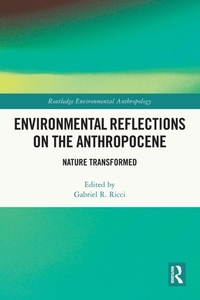
Environmental Reflections on the Anthropocene
Nature Transformed
1st Edition
Published on 21. May 2026
Book
Paperback/Softback
266 pages
978-1-032-47241-6 (ISBN)
Description
Incorporating the intellectual history of disciplines from across the humanities, including environmental anthropology, philosophy, ethics, literature, history, science and technology studies, this volume provides a select orientation to the experience of nature from the ancient world to the Anthropocene.
Taking its momentum from the emerging environmental humanities, this collection integrates Western, Indigenous, postcolonial, feminist and eco-spiritual perspectives that address pressing environmental concerns and reimagine the place of humans within the natural world. Across thirteen chapters, the contributors discuss the blending of environmental concerns with political and moral questions and encourage collaborative methods across disciplines to address dialectical tensions between culture and nature. They draw on a wide range of critical perspectives, provide a historical framework and speak to global environmental pressures from multiple standpoints. The global approach adopted throughout highlights the various realities of the growing ecological crisis experienced across the world.
Written to appeal to a broad range of readers across the environmental humanities, this edited book will be particularly useful to academics, scholars and researchers in philosophy, anthropology, literature, history and critical theory.
Taking its momentum from the emerging environmental humanities, this collection integrates Western, Indigenous, postcolonial, feminist and eco-spiritual perspectives that address pressing environmental concerns and reimagine the place of humans within the natural world. Across thirteen chapters, the contributors discuss the blending of environmental concerns with political and moral questions and encourage collaborative methods across disciplines to address dialectical tensions between culture and nature. They draw on a wide range of critical perspectives, provide a historical framework and speak to global environmental pressures from multiple standpoints. The global approach adopted throughout highlights the various realities of the growing ecological crisis experienced across the world.
Written to appeal to a broad range of readers across the environmental humanities, this edited book will be particularly useful to academics, scholars and researchers in philosophy, anthropology, literature, history and critical theory.
More details
Series
Language
English
Place of publication
London
United Kingdom
Publishing group
Taylor & Francis Ltd
Target group
College/higher education
Professional and scholarly
Academic and Postgraduate
Illustrations
14 s/w Photographien bzw. Rasterbilder, 7 s/w Zeichnungen, 1 s/w Tabelle, 21 s/w Abbildungen
1 Tables, black and white; 7 Line drawings, black and white; 14 Halftones, black and white; 21 Illustrations, black and white
Dimensions
Height: 234 mm
Width: 156 mm
Weight
510 gr
ISBN-13
978-1-032-47241-6 (9781032472416)
Copyright in bibliographic data and cover images is held by Nielsen Book Services Limited or by the publishers or by their respective licensors: all rights reserved.
Schweitzer Classification
Other editions
Additional editions
Book
11/2024
1st Edition
Routledge
€196.50
Shipment within 10-20 days
E-Book
11/2024
1st Edition
Routledge
€60.49
Available for download
E-Book
11/2024
1st Edition
Routledge
€60.49
Available for download
Person
Gabriel R. Ricci is Professor of Humanities at Elizabethtown College, USA, and teaches environmental ethics, political philosophy and ancient philosophy. He has published on phenomenology and time consciousness, and politics, technology and ethics. Recent publications with Routledge include Natural Communions (2019) and The Persistence of Critical Theory (2017).
Content
Introduction 1. Nature in the Anthropocene 2. On The Severance of Production from Reproduction: Simone de Beauvoir and Ecofeminist Critical Theory 3. Nature, Art and Gender in Renaissance Italy: A Counter Narrative 4. Universal Application: The Natural World as Metaphor and Phenomenon in Melville, Thoreau, and Dickinson 5. The Raging Torrent: Myth, Metaphor and Technology 6. The Ecology of the Color Purple in Greco-Roman Antiquity 7. The Byzantine Experience of the Natural World 8. An Eco-Spirituality of Wonder: An Aesthetic-Ethical Response to Myriad Nature 9. The Sovereign Body of Country 10. When Coyote Stole Rabbit's Heart: O'odham Himdag, Environmental Sovereignty, and the End of the American Empire 11. Re-Centering the Ancient-Enduring Indigenous Lens 12. Permaculture as a System for Designing Sustainable Human Settlements: Ahead of its Time or Impossible Dream? 13. A Paradox of the Anthropocene: The Radicalization of Techno-Scientific Modernity and the Future of Solar Geoengineering