

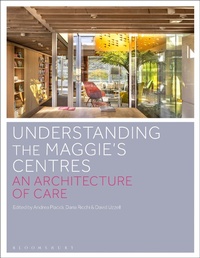
Understanding the Maggie's Centres
An Architecture of Care
Will be published approx. on 12. November 2026
Book
Paperback/Softback
272 pages
978-1-350-23491-8 (ISBN)
Description
This book provides designers and students with an in-depth analysis of the architecture of the world-renowned Maggie's Centres, an international network of buildings offering support to people affected by cancer. Conceived by Maggie Keswick Jencks during her experience of terminal cancer, together with her husband Charles Jencks, landscape designer and architectural critic, the centres represent a radical rethinking of care environments.
Focusing on the relationship between architectural form and social activity, the book examines how and why the Maggie's centres are so successful-addressing themes from the brief (Maggie Jencks' 'Blueprint'), through the manipulation of sensory and atmospheric qualities, to the role of the surrounding environment in providing occupants with a sense of refuge and comfort. The book also includes a comparative review of over 30 Maggie's centres, designed by a select list of celebrated architects (including Frank Gehry, Zaha Hadid, Richard Rogers, and Snohetta) and features over 60 pages of building information-an invaluable reference source for designers alongside the main thematic discussion.
The success of the Maggie's centres has important global implications for the improvement of the design of care structures and therapeutic environments. The centres have established a flexible design methodology capable of uplifting the quality of life of the people involved. By helping to understand and identify these parameters, this book offers important insights for all students, scholars, and professionals involved in healthcare architecture, architecture for social care, as well as all those interested in the broad impact of architectural environments on people.
Focusing on the relationship between architectural form and social activity, the book examines how and why the Maggie's centres are so successful-addressing themes from the brief (Maggie Jencks' 'Blueprint'), through the manipulation of sensory and atmospheric qualities, to the role of the surrounding environment in providing occupants with a sense of refuge and comfort. The book also includes a comparative review of over 30 Maggie's centres, designed by a select list of celebrated architects (including Frank Gehry, Zaha Hadid, Richard Rogers, and Snohetta) and features over 60 pages of building information-an invaluable reference source for designers alongside the main thematic discussion.
The success of the Maggie's centres has important global implications for the improvement of the design of care structures and therapeutic environments. The centres have established a flexible design methodology capable of uplifting the quality of life of the people involved. By helping to understand and identify these parameters, this book offers important insights for all students, scholars, and professionals involved in healthcare architecture, architecture for social care, as well as all those interested in the broad impact of architectural environments on people.
Reviews / Votes
This book brings together design, psychology and healthcare experts to create an authoritative and compelling guide to the ideas and values of each Maggie's centre. This incredible book examines the numerous projects charting their unique commitment and testament to the power of caring and design. * Graeme Brooker, Royal College of Art, UK * Humane design shines through these studies of Maggie's centres, showing how uplifting, supportive architecture can profoundly enhance wellbeing for people affected by cancer. Their insights are an inspiration for all who aim to create buildings that genuinely care. * David Canter, University of Liverpool, UK * Thoughtful design plays a vital role in the transformative cancer support Maggie's delivers in our centres across the UK. Understanding the Maggie's Centres perfectly captures the importance the design of our centres over the last 30 years in creating warm, welcoming spaces which allow people to process and unpack huge emotions. It also thoughtfully delves into the history of healing architecture and provides a fascinating insight into why our environments matter when it comes to physical and emotional health. * Dame Laura Lee DBE, Chief Executive of Maggie's *More details
Language
English
Place of publication
London
United Kingdom
Publishing group
Bloomsbury Publishing PLC
Target group
College/higher education
Illustrations
118 bw illus
Dimensions
Height: 246 mm
Width: 189 mm
Thickness: 25 mm
Weight
454 gr
ISBN-13
978-1-350-23491-8 (9781350234918)
Copyright in bibliographic data and cover images is held by Nielsen Book Services Limited or by the publishers or by their respective licensors: all rights reserved.
Schweitzer Classification
Persons
Daria Ricchi is Senior Lecturer of Architecture at Oxford Brookes University, UK.
Andrea Placidi is Senior Lecturer and Subject Coordinator for Interior Architecture at Oxford Brookes University, UK and the Research Lead for the Therapeutic Environment research group.
David Uzzell is Professor Emeritus of Environmental Psychology at the University of Surrey, UK and formerly Director of the Environmental Psychology Research Group.
Andrea Placidi is Senior Lecturer and Subject Coordinator for Interior Architecture at Oxford Brookes University, UK and the Research Lead for the Therapeutic Environment research group.
David Uzzell is Professor Emeritus of Environmental Psychology at the University of Surrey, UK and formerly Director of the Environmental Psychology Research Group.
Content
Introduction, D. Ricchi, A. Placidi (both Oxford Brookes University, UK) & D. Uzzell (University of Surrey, UK)
Section 1. HISTORY
1. On a Tuesday: A Pre-history of the Maggie's (1994-present), D. Ricchi (Oxford Brookes University, UK)
2. Introduction to the Maggie's Architectural Brief, D. Ricchi (Oxford Brookes University, UK)
3. From Social Vision to Architectural Propositions: The Evolving 'Blueprint' of the Maggie's Centre, O. Sarfatti (Oxford Brookes University, UK)
Section 2. ARCHITECTURE
4. Spatial Qualities, A. Placidi (Oxford Brookes University, UK)
5. Furnitecture, A. Placidi (Oxford Brookes University, UK)
6. Atmosphere, A. Placidi (Oxford Brookes University, UK)
Section 3. EXPERIENCE
7. Maggie's Therapeutic Space, C. Frisone (University Iuav of Venice, Italy)
8. Exploring the Balance between Social Interaction and Privacy in a Maggie's Centres, S. Poncelet (KU Leuven, Belgium) & D. Uzzell (University of Surrey, UK)
9. Hope through Affordances in a Maggie's Cancer Care Centre, Oxford, M. Cumming (Swansea University, UK) & D. Uzzell (University of Surrey, UK)
Index
Section 1. HISTORY
1. On a Tuesday: A Pre-history of the Maggie's (1994-present), D. Ricchi (Oxford Brookes University, UK)
2. Introduction to the Maggie's Architectural Brief, D. Ricchi (Oxford Brookes University, UK)
3. From Social Vision to Architectural Propositions: The Evolving 'Blueprint' of the Maggie's Centre, O. Sarfatti (Oxford Brookes University, UK)
Section 2. ARCHITECTURE
4. Spatial Qualities, A. Placidi (Oxford Brookes University, UK)
5. Furnitecture, A. Placidi (Oxford Brookes University, UK)
6. Atmosphere, A. Placidi (Oxford Brookes University, UK)
Section 3. EXPERIENCE
7. Maggie's Therapeutic Space, C. Frisone (University Iuav of Venice, Italy)
8. Exploring the Balance between Social Interaction and Privacy in a Maggie's Centres, S. Poncelet (KU Leuven, Belgium) & D. Uzzell (University of Surrey, UK)
9. Hope through Affordances in a Maggie's Cancer Care Centre, Oxford, M. Cumming (Swansea University, UK) & D. Uzzell (University of Surrey, UK)
Index