

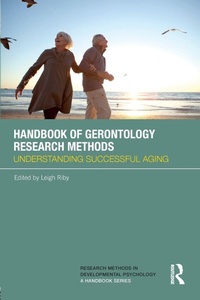
Handbook of Gerontology Research Methods
Understanding successful aging
1st Edition
Published on 7. December 2016
Book
Paperback/Softback
252 pages
978-1-138-77906-8 (ISBN)
Description
The Handbook of Gerontology Research Methods offers a clear understanding of the most important research challenges and issues in the burgeoning field of the psychology of aging. As people in developed countries live longer, so a range of research methods has evolved that allows a more nuanced understanding of how we develop psychological and neurologically. Allied to this is an increasing concern with the idea of well-being, a concept which places cognitive performance and development within a more socially grounded context.
With contributions from a range of top international scholars, the book addresses both typical and atypical aging, highlighting key areas such as physical and cognitive exercise, nutrition, stress, diabetes and issues related to death, dying and bereavement. Successful ageing is emphasised throughout the text. Each chapter concludes with a series of practical tips on how to undertake successful research in this area. This unique collection is the first book to provide both a concise overview of the major themes, findings and current controversies in this growing field, as well as an understanding of the practical issues when researching older adults which may impact on research outcomes, intervention, policy and future directions.
Designed for both students and researchers interested in the psychology of aging, but also highly relevant for students or researchers in related fields such as health psychology and social care, the Handbook of Gerontology Research Methods is essential reading for anyone wishing to understand more about the psychology of aging.
With contributions from a range of top international scholars, the book addresses both typical and atypical aging, highlighting key areas such as physical and cognitive exercise, nutrition, stress, diabetes and issues related to death, dying and bereavement. Successful ageing is emphasised throughout the text. Each chapter concludes with a series of practical tips on how to undertake successful research in this area. This unique collection is the first book to provide both a concise overview of the major themes, findings and current controversies in this growing field, as well as an understanding of the practical issues when researching older adults which may impact on research outcomes, intervention, policy and future directions.
Designed for both students and researchers interested in the psychology of aging, but also highly relevant for students or researchers in related fields such as health psychology and social care, the Handbook of Gerontology Research Methods is essential reading for anyone wishing to understand more about the psychology of aging.
More details
Series
Language
English
Place of publication
London
United Kingdom
Publishing group
Taylor & Francis Ltd
Target group
College/higher education
Illustrations
1 s/w Photographie bzw. Rasterbild, 5 s/w Zeichnungen, 4 s/w Tabellen
4 Tables, black and white; 5 Line drawings, black and white; 1 Halftones, black and white
Dimensions
Height: 234 mm
Width: 156 mm
Thickness: 15 mm
Weight
412 gr
ISBN-13
978-1-138-77906-8 (9781138779068)
Copyright in bibliographic data and cover images is held by Nielsen Book Services Limited or by the publishers or by their respective licensors: all rights reserved.
Schweitzer Classification
Other editions
Additional editions
E-Book
12/2016
Routledge
€80.49
Available for download
E-Book
12/2016
Routledge
€80.49
Available for download
Book
11/2016
1st Edition
Routledge
€262.30
Shipment within 10-20 days
Person
Dr Leigh.Riby is currently a Reader in Neuropsychology at Northumbria University, United Kingdom
Content
Section 1: Introduction; 1. Understanding successful ageing, key challenges and research methods; Section 2: Lifestyle factors and Psychological Functioning; 2. Physical and Cognitive Exercise in Ageing 3. Nutrition, Health and the Ageing Process 4. Stress, Coping and resilience in an ageing population 5. The dual continua model of mental health and illness: Theory, findings and applications 6. Successful aging in the Workplace: a resources-oriented intervention perspective 7. Ageing and retirement behaviour; Section 3: Less successful Ageing; 8. The frontal ageing hypothesis: Evidence from Normal ageing and dementia 9. Examining cognitive function in type 2 diabetes: the importance of an inclusive research approach 10. Alzheimer's disease: interaction of lifestyle factors and traumatic head injury; Section 4: Novel Interventions for dementia; 11. The effect of music therapy for people with dementia 12. Poetry as a means of (re)creating satisfying levels of personhood and social integration for Alzheimer's sufferers: method discussion and outcomes; Section 5: End of Life; 13. Death, dying and bereavement in old age: Working towards a 'good death' for elderly individuals