

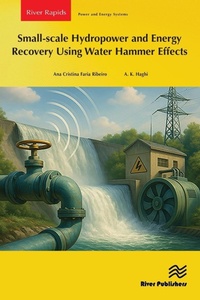
Small-scale Hydropower and Energy Recovery Using Water Hammer Effect
1st Edition
Will be published approx. on 28. November 2025
Book
Paperback/Softback
38 pages
978-87-438-0702-5 (ISBN)
Description
This is an overview of the principles and practical applications of small-scale hydropower and energy recovery using water hammer effects. It offers new insights for engineers, technicians, and students alike, bridging the gap between theory and practice. The book shows that the excessive working pressure of water transmission lines has led to an increase in water accidents and water loss and how this excessive pressure of water can be converted to electrical power.
Inside this book, you will also find:
In-depth explanations and visual aids along with numerous explanatory figures.
Detailed discussions on key concepts, making complex ideas accessible and understandable.
The standard and advanced protective measures, and thorough risk assessment methodologies to ensure the safety and reliability of hydropower systems.
The hydraulic analysis, based on the simulation of Hammer, Fluent, Gambit, and ANSYS Meshing software by selecting the most suitable location for installing the hydro generator for dumping the excessive working pressure.
Practical advice through networked sensors, and the Internet of Things (IoT) on effectively controlling water excessive working pressure and how to convert this pressure to electricity power in a district metering area (DMA).
Inside this book, you will also find:
In-depth explanations and visual aids along with numerous explanatory figures.
Detailed discussions on key concepts, making complex ideas accessible and understandable.
The standard and advanced protective measures, and thorough risk assessment methodologies to ensure the safety and reliability of hydropower systems.
The hydraulic analysis, based on the simulation of Hammer, Fluent, Gambit, and ANSYS Meshing software by selecting the most suitable location for installing the hydro generator for dumping the excessive working pressure.
Practical advice through networked sensors, and the Internet of Things (IoT) on effectively controlling water excessive working pressure and how to convert this pressure to electricity power in a district metering area (DMA).
More details
Series
Language
English
Place of publication
Gistrup
Denmark
Target group
Professional and scholarly
College/higher education
Academic, Postgraduate, and Professional Practice & Development
Illustrations
2 s/w Tabellen, 13 farbige Abbildungen, 3 s/w Abbildungen
2 Tables, black and white; 13 Illustrations, color; 3 Illustrations, black and white
Dimensions
Height: 234 mm
Width: 156 mm
Thickness: 3 mm
Weight
93 gr
ISBN-13
978-87-438-0702-5 (9788743807025)
Copyright in bibliographic data and cover images is held by Nielsen Book Services Limited or by the publishers or by their respective licensors: all rights reserved.
Schweitzer Classification
Other editions
Additional editions
Ana Cristina Faria Ribeiro | A. K. Haghi
Small-scale Hydropower and Energy Recovery Using Water Hammer Effect
E-Book
11/2025
River Publishers
€64.49
Available for download
Ana Cristina Faria Ribeiro | A. K. Haghi
Small-scale Hydropower and Energy Recovery Using Water Hammer Effect
E-Book
11/2025
River Publishers
€64.49
Available for download
Persons
Ana Cristina Faria Ribeiro is a researcher in the Department of Chemistry at the University of Coimbra, Portugal. Her areas of scientific activity is physical chemistry and electrochemistry. Her main areas of research interest are the transport properties of ionic and non-ionic components in aqueous solutions. Dr Ribeiro obtained her PhD and Habilitation from the University of Coimbra, Coimbra, Portugal.
A. K. Haghi is a retired professor and is currently a research associate at the University of Coimbra, Portugal. Professor Haghi holds a BSc in urban and environmental engineering from the University of North Carolina (USA) and holds two MSc degrees, one in mechanical engineering from North Carolina State University (USA) and the other in applied mechanics, acoustics, and materials from the Universite de Technologie de Compiegne (France). He was awarded a PhD in engineering sciences at Universite de Franche-Comte (France). He has written, co-written, edited, or co-edited more than 1000 publications, including books, book chapters, and papers in refereed journals with over 4300 citations and an h-index of 35, according to Google Scholar database.
A. K. Haghi is a retired professor and is currently a research associate at the University of Coimbra, Portugal. Professor Haghi holds a BSc in urban and environmental engineering from the University of North Carolina (USA) and holds two MSc degrees, one in mechanical engineering from North Carolina State University (USA) and the other in applied mechanics, acoustics, and materials from the Universite de Technologie de Compiegne (France). He was awarded a PhD in engineering sciences at Universite de Franche-Comte (France). He has written, co-written, edited, or co-edited more than 1000 publications, including books, book chapters, and papers in refereed journals with over 4300 citations and an h-index of 35, according to Google Scholar database.
Content
1. Introduction 2. Materials and Methods 3. Results and Discussion 4. Conclusion