

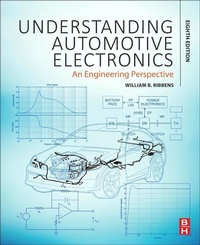
Understanding Automotive Electronics
An Engineering Perspective
8th Edition
Published on 18. June 2017
Book
Paperback/Softback
710 pages
978-0-12-810434-7 (ISBN)
Description
Understanding Automotive Electronics: An Engineering Perspective, Eighth Edition, is written with an engineering perspective that includes mathematical models, providing a qualitative explanation of each subject that requires no mathematical background.
Thoroughly updated throughout, this new edition moves away from introductory mechanic-level electronics to cover hot topics such as automotive camera systems and typical electronic camera systems, hybrid control, AUTOSAR (AUTomotive Open System ARchitecture) and vehicle networks. Comprehensive coverage of automotive electronics and control, including the latest technology in telematics, active safety, entertainment, and communications are also included.
This book is the first port of call for control engineers, system engineers, and electronic engineers in automotive who need a thorough grounding in automotive electronics and control. From simple automotive electronic circuits, to the latest developments in telematics, active safety, entertainment, and communications, the book is also an ideal resource for more senior automotive engineers without a background in electronics or control who to work in the area or supervise specialists.
Thoroughly updated throughout, this new edition moves away from introductory mechanic-level electronics to cover hot topics such as automotive camera systems and typical electronic camera systems, hybrid control, AUTOSAR (AUTomotive Open System ARchitecture) and vehicle networks. Comprehensive coverage of automotive electronics and control, including the latest technology in telematics, active safety, entertainment, and communications are also included.
This book is the first port of call for control engineers, system engineers, and electronic engineers in automotive who need a thorough grounding in automotive electronics and control. From simple automotive electronic circuits, to the latest developments in telematics, active safety, entertainment, and communications, the book is also an ideal resource for more senior automotive engineers without a background in electronics or control who to work in the area or supervise specialists.
More details
Edition
8th edition
Language
English
Place of publication
Woburn
United States
Publishing group
Elsevier - Health Sciences Division
Target group
College/higher education
Control and system engineers, technicians and electrical engineers entering the automotive field. Senior engineers without electronics/ control background supervising specialists. Undergrads studying Electronics, Automobile and Grad Students in Embedded & real-Time Systems, Applied Electronics, Automobile Engineering
Product notice
Paperback (trade)
Unsewn / adhesive bound
Dimensions
Height: 236 mm
Width: 195 mm
Thickness: 55 mm
Weight
1418 gr
ISBN-13
978-0-12-810434-7 (9780128104347)
Copyright in bibliographic data and cover images is held by Nielsen Book Services Limited or by the publishers or by their respective licensors: all rights reserved.
Schweitzer Classification
Other editions
Additional editions
E-Book
06/2017
8th Edition
Butterworth-Heinemann
€92.95
Available for download
Previous edition
Book
12/2012
7th Edition
Butterworth-Heinemann
€85.41
Shipment within 15-20 days
Person
Professor Ribbens received his B.S.E.E. degree in 1960, his M.S.E.E. degree in 1961, and his Ph.D. degree in 1965, all from the University of Michigan. From 1962-69, he was an assistant research engineer, associate research engineer, and research engineer. He was appointed assistant professor in 1969 and was promoted to associate professor in 1972 and professor in 1993. He was appointed professor of aerospace engineering in 1995. His research most recently has focused on electronic systems and devices that are applicable to all vehicles. His particular emphasis has been on engine control applications, mathematical models for drive-train systems, computer-assisted diagnostics for electronically controlled engines, and failure detection systems. His work in these areas has substantially advanced the art of automotive electronics, and he is recognized as a world leader in this area. He served on the Hitachi Science Board, a distinction given to few U.S. academics. He was also a visiting scientist at the Lawrence Livermore Laboratory, General Motors Technical Center, and the Technical University of Berlin.
Content
1. Survey of book technology2. Electronic Fundamentals3. Microprocessors4. Engine control basics5. Sensors and actuators6. Practical power train control7. Motion control8. Instrumentation9. Vehicle communications10. Safety related systems11. Diagnostics12. Autonomous vehicles