

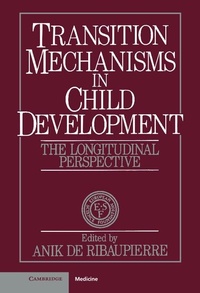
Transition Mechanisms in Child Development
The Longitudinal Perspective
Published on 29. September 1989
Book
Hardback
354 pages
978-0-521-37138-4 (ISBN)
Description
This collection brings together work in an important area that has become the focus of major research in European developmental psychology: the longitudinal study of the interaction of cognition and emotion in individual development. Leading international researchers in developmental psychology have prepared chapters that examine transition mechanisms in areas including cognitive and memory development, language development, social and emotional development, and motor development in children. The volume is an outgrowth of a workshop on longitudinal research in individual development, sponsored by the European Science Foundation. It reflects the many conceptual and methodological advances that have taken place in the application of longitudinal strategies to research in developmental psychology, and demonstrates the need for the longitudinal perspective in future research.
More details
Series
Language
English
Place of publication
Cambridge
United Kingdom
Target group
Professional and scholarly
Dimensions
Height: 235 mm
Width: 157 mm
Thickness: 25 mm
Weight
725 gr
ISBN-13
978-0-521-37138-4 (9780521371384)
Copyright in bibliographic data and cover images is held by Nielsen Book Services Limited or by the publishers or by their respective licensors: all rights reserved.
Schweitzer Classification
Person
Content
Foreword D. Magnusson; Preface A. De Ribaupierre; 1. The study of transitions in development S. Hoppe-Graff; Part I. Cognitive Development: 2. Mechanisms of variation in developmental levels: cognitive and emotional transitions during adolescence K. Fischer; 3. Universal trends and individual differences in memory development W. Schneider and F. E. Weinert; Part II. Language Development: 4. The role of social interaction in the transition from communication to language L. Camaioni; 5. The transition from spoken to written language P. Bryant and J. Alegria; Part III. Social and Emotional Development: 6. Social transition in adolescence: a biosocial perspective H. Stattin and D. Magnusson; 7. Developmental change in children's understanding of mixed and masked emotions P. Harris; 8. The case of ambivalence: the interface between emotional and cognitive development G. Attili; Part IV. Motor Development: 9. Transition mechanisms in sensori-motor development C. Von Hofsten; 10. On early coordinations and their future H. Bloch; 11. On U-shaped and other transitions in sensori-motor development G. Butterworth; Epilogue: On the need for longitudinal studies in developmental psychology A. De Ribaupierre; Index.