

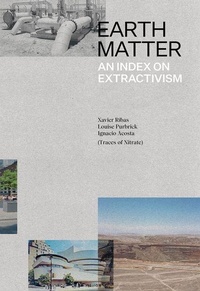
Earth Matter
An Index on Extractivism
Published on 6. March 2026
Book
Paperback/Softback
224 pages
978-84-127567-0-8 (ISBN)
Description
The culmination of over a decade of collaborative research exploring the global impact of extractivism, tied to the Traces of Nitrate project.
Earth Matter delves into the history of extractivism in Chile, beginning with the nitrate mines in the Atacama Desert in the nineteenth century and extending to the ongoing extraction of copper, lithium, and water. Through photography, video, archival research, and personal interviews, artist-researchers Xavier Ribas, Ignacio Acosta, and activist-writer Louise Purbrick examine the interconnected forces that bind Chile's natural resources to global capital, particularly in the financial district of London.
This publication offers a critical analysis of how extractivist practices have shaped both historical and contemporary life, while anticipating future forms of exploitation. An index of terms explores past and present facts, documents, sites, projects, politicians, activists, NGOs, and critical writings, forming a Benjaminian constellation that readers can connect and decipher at their own pace.
The book includes essays by scientist Cristina Dorador on life in extreme climates, politician and environmentalist Sara Larrain on the legal protection of glaciers, political theory professor Robert Nichols on the history of land expropriation related to extractivism, and art curator Carles Guerra. Earth Matter provides a comprehensive map of the forces driving the increasingly hegemonic system of resource extraction. It reflects not only on past struggles but also on the ongoing fight for justice in the face of an unrelenting global economy.
Traces of Nitrate is an arts research collective led by Ignacio Acosta, Louise Purbrick, and Xavier Ribas, committed to documenting the extraction of minerals from Chile and their transformation in global capitalist systems. Through writing, photography, video, and sound, they seek to reveal the ecological and colonial legacies of mining and advocate for environmental justice.
Earth Matter delves into the history of extractivism in Chile, beginning with the nitrate mines in the Atacama Desert in the nineteenth century and extending to the ongoing extraction of copper, lithium, and water. Through photography, video, archival research, and personal interviews, artist-researchers Xavier Ribas, Ignacio Acosta, and activist-writer Louise Purbrick examine the interconnected forces that bind Chile's natural resources to global capital, particularly in the financial district of London.
This publication offers a critical analysis of how extractivist practices have shaped both historical and contemporary life, while anticipating future forms of exploitation. An index of terms explores past and present facts, documents, sites, projects, politicians, activists, NGOs, and critical writings, forming a Benjaminian constellation that readers can connect and decipher at their own pace.
The book includes essays by scientist Cristina Dorador on life in extreme climates, politician and environmentalist Sara Larrain on the legal protection of glaciers, political theory professor Robert Nichols on the history of land expropriation related to extractivism, and art curator Carles Guerra. Earth Matter provides a comprehensive map of the forces driving the increasingly hegemonic system of resource extraction. It reflects not only on past struggles but also on the ongoing fight for justice in the face of an unrelenting global economy.
Traces of Nitrate is an arts research collective led by Ignacio Acosta, Louise Purbrick, and Xavier Ribas, committed to documenting the extraction of minerals from Chile and their transformation in global capitalist systems. Through writing, photography, video, and sound, they seek to reveal the ecological and colonial legacies of mining and advocate for environmental justice.
More details
Language
English
Place of publication
Barcelona
Spain
Target group
Professional and scholarly
Illustrations
180 color plates
Dimensions
Height: 245 mm
Width: 175 mm
Thickness: 23 mm
Weight
724 gr
ISBN-13
978-84-127567-0-8 (9788412756708)
Copyright in bibliographic data and cover images is held by Nielsen Book Services Limited or by the publishers or by their respective licensors: all rights reserved.
Schweitzer Classification
Persons
Xavier Ribas is a photographer, based at the University of Brighton. Trained as an anthropologist interested in geography, urban studies, and the philosophy of history, his photographic work investigates contested sites and histories, border territories, and geographies of extraction. His recent works take the form of large photographic grids, often including text, archive materials, moving image, and sound. Acosta, Purbrick and Ribas work collectively on the project Traces of Nitrate (www.tracesofnitrate.org). Louise Purbrick is a writer and activist based at the Royal College of Art, London. She works on landscapes of extractivism, spaces of incarceration, border zones, colonial sites, and acts of everyday, ecological, and political resistance. Ignacio Acosta is a Chilean-born artist and researcher working with photography and video in territories under pressure from extractive industries. Stemming from his PhD at the University of Brighton, as part of the research project Traces of Nitrate, Copper Geographies was published in 2018. He is currently a Post-Doctoral Research Fellow at the Centre for Multidisciplinary Studies on Racism (CEMFOR) Uppsala University, Sweden.