

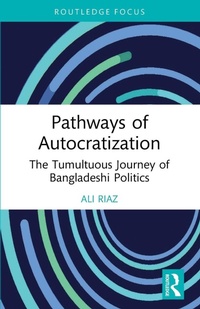
Pathways of Autocratization
The Tumultuous Journey of Bangladeshi Politics
1st Edition
Published on 14. April 2025
Book
Paperback/Softback
92 pages
978-1-032-71201-7 (ISBN)
Description
Pathways of Autocratization addresses one of the most important questions in contemporary global politics: how does a country regress from a democracy to an autocracy?
This book offers a novel framework for understanding the processes that erode democracy and lead to autocracy and explains a specific instance of democratic backsliding in Bangladesh: the world's eighth most populous country. With probing analysis of events and trends of Bangladeshi politics, especially since 2009, the book contextualizes the country's autocratization process within global trends and compares it with others which have trod a similar path in recent decades, including Bolivia, Cambodia, Hungary, Poland, the Philippines and Turkey. The book discusses the implications of institutional changes, the role of pliant media, the contribution of ideology, and the conduct of international actors in the autocratization process while also mapping future trajectories for the country.
Succinct, incisive, and thought provoking, this book is rich in its theoretical robustness and empirical details. This is a must-read for anyone interested in understanding the dynamics of democratic backsliding and prospects for reversing this trend.
This book offers a novel framework for understanding the processes that erode democracy and lead to autocracy and explains a specific instance of democratic backsliding in Bangladesh: the world's eighth most populous country. With probing analysis of events and trends of Bangladeshi politics, especially since 2009, the book contextualizes the country's autocratization process within global trends and compares it with others which have trod a similar path in recent decades, including Bolivia, Cambodia, Hungary, Poland, the Philippines and Turkey. The book discusses the implications of institutional changes, the role of pliant media, the contribution of ideology, and the conduct of international actors in the autocratization process while also mapping future trajectories for the country.
Succinct, incisive, and thought provoking, this book is rich in its theoretical robustness and empirical details. This is a must-read for anyone interested in understanding the dynamics of democratic backsliding and prospects for reversing this trend.
More details
Series
Language
English
Place of publication
London
United Kingdom
Publishing group
Taylor & Francis Ltd
Target group
College/higher education
Postgraduate
Illustrations
6 s/w Tabellen, 8 s/w Photographien bzw. Rasterbilder, 8 s/w Abbildungen
6 Tables, black and white; 8 Halftones, black and white; 8 Illustrations, black and white
Dimensions
Height: 216 mm
Width: 140 mm
Thickness: 6 mm
Weight
140 gr
ISBN-13
978-1-032-71201-7 (9781032712017)
Copyright in bibliographic data and cover images is held by Nielsen Book Services Limited or by the publishers or by their respective licensors: all rights reserved.
Schweitzer Classification
Other editions
Additional editions
E-Book
12/2023
1st Edition
Routledge
€25.99
Available for download
Book
12/2023
1st Edition
Routledge
€76.60
Shipment within 10-20 days
E-Book
12/2023
1st Edition
Routledge
€25.99
Available for download
Person
Ali Riaz is a Distinguished Professor of political science at Illinois State University, USA, a Nonresident Senior Fellow of Atlantic Council, and the President of the American Institute of Bangladesh Studies. He served as a Visting Scholar at the Varieties of Democracy (V-Dem) Institute, University of Gothenburg, Sweden (2023) and as a Public Policy Scholar at the Woodrow Wilson International Center for Scholars at Washington D.C (2013). His research interests include democratization, violent extremism, and Bangladeshi politics. His recent publications include More than Meets the Eye (2022), Religion and Politics in South Asia (2021), Voting in a Hybrid Regime: Explaining the 2018 Bangladeshi Election (2019).
Content
Introduction; 1: Understanding and Explaining the Autocratization Process; 2: Why Bangladesh warrants attention? 3: Bangladesh's quiet slide to autocracy: Roles of institutional changes and media; 4: Bangladesh's quiet slide to autocracy: Roles of ideology and external actors; Conclusions: Is the Bangladesh case unique? What's next? Index